















Asia Pacific Autonomous Ships Market Outlook to 2030
Region:Asia
Author(s):Shreya Garg
Product Code:KROD7828
December 2024
97
About the Report
Asia Pacific Autonomous Ships Market Overview
- The Asia Pacific Autonomous Ships Market is valued at USD 2.1 billion. Driven by advancements in sensor technologies and AI integration, the market has gained traction due to the growing demand for cost-effective, sustainable shipping solutions. This growth is underpinned by robust support from governments in the region, incentivizing autonomous shipping trials and deployment in response to labor shortages and rising operational costs in the maritime industry. The adoption of digital navigation and autonomous operational software also accelerates market expansion.
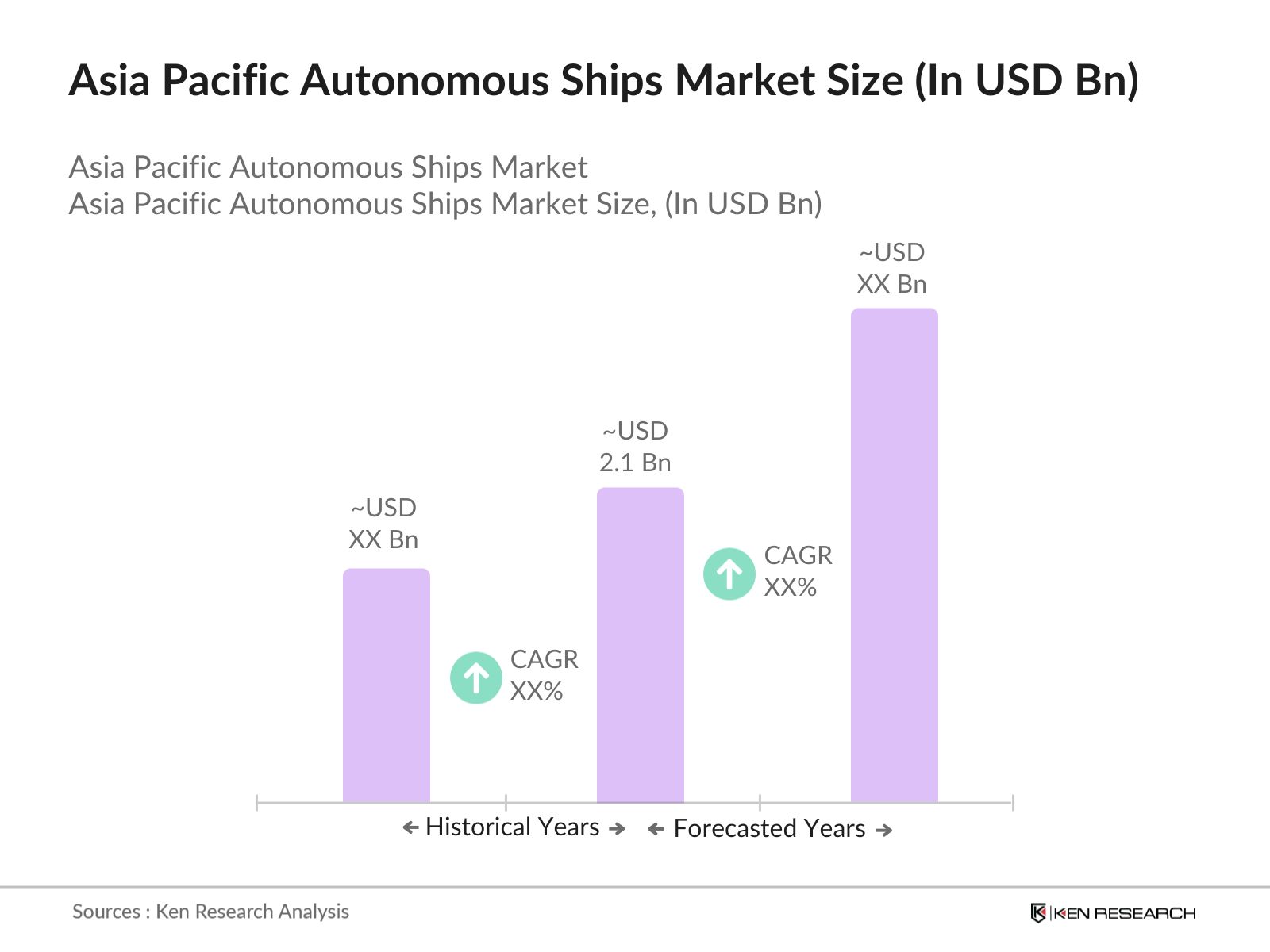
- Countries such as Japan, South Korea, and China lead the Asia Pacific Autonomous Ships Market due to their advanced technological infrastructure and strong shipbuilding industries. Japan and South Korea have long-standing expertise in maritime technology, while Chinas massive investment in its marine industry and state-backed initiatives to modernize its fleet give it a competitive edge. These countries are well-positioned to support autonomous systems deployment due to regulatory alignment, R&D funding, and substantial domestic shipping demand.
- IMO standards are essential for establishing global safety and environmental regulations, critical for autonomous vessel operations in the Asia Pacific. Member nations like Japan and South Korea have aligned their policies with IMO standards, ensuring consistent safety protocols. In 2024, Japan intends to incorporate these standards across its fleet, targeting enhanced safety in international waters, demonstrating the IMOs influence on regional autonomous operations
Asia Pacific Autonomous Ships Market Segmentation
By Vessel Type: The Market is segmented by vessel type into Autonomous Cargo Ships, Passenger Ships, Defense and Patrol Vessels, and Research and Survey Vessels. Recently, Autonomous Cargo Ships hold a dominant position due to the increasing focus on optimizing commercial shipping logistics and reducing reliance on crewed operations. Given the extensive shipping demands within and beyond Asia, autonomous cargo vessels have been rapidly adopted, driven by their potential to streamline operations and cut costs significantly. 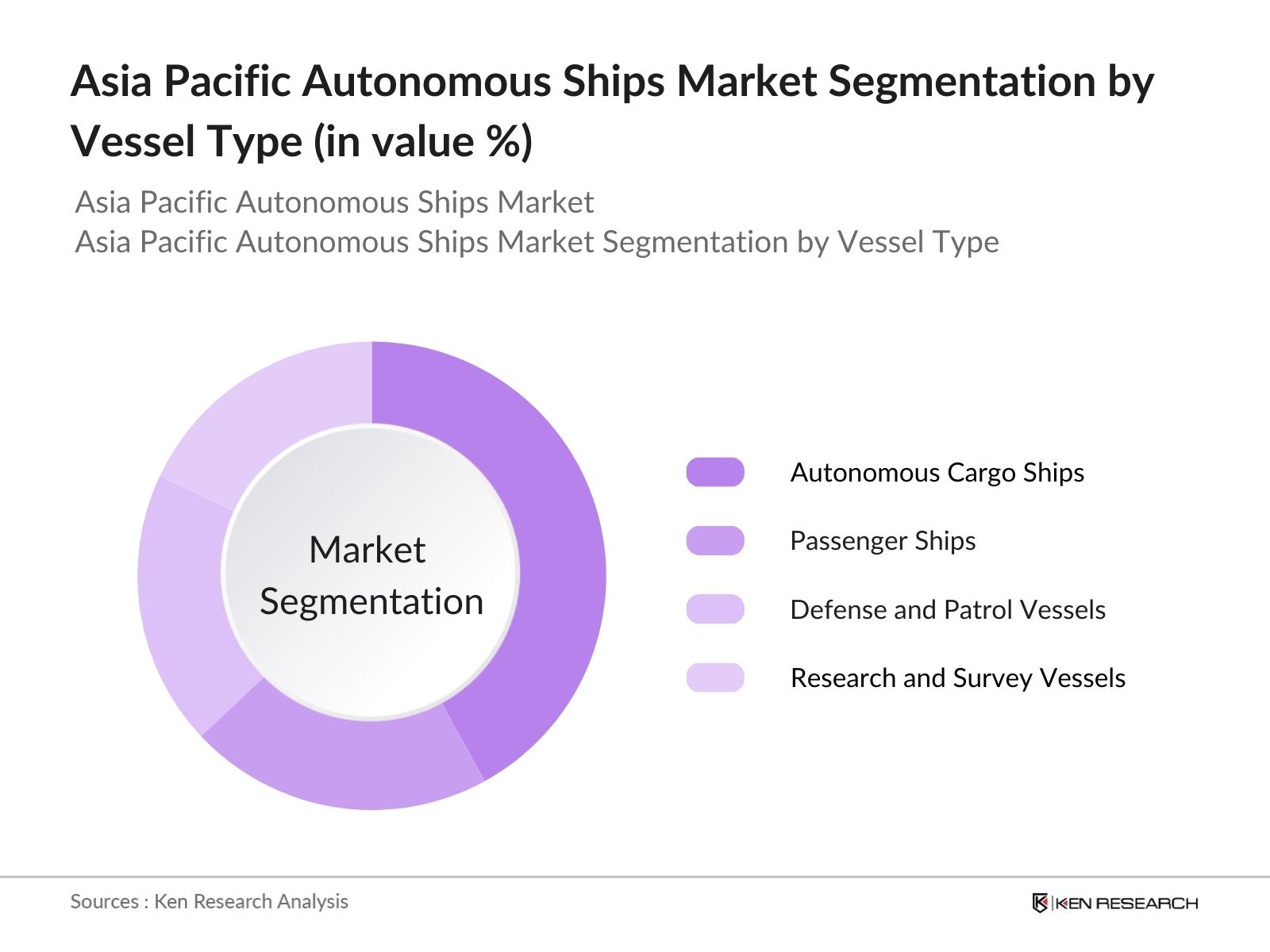
By Autonomy Level: This market is segmented by autonomy level into Semi-Autonomous and Fully Autonomous ships. Semi-Autonomous systems dominate the market, primarily due to current regulatory frameworks and safety considerations. These vessels are equipped with autonomous navigation capabilities but retain human oversight to mitigate operational risks, especially in congested waters. This setup aligns well with regulatory expectations, allowing companies to adopt semi-autonomous systems more readily than fully autonomous counterparts. 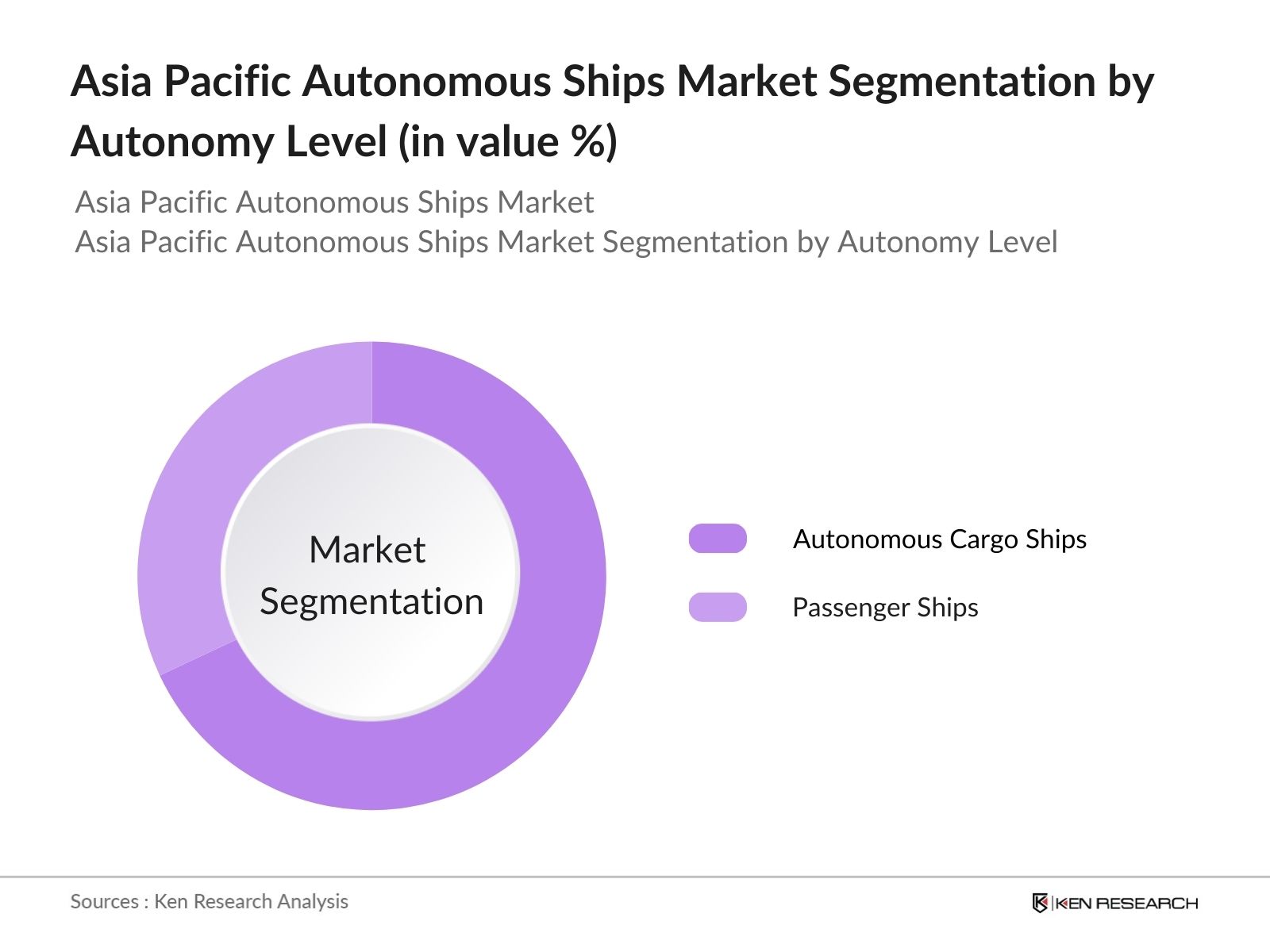
Asia Pacific Autonomous Ships Market Competitive Landscape
The Asia Pacific Autonomous Ships Market is led by several prominent players specializing in maritime technologies and autonomous systems. This competitive environment includes a mix of global and regional players who offer a diverse range of solutions, from navigation technology to autonomous software systems. The competitive landscape shows that leading firms leverage high R&D spending and strategic partnerships to sustain growth, aiming to meet the rising demand for autonomous maritime operations.
|
Company |
Establishment Year |
Headquarters |
Fleet Size |
R&D Expenditure |
Technological Capabilities |
Strategic Partnerships |
Customer Base |
Revenue |
Number of Employees |
|
Rolls-Royce Holdings |
1906 |
London, UK |
|||||||
|
Kongsberg Gruppen |
1814 |
Kongsberg, Norway |
|||||||
|
Wartsila Corporation |
1834 |
Helsinki, Finland |
|||||||
|
Samsung Heavy Industries |
1974 |
Seoul, South Korea |
|||||||
|
Ocean Infinity |
2017 |
Austin, USA |
Asia Pacific Autonomous Ships Industry Analysis
Growth Drivers
- Regulatory Support for Autonomous Technologies: In the Asia Pacific region, regulatory bodies have actively endorsed advancements in autonomous technologies, particularly in maritime transportation. For instance, the International Maritime Organization (IMO) has established frameworks to ensure the operational safety of autonomous vessels, prompting countries like Japan and South Korea to launch initiatives to integrate autonomous ships into their commercial fleets. Japans Ministry of Land, Infrastructure, Transport, and Tourism (MLIT) has been working on legislative frameworks to support autonomous maritime technologies, reducing bureaucratic delays and fostering innovation across its fleet. By 2024, regulatory compliance measures are expected to cover over 60% of Asia Pacifics operational cargo fleets.
- Rising Demand for Efficient Maritime Logistics: With the Asia Pacific region handling over 60% of the worlds maritime trade by volume, efficiency improvements are paramount. Nations such as China, which processes nearly 30 billion tons of cargo annually, are investing heavily in autonomous ships to streamline logistics operations. Autonomous vessels reduce human error and fuel consumption, enhancing cargo handling speeds and operational costs. Chinas Ministry of Transport has invested in autonomous projects, reflecting the region's demand for efficient logistics solutions. As of 2024, maritime authorities across Asia aim to boost cargo processing speed by 15-20% using autonomous solutions.
- Advancements in Sensor Technologies: Technological advancements, especially in sensor technology, are enhancing the precision and reliability of autonomous ships in the Asia Pacific market. South Korea, leading in sensor innovation, developed the Smart Autonomous Ship Program, which includes a $160 million investment in sensor integration for improved navigation and obstacle detection in varying maritime conditions. The countrys Ministry of Oceans and Fisheries reported that sensor-integrated autonomous vessels could improve navigational accuracy by 25%. In 2024, South Korea is anticipated to pilot fully sensor-equipped vessels to elevate its position in autonomous maritime logistics.
Market Challenges
- High Initial Investment: Implementing autonomous technologies in the maritime sector involves substantial costs, with estimates showing that retrofitting existing fleets can reach $1-2 million per vessel. Countries like Singapore have already begun trialing autonomous technology on existing fleets, with government-backed programs aimed at subsidizing costs. The upfront financial requirements can be a deterrent for smaller operators in Asia Pacific, where national policies and financial aids vary. As of 2024, only a small portion of commercial fleets have adopted these upgrades, indicating that high capital requirements remain a challenge.
- Cybersecurity Concerns: With the integration of advanced navigation systems, Asia Pacific autonomous vessels are increasingly vulnerable to cyber threats. The Ministry of Communications and Information in Singapore reported that maritime cybersecurity threats have increased by over 30% from 2022, with vulnerabilities in autonomous vessels posing potential risks to cargo and crew safety. In response, Japan and South Korea have implemented cybersecurity frameworks specifically designed for the maritime sector. By 2024, nations across Asia Pacific aim to bolster their cyber defenses by over 50%, particularly for autonomous technologies.
Asia Pacific Autonomous Ships Market Future Outlook
In the coming years, the Asia Pacific Autonomous Ships Market is expected to continue evolving, bolstered by ongoing technological advancements, regulatory support, and the growing push for eco-friendly shipping practices. Increasing investments in R&D, particularly in artificial intelligence, sensor technologies, and cybersecurity, are likely to foster further growth. The markets progression is also expected to be influenced by the regions robust shipbuilding infrastructure, helping support the widespread adoption of both semi-autonomous and fully autonomous vessels.
Future Market Opportunities
- Integration with IoT and AI: Asia Pacifics adoption of IoT and AI in autonomous vessels has created avenues for efficiency and predictive maintenance. Japan has led investments in IoT-enabled vessels to monitor real-time vessel conditions, with over 1,000 IoT-equipped vessels set for deployment by 2024. Japans Ministry of Economy, Trade, and Industry (METI) reported that IoT integration could reduce maintenance costs by 30%, aligning with the Asia Pacific regions goal for fleet optimization. Integration with AI for route planning further enhances operational efficiency, addressing high demand in maritime logistics. Source.
- Partnerships in Asia Pacific Region for Autonomous Operations: Strategic partnerships in the Asia Pacific region have accelerated the development of autonomous vessels. In 2024, South Korea, Japan, and China established the Asia Maritime Autonomous Cluster, which aims to pool resources and expertise to further autonomous operations. This partnership has enabled shared technological development, resulting in a projected increase of 40% in autonomous operational capabilities across these regions by the end of the current year. Such collaborations are vital in creating a unified ecosystem, facilitating technology transfer, and promoting cross-border regulations. Source.
Scope of the Report
|
Vessel Type |
Autonomous Cargo Ships Passenger Ships Defense and Patrol Vessels Research and Survey Vessels |
|
Autonomy Level |
Semi-Autonomous Fully Autonomous |
|
Component |
Sensors and Navigation Systems Communication and Control Systems Software and Data Processing Propulsion and Power Management |
|
Application |
Commercial Shipping Defense and Security Scientific Research Recreational |
|
Region |
East Asia Southeast Asia Oceania South Asia |
Products
Key Target Audience
Autonomous Shipping Solution Providers
Logistics and Shipping Companies
Defense and Security Organizations
Banks and Financial Institutes
Research Institutions focusing on Maritime Technologies
Government and Regulatory Bodies (e.g., International Maritime Organization)
Port Authorities
Investor and Venture Capitalist Firms
Maritime Training and Development Institutes
Companies
Major Players
Rolls-Royce Holdings
Kongsberg Gruppen
Wartsila Corporation
Samsung Heavy Industries
Ocean Infinity
General Electric
Hyundai Heavy Industries
Daewoo Shipbuilding & Marine Engineering
Fugro
Shone Automation
L3 Harris Technologies
BAE Systems
Sea Machines Robotics
Mitsubishi Heavy Industries
ABB Group
Table of Contents
1. Asia Pacific Autonomous Ships Market Overview
1.1 Definition and Scope
1.2 Market Taxonomy
1.3 Growth Rate Analysis
1.4 Market Segmentation Overview
2. Asia Pacific Autonomous Ships Market Size (In USD Bn)
2.1 Historical Market Size
2.2 Key Growth Indicators and Market Milestones
2.3 Adoption Milestones in Maritime Sector
3. Asia Pacific Autonomous Ships Market Analysis
3.1 Growth Drivers
3.1.1 Advancements in Autonomous Navigation Technology
3.1.2 Investment in Digital Infrastructure
3.1.3 Maritime Safety Improvements
3.1.4 Demand for Cost-Efficient Marine Operations
3.2 Market Challenges
3.2.1 High Development and Maintenance Costs
3.2.2 Cybersecurity Risks in Maritime AI Systems
3.2.3 Regulatory Uncertainty in Autonomous Standards
3.3 Opportunities
3.3.1 Expansion of Maritime Trade Routes
3.3.2 Integration with Smart Port Solutions
3.3.3 Growing Demand for Unmanned Cargo Solutions
3.4 Trends
3.4.1 Development of Hybrid Autonomous Systems
3.4.2 Use of AI and Machine Learning in Navigation
3.4.3 Collaborations with Technology Providers
3.5 Government Regulations
3.5.1 National Maritime Safety Protocols
3.5.2 Standards for Autonomous Vessel Operation
3.5.3 Emission Reduction Targets
3.6 SWOT Analysis
3.7 Stakeholder Ecosystem
3.8 Porters Five Forces Analysis
3.9 Competitive Ecosystem
4. Asia Pacific Autonomous Ships Market Segmentation
4.1 By Autonomy Level (In Value %)
4.1.1 Semi-Autonomous
4.1.2 Fully Autonomous
4.2 By Vessel Type (In Value %)
4.2.1 Commercial Cargo
4.2.2 Passenger Ships
4.2.3 Defense
4.3 By Technology (In Value %)
4.3.1 Sensor Fusion
4.3.2 Connectivity Solutions (Satellite, 5G, and IoT)
4.3.3 Artificial Intelligence Systems
4.4 By Component (In Value %)
4.4.1 Navigation and Control Systems
4.4.2 Communication Modules
4.4.3 Power and Propulsion Systems
4.5 By Region (In Value %)
4.5.1 East Asia
4.5.2 Southeast Asia
4.5.3 Oceania
4.5.4 South Asia
5. Asia Pacific Autonomous Ships Market Competitive Analysis
5.1 Detailed Profiles of Major Companies
5.1.1 Kongsberg Gruppen ASA
5.1.2 Rolls-Royce Holdings PLC
5.1.3 Wrtsil Corporation
5.1.4 ABB Ltd.
5.1.5 General Electric Company
5.1.6 Samsung Heavy Industries Co., Ltd.
5.1.7 Mitsui O.S.K. Lines, Ltd.
5.1.8 Hyundai Heavy Industries Co., Ltd.
5.1.9 ST Engineering Marine Ltd.
5.1.10 Marine Technologies LLC
5.1.11 L3Harris Technologies, Inc.
5.1.12 BAE Systems PLC
5.1.13 Daewoo Shipbuilding & Marine Engineering Co., Ltd.
5.1.14 Schottel GmbH
5.1.15 Siemens AG
5.2 Cross Comparison Parameters (Revenue, Technology Capabilities, Autonomy Level Expertise, Fleet Size, Customer Base, Production Facilities, Regional Presence, Environmental Initiatives)
5.3 Market Share Analysis
5.4 Strategic Initiatives
5.5 Mergers and Acquisitions
5.6 Investment Analysis
5.7 Venture Capital Funding
5.8 Government Grants and Public Investments
5.9 Private Equity Investments
6. Asia Pacific Autonomous Ships Market Regulatory Framework
6.1 Autonomous Maritime Standards
6.2 International Compliance Requirements
6.3 Certification and Operational Safety Standards
7. Asia Pacific Autonomous Ships Future Market Size (In USD Bn)
7.1 Projected Market Size
7.2 Factors Influencing Future Market Size
8. Asia Pacific Autonomous Ships Future Market Segmentation
8.1 By Autonomy Level (In Value %)
8.2 By Vessel Type (In Value %)
8.3 By Technology (In Value %)
8.4 By Component (In Value %)
8.5 By Region (In Value %)
9. Asia Pacific Autonomous Ships Market Analysts Recommendations
9.1 TAM/SAM/SOM Analysis
9.2 Customer Cohort Analysis
9.3 Marketing Initiatives
9.4 White Space Opportunity Analysis
Disclaimer Contact UsResearch Methodology
Step 1: Identification of Key Variables
The research began with identifying crucial variables impacting the Asia Pacific Autonomous Ships Market. This included mapping industry stakeholders, conducting desk research, and collecting data from proprietary databases to outline the ecosystem of autonomous shipping.
Step 2: Market Analysis and Construction
This phase involved gathering and analyzing historical data for the autonomous ships market. Market penetration, service provider distribution, and revenue generation were evaluated to ensure accuracy in revenue and market structure assessments.
Step 3: Hypothesis Validation and Expert Consultation
Hypotheses regarding market trends and growth drivers were validated through interviews with industry experts from key companies. These insights provided operational and financial perspectives crucial to refining market data.
Step 4: Research Synthesis and Final Output
The final step included direct consultations with autonomous ship manufacturers to acquire detailed insights into product segments, sales data, and consumer demand. These interactions verified findings from previous phases, ensuring a comprehensive and accurate view of the Asia Pacific Autonomous Ships Market.
Frequently Asked Questions
01. How big is the Asia Pacific Autonomous Ships Market?
The Asia Pacific Autonomous Ships Market is valued at USD 2.1 billion, driven by advances in AI and increasing demand for sustainable shipping solutions.
02. What are the challenges in the Asia Pacific Autonomous Ships Market?
Key challenges in the Asia Pacific Autonomous Ships Market include high initial investment requirements, cybersecurity risks, and complex regulatory frameworks that govern autonomous vessel operations.
03. Who are the major players in the Asia Pacific Autonomous Ships Market?
Major players in the Asia Pacific Autonomous Ships Market include Rolls-Royce Holdings, Kongsberg Gruppen, Samsung Heavy Industries, and Mitsubishi Heavy Industries. These companies dominate due to their technological expertise, strong maritime experience, and extensive R&D investments.
04. What factors drive the Asia Pacific Autonomous Ships Market?
The Asia Pacific Autonomous Ships Market is propelled by advancements in sensor technology, strong regulatory support, and the need for sustainable shipping solutions. Additionally, high maritime traffic in Asia supports rapid adoption.
05. What is the role of governments in this market?
Government bodies like the International Maritime Organization set standards and guidelines that facilitate autonomous shipping operations, while regional governments support industry growth through funding and regulatory alignment in the Asia Pacific Autonomous Ships Market.
Why Buy From Us?

What makes us stand out is that our consultants follows Robust, Refine and Result (RRR) methodology. i.e. Robust for clear definitions, approaches and sanity checking, Refine for differentiating respondents facts and opinions and Result for presenting data with story

We have set a benchmark in the industry by offering our clients with syndicated and customized market research reports featuring coverage of entire market as well as meticulous research and analyst insights.

While we don't replace traditional research, we flip the method upside down. Our dual approach of Top Bottom & Bottom Top ensures quality deliverable by not just verifying company fundamentals but also looking at the sector and macroeconomic factors.

With one step in the future, our research team constantly tries to show you the bigger picture. We help with some of the tough questions you may encounter along the way: How is the industry positioned? Best marketing channel? KPI's of competitors? By aligning every element, we help maximize success.

Our report gives you instant access to the answers and sources that other companies might choose to hide. We elaborate each steps of research methodology we have used and showcase you the sample size to earn your trust.

If you need any support, we are here! We pride ourselves on universe strength, data quality, and quick, friendly, and professional service.