















Europe Electric Ships Market Outlook to 2030
Region:Europe
Author(s):Shreya Garg
Product Code:KROD9974
December 2024
91
About the Report
Europe Electric Ships Market Overview
- The Europe Electric Ships Market, valued at USD 6.7 billion, is experiencing robust growth driven by multiple factors. One of the primary drivers of this market is the increasing focus on sustainability and the need to comply with stringent emissions regulations within the European Union. Electric ships, which reduce emissions and fuel costs, are gaining traction across various maritime applications. Key industries such as commercial shipping and defense have been embracing electric ships as part of their broader decarbonization efforts. The maritime industry, which is traditionally dependent on fossil fuels, is now rapidly transitioning towards electric propulsion systems.
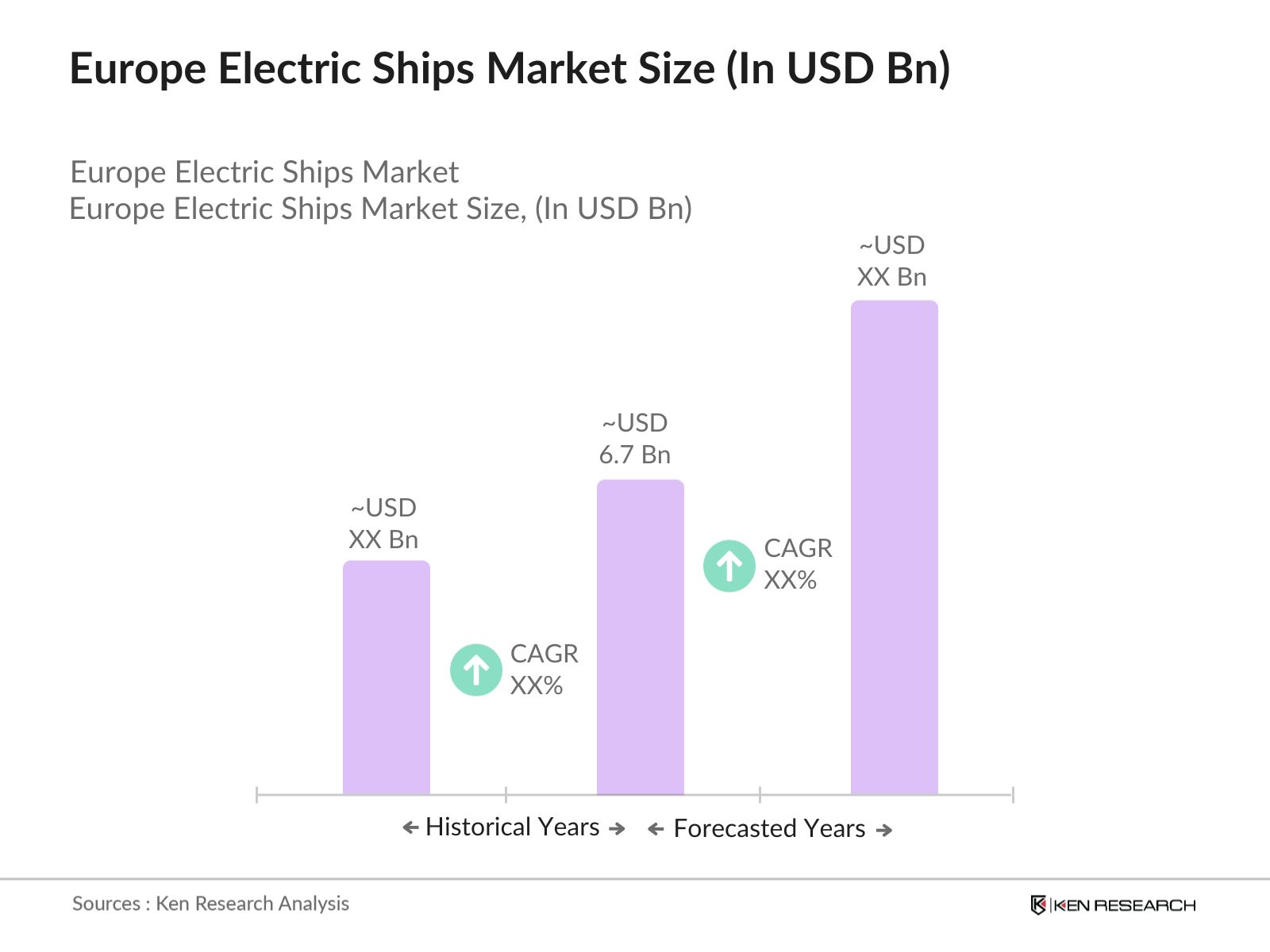
- Dominant regions in the European Electric Ships Market include Norway, Finland, and Germany. Norway leads the market due to its strong government policies favoring zero-emission vessels and its extensive maritime sector. Finland is emerging as a significant player due to its focus on technology development for electric propulsion, while Germanys dominance comes from its well-established shipbuilding industry, which is transitioning to greener alternatives, supported by industrial innovation and research funding.
- The European Union has taken significant steps towards decarbonizing maritime transport. In 2022, the EU introduced a regulation requiring new ships to meet stricter energy efficiency standards by 2025. This policy has encouraged shipowners to transition to electric and hybrid propulsion systems. Norway has gone a step further, mandating that all ships entering its World Heritage fjords be zero-emission by 2026. These policies are creating a strong regulatory framework that supports the growth of the electric ship market.
Europe Electric Ships Market Segmentation
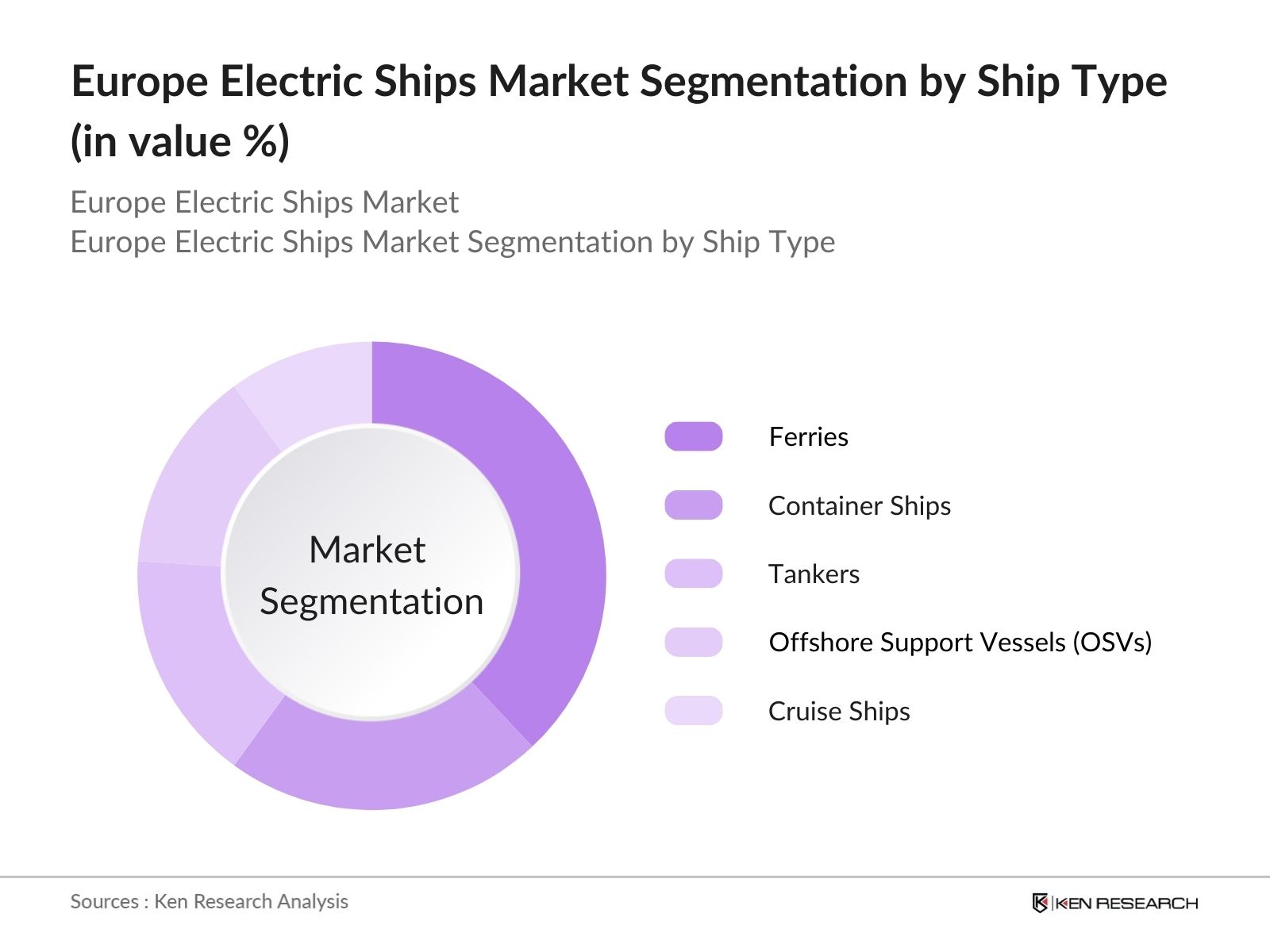
By Ship Type: The Market is segmented by ship type into ferries, container ships, tankers, offshore support vessels (OSVs), and cruise ships. Among these, ferries dominate the market, particularly in countries like Norway and Finland, where short-haul electric ferries have been widely adopted. The success of electric ferries is largely attributed to their frequent docking schedules, allowing for regular charging and their relatively lower energy requirements compared to larger vessels like tankers and cruise ships.
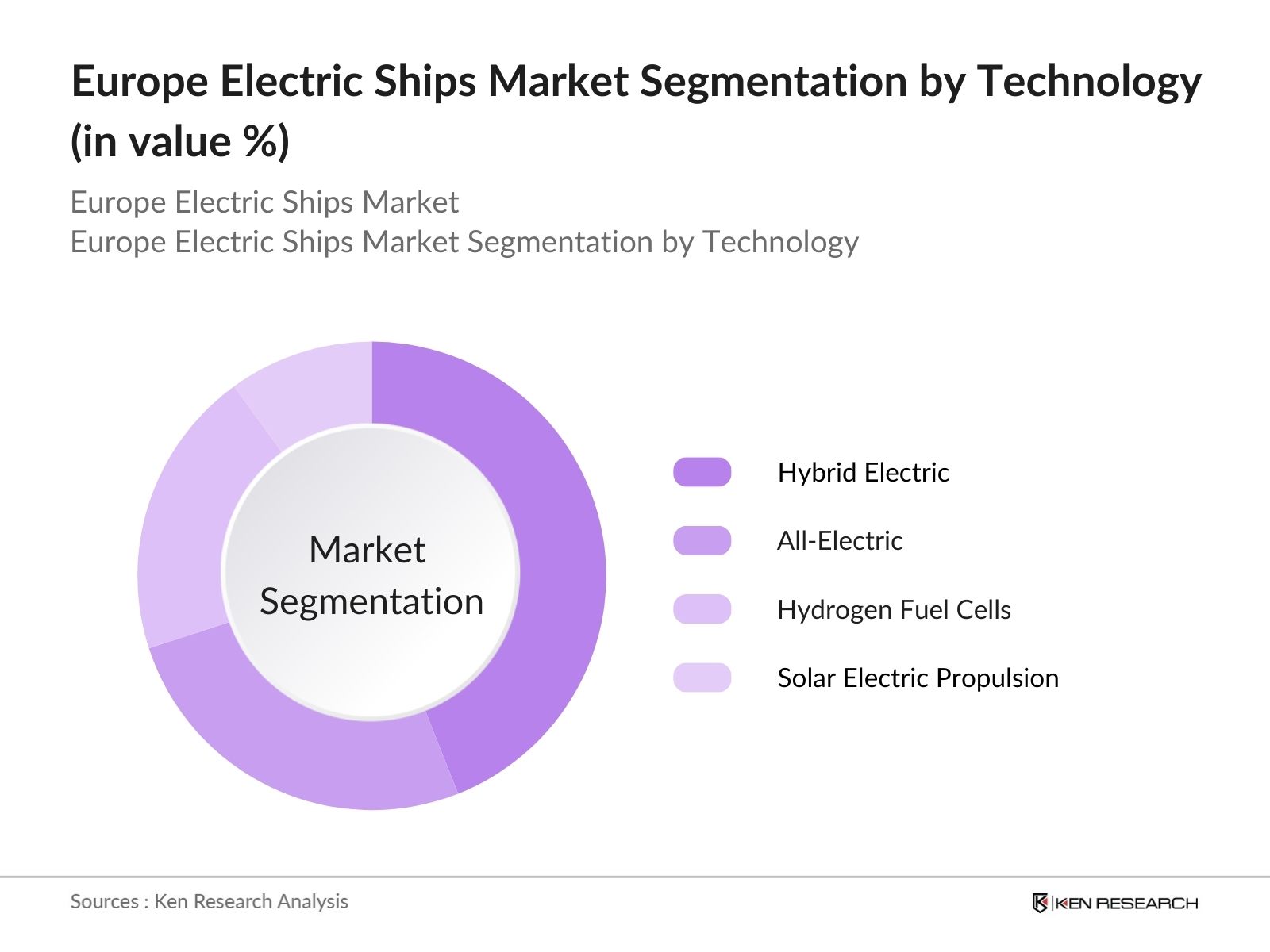
By Technology: The market is further segmented by technology into hybrid electric, all-electric, hydrogen fuel cells, and solar electric propulsion. Hybrid electric systems hold the largest market share due to their flexibility in combining traditional fuel sources with electric propulsion. This dual-system approach is highly favored by operators who need to balance fuel efficiency with operational range, making hybrid technology a more viable option for long-haul and larger vessels compared to fully electric or solar-powered alternatives.
Europe Electric Ships Market Competitive Landscape
The Europe Electric Ships Market is marked by the presence of key global and regional players. The competitive landscape is highly concentrated, with technological expertise being a significant barrier to entry for new companies. Some of the leading firms are known for their continuous innovation in electric propulsion technology and strong collaboration with maritime regulatory bodies, ensuring their solutions meet future sustainability standards.
|
Company Name |
Establishment Year |
Headquarters |
No. of Employees |
R&D Expenditure |
Sustainability Initiatives |
Technology Partnerships |
Fleet Contracts |
Revenue (USD Mn) |
|
ABB Marine |
1883 |
Zurich, Switzerland |
||||||
|
Siemens AG |
1847 |
Munich, Germany |
||||||
|
Wrtsil Corporation |
1834 |
Helsinki, Finland |
||||||
|
Kongsberg Gruppen |
1814 |
Kongsberg, Norway |
||||||
|
Corvus Energy |
2009 |
Bergen, Norway |
Europe Electric Ships Industry Analysis
Growth Drivers
- Renewable Energy Integration: The integration of renewable energy in maritime transport has accelerated, driven by innovations in solar and wind technologies. European maritime organizations are increasingly adopting hybrid propulsion systems that combine electric propulsion with renewable energy. In 2023, the Port of Rotterdam reported a 15% increase in solar-powered ships docking annually, reflecting growing interest. Additionally, wind-assisted propulsion saw 40 new vessels equipped with wind propulsion in Europe between 2022 and 2024, enhancing fuel efficiency and reducing CO emissions. Renewable energy projects in ports are also contributing to reducing the carbon footprint.
- Emission Reduction Regulations: Europe has implemented stringent emission regulations that are shaping the adoption of electric ships. The EU aims to cut shipping emissions by at least 55% by 2030 as part of its "Fit for 55" plan. In 2022, the International Maritime Organization (IMO) introduced new regulations limiting sulfur content in ship fuels to 0.5%, pushing shipowners to explore electric propulsion options. By 2023, Norway had banned non-electric ships from its World Heritage fjords, fostering the rapid development of electric ferries.
- Maritime Decarbonization Initiatives: Maritime decarbonization has become a key focus for European countries, leading to increased adoption of electric ships. As of 2024, 35 European ports have committed to becoming zero-emission hubs, with electric vessel technology at the forefront. The European Green Deal emphasizes decarbonization through the use of alternative fuels and electric propulsion. In 2022, the Port of Antwerp-Bruges invested 50 million in decarbonization projects, including electric ship infrastructure, reflecting Europe's aggressive push for cleaner maritime operations.
Market Challenges
High Initial Costs of Electric Vessels: One of the major challenges in the electric ship market is the high initial cost of vessels. The average cost of an electric vessel in Europe is estimated to be 20 million in 2023, which is nearly twice the cost of conventional diesel-powered ships. This cost is a barrier to entry, especially for smaller maritime companies. Although operating costs for electric ships are lower due to reduced fuel consumption, the upfront expenditure on battery technology and electrical systems remains a challenge.
Limited Charging Infrastructure Across Ports: Despite ongoing development, charging infrastructure for electric ships is still limited across Europe. In 2022, only 18% of European ports were equipped with adequate charging stations for electric ships. While countries like Norway and the Netherlands lead the way, with over 30% of their ports offering electric charging, many Southern European ports are lagging. This disparity in infrastructure poses a significant challenge for the growth of the electric ship market, limiting long-range voyages and increasing reliance on hybrid systems.
Europe Electric Ships Market Future Outlook
Over the next five years, the Europe Electric Ships Market is expected to grow substantially, driven by government mandates for emission reduction, technological advancements in electric propulsion systems, and the increasing adoption of renewable energy sources for maritime applications. As environmental concerns intensify, both commercial and defense sectors are accelerating their transition to cleaner energy solutions. The ongoing innovation in hybrid and hydrogen fuel cell technologies is expected to play a crucial role in shaping the future of the market. Furthermore, the deployment of charging infrastructure and the establishment of green corridors in European ports will enhance the operational feasibility of fully electric ships.
Scope of the Report
|
Ship Type |
Ferries Cargo Ships Passenger Vessels Tugboats and Service Vessels |
|
Power Source |
Battery Electric Hybrid Electric Hydrogen Fuel Cell Electric |
|
Application |
Short Sea Shipping Inland Waterways Offshore Supply and Services |
|
End-User |
Commercial Shipping Operators Government and Defense Bodies Private Yacht Owners |
|
Region |
Western Europe Northern Europe Southern Europe Eastern Europe |
Products
Key Target Audience
Shipbuilders
Maritime Regulatory Bodies (e.g., European Maritime Safety Agency)
Shipping Companies
Defense Ministries
Renewable Energy Solution Providers
Electric Propulsion Technology Providers
Investors and Venture Capitalist Firms
Government and Regulatory Bodies (e.g., EU Commission, International Maritime Organization)
Companies
Major Players
ABB Marine
Siemens AG
Wrtsil Corporation
Kongsberg Gruppen
Corvus Energy
General Electric
Rolls-Royce Holdings
Leclanch SA
MAN Energy Solutions
Baltic Workboats
Damen Shipyards Group
BAE Systems
Schottel Group
Vard Group
Yanmar Co., Ltd.
Table of Contents
1. Europe Electric Ships Market Overview
- 1.1 Definition and Scope
- 1.2 Market Taxonomy
- 1.3 Market Growth Rate
- 1.4 Market Segmentation Overview
2. Europe Electric Ships Market Size (In USD Mn)
- 2.1 Historical Market Size
- 2.2 Year-on-Year Growth Analysis
- 2.3 Key Market Developments and Milestones
3. Europe Electric Ships Market Analysis
- 3.1 Growth Drivers (Electric Propulsion Adoption Rate, Sustainability Focus, Fuel Efficiency)
- 3.1.1 Renewable Energy Integration (Solar and Wind Technologies)
- 3.1.2 Emission Reduction Regulations
- 3.1.3 Maritime Decarbonization Initiatives
- 3.1.4 Technological Advancements (Battery and Charging Infrastructure)
- 3.2 Market Challenges (Infrastructure Development, Battery Capacity, Operational Costs)
- 3.2.1 High Initial Costs of Electric Vessels
- 3.2.2 Limited Charging Infrastructure Across Ports
- 3.2.3 Battery Efficiency and Weight Constraints
- 3.2.4 Regulatory Hurdles and Standards Harmonization
- 3.3 Opportunities (Hybrid Technologies, Autonomous Electric Ships)
- 3.3.1 Technological Innovations in Hybrid Electric Systems
- 3.3.2 Autonomous Electric Shipping Advancements
- 3.3.3 Expansion of Green Shipping Corridors
- 3.4 Trends (Sustainability Partnerships, Digitalization)
- 3.4.1 Collaborations with Renewable Energy Providers
- 3.4.2 Growth of Digital Monitoring Systems for Electric Ships
- 3.4.3 Modular Battery Systems Development
- 3.5 Government Regulations (Emission Standards, Green Shipping Initiatives)
- 3.5.1 EU Maritime Transport Decarbonization Policies
- 3.5.2 Incentives for Electric Ship Adoption
- 3.5.3 Standards for Port Electrification and Infrastructure Development
- 3.5.4 Collaboration Between Maritime Authorities and Shipbuilders
- 3.6 SWOT Analysis (Electric Ships Market)
- 3.7 Stakeholder Ecosystem
- 3.8 Porters Five Forces (Supplier Power, Buyer Power, Competitive Rivalry, etc.)
- 3.9 Competition Ecosystem
4. Europe Electric Ships Market Segmentation
- 4.1 By Ship Type (In Value %)
- 4.1.1 Ferries
- 4.1.2 Cargo Ships
- 4.1.3 Passenger Vessels
- 4.1.4 Tugboats and Service Vessels
- 4.2 By Power Source (In Value %)
- 4.2.1 Battery Electric
- 4.2.2 Hybrid Electric
- 4.2.3 Hydrogen Fuel Cell Electric
- 4.3 By Application (In Value %)
- 4.3.1 Short Sea Shipping
- 4.3.2 Inland Waterways
- 4.3.3 Offshore Supply and Services
- 4.4 By End-User (In Value %)
- 4.4.1 Commercial Shipping Operators
- 4.4.2 Government and Defense Bodies
- 4.4.3 Private Yacht Owners
- 4.5 By Region (In Value %)
- 4.5.1 Western Europe
- 4.5.2 Northern Europe
- 4.5.3 Southern Europe
- 4.5.4 Eastern Europe
5. Europe Electric Ships Market Competitive Analysis
- 5.1 Detailed Profiles of Major Companies
- 5.1.1 ABB Ltd.
- 5.1.2 Siemens AG
- 5.1.3 Wrtsil Corporation
- 5.1.4 General Electric (GE)
- 5.1.5 Corvus Energy
- 5.1.6 Rolls-Royce Holdings PLC
- 5.1.7 Vard Holdings Limited
- 5.1.8 MAN Energy Solutions
- 5.1.9 Kongsberg Gruppen ASA
- 5.1.10 BAE Systems
- 5.1.11 Yara Marine Technologies
- 5.1.12 Ballard Power Systems
- 5.1.13 Norled AS
- 5.1.14 Damen Shipyards Group
- 5.1.15 Leclanch SA
- 5.2 Cross Comparison Parameters (Headquarters, Market Presence, Power Output, Fleet Size, Sustainability Initiatives)
- 5.3 Market Share Analysis
- 5.4 Strategic Initiatives (Partnerships, Mergers, and Acquisitions)
- 5.5 Investment Analysis
- 5.6 Venture Capital Funding
- 5.7 Private Equity Investments
- 5.8 Government Grants and Incentives
6. Europe Electric Ships Market Regulatory Framework
- 6.1 European Union Emission Standards
- 6.2 Compliance with IMO Regulations (International Maritime Organization)
- 6.3 Certification Processes for Electric Ship Components
- 6.4 Environmental Safety Standards for Electric Ships
7. Europe Electric Ships Future Market Size (In USD Mn)
- 7.1 Future Market Size Projections
- 7.2 Key Factors Driving Future Market Growth
8. Europe Electric Ships Future Market Segmentation
- 8.1 By Ship Type (In Value %)
- 8.2 By Power Source (In Value %)
- 8.3 By Application (In Value %)
- 8.4 By End-User (In Value %)
- 8.5 By Region (In Value %)
9. Europe Electric Ships Market Analysts Recommendations
- 9.1 TAM/SAM/SOM Analysis
- 9.2 Customer Cohort Analysis
- 9.3 Strategic Marketing Initiatives
- 9.4 White Space Opportunity Analysis
Research Methodology
Step 1: Identification of Key Variables
The initial phase focuses on constructing an ecosystem map for the Europe Electric Ships Market, which includes major stakeholders such as shipbuilders, energy solution providers, and regulatory authorities. Extensive desk research is carried out, leveraging secondary and proprietary data to identify the market dynamics.
Step 2: Market Analysis and Construction
This step involves analyzing historical data, assessing the market penetration of electric ships, and calculating the ratio of electric propulsion system adoption to traditional systems. The evaluation also includes service quality and infrastructure readiness to support electric ships.
Step 3: Hypothesis Validation and Expert Consultation
Consultations are conducted with industry experts from shipyards, energy providers, and government bodies to validate market hypotheses. These interactions provide operational insights, which refine the research findings.
Step 4: Research Synthesis and Final Output
The final step synthesizes insights from various market players, combining both quantitative and qualitative data to present a detailed analysis. This ensures that the final report is accurate, comprehensive, and reflective of the current market environment.
Frequently Asked Questions
01. How big is the Europe Electric Ships Market?
The Europe Electric Ships Market is valued at USD 6.7 billion. The market is driven by stringent emissions regulations and technological advancements in electric propulsion systems.
02. What are the challenges in the Europe Electric Ships Market?
Challenges in the Europe Electric Ships Market include high upfront costs, battery technology limitations, and the lack of sufficient charging infrastructure at ports. These issues create barriers to widespread adoption in long-haul maritime operations.
03. Who are the major players in the Europe Electric Ships Market?
Key players in the Europe Electric Ships Market include ABB Marine, Siemens AG, Wrtsil Corporation, Kongsberg Gruppen, and Corvus Energy, all of whom are actively innovating in electric propulsion systems and battery technologies.
04. What are the growth drivers of the Europe Electric Ships Market?
Key drivers in the Europe Electric Ships Market include government mandates for emission reduction, declining costs of battery technology, and the increasing use of renewable energy sources like hydrogen and solar power for maritime applications.
05. Which ship types dominate the Europe Electric Ships Market?
Ferries dominate the Europe Electric Ships Market, especially in Norway and Finland, due to their shorter routes and frequent docking schedules, which facilitate regular charging cycles and make electric propulsion a viable solution.
Why Buy From Us?

What makes us stand out is that our consultants follows Robust, Refine and Result (RRR) methodology. i.e. Robust for clear definitions, approaches and sanity checking, Refine for differentiating respondents facts and opinions and Result for presenting data with story

We have set a benchmark in the industry by offering our clients with syndicated and customized market research reports featuring coverage of entire market as well as meticulous research and analyst insights.

While we don't replace traditional research, we flip the method upside down. Our dual approach of Top Bottom & Bottom Top ensures quality deliverable by not just verifying company fundamentals but also looking at the sector and macroeconomic factors.

With one step in the future, our research team constantly tries to show you the bigger picture. We help with some of the tough questions you may encounter along the way: How is the industry positioned? Best marketing channel? KPI's of competitors? By aligning every element, we help maximize success.

Our report gives you instant access to the answers and sources that other companies might choose to hide. We elaborate each steps of research methodology we have used and showcase you the sample size to earn your trust.

If you need any support, we are here! We pride ourselves on universe strength, data quality, and quick, friendly, and professional service.