















Global AI Agent Market Outlook 2030
Region:Global
Author(s):Shivani Mehra
Product Code:KROD5999
November 2024
83
About the Report
Global AI Agent Market Overview
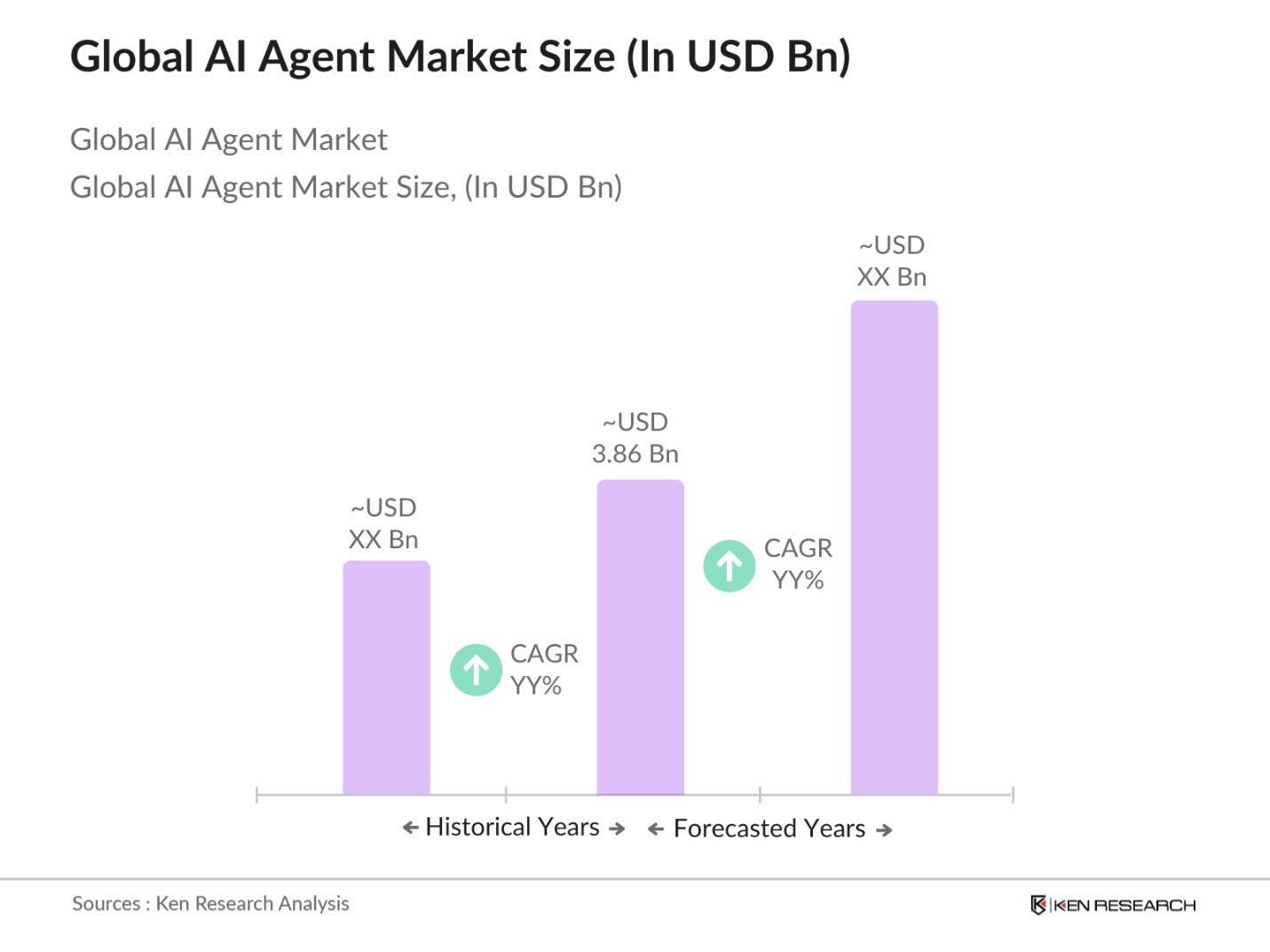
- The global AI agent market has seen substantial growth and is valued at USD 3.86 billion, driven by advancements in artificial intelligence technology, especially in natural language processing (NLP) and machine learning (ML). AI agents have been increasingly integrated into customer service, sales, and automation systems across multiple industries, fueling their demand. The rise in AI-based applications such as chatbots and virtual assistants, as well as the surge in automation needs within enterprises, has accelerated market expansion. A key driver is the shift towards digital transformation in industries like BFSI and healthcare, which rely on AI for enhanced customer engagement and operational efficiency.
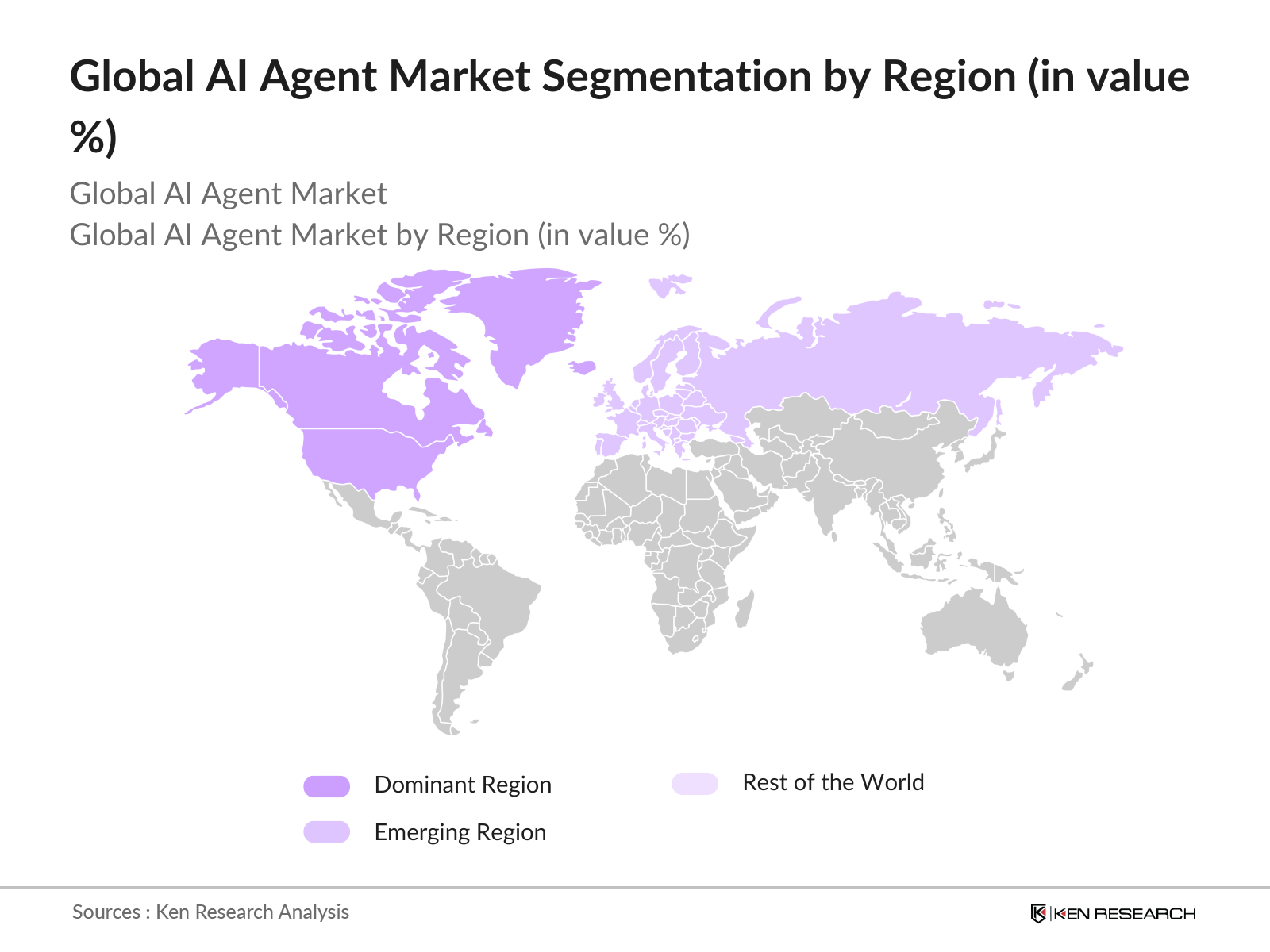
- The global AI agent market is predominantly led by North America, particularly cities such as San Francisco and New York, due to the presence of major tech companies and a strong infrastructure for AI development. The dominance is fueled by the presence of global tech giants like Google, Microsoft, and Amazon that have heavily invested in AI research and development. In Asia, cities like Shenzhen and Beijing are emerging as leaders due to their rapid advancements in AI technologies, government-backed AI initiatives, and a growing number of AI startups. These cities' dominance is attributed to their favorable policies, talent availability, and innovation ecosystems.
- Governments worldwide are increasingly focusing on the ethical deployment of AI agents, implementing strict regulations to ensure transparency and accountability. In 2023, over 25 countries have established frameworks for AI ethics, emphasizing the need for human oversight in AI decision-making processes. Key economies such as the European Union and the United States have spearheaded initiatives to create ethical AI guidelines, focusing on issues such as algorithmic bias, discrimination, and transparency in AI systems. These efforts aim to build public trust in AI technologies.
Global AI Agent Market Segmentation
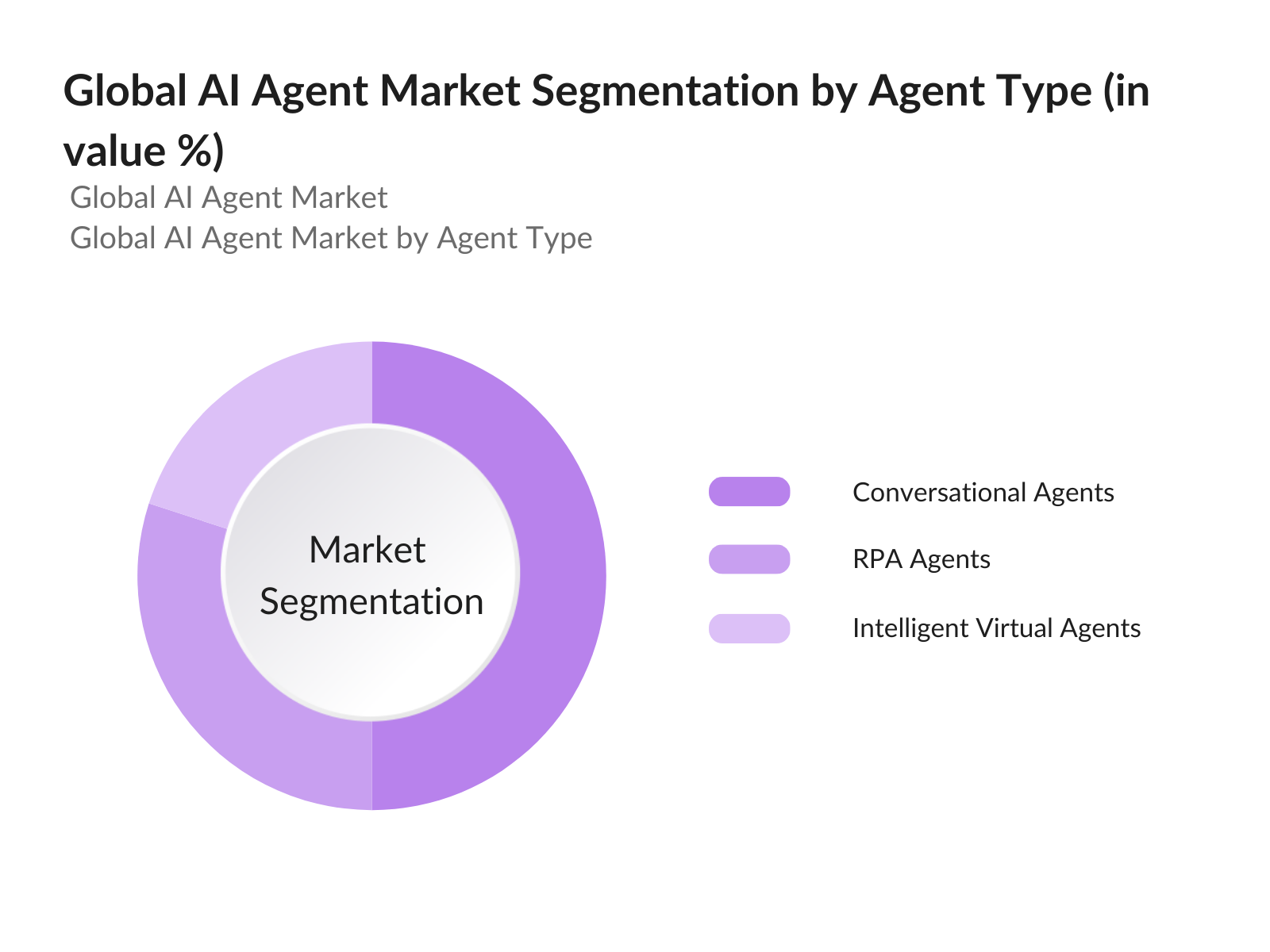
By Agent Type: The global AI agent market is segmented by agent type into Conversational Agents, Robotic Process Automation (RPA) Agents, and Intelligent Virtual Assistants (IVAs). Conversational agents, such as chatbots and voice assistants, have held a dominant market share in recent years due to their wide application in customer service and automation. Companies like Amazon (Alexa) and Google (Google Assistant) have contributed to the growing adoption of conversational agents, which are now essential for improving customer interactions and automating simple tasks.
By Region: The AI agent market is segmented by region into North America, Europe, Asia Pacific, Latin America, and the Middle East & Africa. North America leads the market due to the significant presence of technology innovators, favorable AI policies, and investment in R&D. Europe is closely following, with increased demand in countries such as Germany and the UK, particularly in the automation and healthcare sectors. Asia Pacific, led by China and Japan, is growing rapidly, driven by strong governmental support and a growing tech ecosystem.
Global AI Agent Market Competitive Landscape
The global AI agent market is dominated by major players who are leveraging AI advancements to drive growth and innovation. Key companies include global tech leaders such as Google, IBM, and Microsoft, which have invested heavily in AI R&D, thereby securing a significant market share. The market also witnesses contributions from specialized players such as Nuance Communications and Kore.ai, who focus on niche AI agent applications. This consolidation reflects the stronghold of established companies in shaping the markets competitive landscape.
|
Company Name |
Establishment Year |
Headquarters |
AI Capabilities |
Key Partnerships |
Product Offerings |
Global Presence |
Customer Base |
|
Google LLC |
1998 |
Mountain View, USA |
|||||
|
IBM Corporation |
1911 |
Armonk, USA |
|||||
|
Microsoft Corporation |
1975 |
Redmond, USA |
|||||
|
Nuance Communications |
1992 |
Burlington, USA |
|||||
|
Kore.ai |
2014 |
Orlando, USA |
Global AI Agent Market Analysis
Growth Drivers
- Demand for Enhanced Customer Experience: The demand for AI agents has been boosted by enterprises seeking to improve customer experience through seamless, personalized interactions. In 2023, it was reported that companies employing AI-driven customer service agents processed over 2 billion customer interactions globally, particularly in sectors like telecommunications and retail. The push for enhanced customer service has accelerated AI adoption in enterprises, with global businesses using AI to resolve customer queries in under 10 minutes on average. This shift is being led by digital-first economies such as the U.S. and China.
- Rise of Conversational AI: The conversational AI market has surged as enterprises move towards more natural and efficient customer communication methods. In 2024, nearly 1.5 billion people globally are estimated to have interacted with a conversational AI agent, spanning industries from retail to healthcare. These systems have been particularly effective in reducing customer service costs, streamlining processes, and improving response times for businesses. For instance, in the banking sector, AI-powered conversational bots have significantly reduced the burden on human agents by handling a substantial portion of customer queries, helping to drive operational efficiency.
- Increasing Automation in Enterprises: The global AI agent market has seen a significant rise in automation, fueled by enterprise demand to streamline operations and reduce manual workloads. In 2023, many companies, particularly in developed economies, have adopted AI agents to automate various tasks, including customer service, data analysis, and operational workflows. This shift has resulted in substantial operational cost reductions, with enterprises reporting notable efficiency gains. For instance, businesses have saved an average of 10 hours per week per employee by automating repetitive tasks, further driving the demand for AI agent deployment across sectors.
Market Challenges:
- Data Privacy and Security Concerns: Data security continues to pose a major challenge in the AI agent market, especially as businesses increasingly depend on AI to handle sensitive customer data. In 2023, global losses attributed to cyberattacks on AI systems amounted to approximately $2.5 billion, with sectors like financial services and healthcare being the most affected. Regulatory frameworks such as GDPR and CCPA have escalated compliance costs, prompting companies to invest heavily in AI-related security measures. These heightened security requirements have also slowed the adoption of AI agents in highly regulated industries, as businesses prioritize protecting customer data.
- High Implementation Costs: The deployment of AI agents in enterprises can be financially challenging due to the substantial costs associated with AI infrastructure, including hardware, software, and the need for specialized personnel. In 2023, large-scale organizations spent an average of $1.2 million on implementing AI-driven solutions, making it difficult for smaller enterprises to adopt these technologies quickly. Industries such as manufacturing and logistics face significant financial strain, as their capital expenditure on AI-related infrastructure represents a major portion of their technology spending. This challenge is particularly evident in developing economies where digital infrastructure is still evolving.
Global AI Agent Market Future Outlook
Over the next five years, the global AI agent market is poised for significant growth driven by ongoing advancements in AI and machine learning technologies, increasing automation demand, and the integration of AI agents across industries. Companies will continue investing in AI to enhance operational efficiency, customer experience, and innovation. The increasing adoption of AI-powered virtual assistants and conversational agents in sectors such as healthcare, banking, and retail will further accelerate market growth, with strong contributions from regions like North America and Asia Pacific.
Market Opportunities:
- Integration of AI Agents with IoT Devices: The integration of AI agents with Internet of Things (IoT) devices has accelerated, boosting the connectivity and operational efficiency of enterprises across various sectors. In 2023, IoT-enabled AI agents managed over 10 billion connected devices globally, driving advancements in areas such as smart homes, industrial automation, and healthcare. Key industries, particularly in manufacturing, have experienced significant productivity gains due to the synergy between AI and IoT. Countries like Japan and South Korea have been at the forefront of this integration, leveraging AI-IoT technologies to optimize automation processes and enhance operational outcomes.
- Enhanced AI Personalization Features: AI agents are increasingly offering advanced personalization capabilities, enabling enterprises to customize services and products based on individual customer preferences. In 2023, AI-driven systems in consumer-facing industries, such as retail and hospitality, incorporated sophisticated personalization features that significantly improved customer satisfaction and retention. Businesses in regions like Europe and North America have particularly benefited from AI's ability to predict and respond to consumer behavior, leading to more targeted and effective customer engagement strategies. This trend toward hyper-personalization is opening new opportunities for growth across various sectors.
Scope of the Report
|
By Agent Type |
Conversational Agents Robotic Process Automation (RPA) Agents Intelligent Virtual Agents (IVAs) |
|
By Technology |
Natural Language Processing (NLP) Machine Learning (ML) Deep Learning (DL) |
|
By Application |
Customer Service Sales and Marketing IT Helpdesk Healthcare Assistance |
|
By End-User |
BFSI Retail & E-Commerce Healthcare Telecommunications Automotive |
|
By Region |
North America Europe Asia Pacific Latin America Middle East & Africa |
Products
Key Target Audience
AI Software Developers
IT Service Providers
E-Commerce Companies
BFSI Sector Enterprises
Telecommunications Companies
Healthcare Service Providers
Investments and Venture Capitalist Firms
Government and Regulatory Bodies (e.g., US Federal AI Task Force, European AI Alliance)
Companies
Players Mention in the Reports
Google LLC
IBM Corporation
Microsoft Corporation
Amazon Web Services
Oracle Corporation
Salesforce Inc.
Nuance Communications
Haptik Technologies
Rasa Technologies
Kore.ai
SAP SE
SoundHound Inc.
Avaamo Inc.
Pypestream
Aivo Inc.
Table of Contents
01. Global AI Agent Market Overview
1.1 Definition and Scope
1.2 Market Taxonomy
1.3 Market Growth Rate
1.4 Market Segmentation Overview
02. Global AI Agent Market Size (In USD Bn)
2.1 Historical Market Size
2.2 Year-On-Year Growth Analysis
2.3 Key Market Developments and Milestones
03. Global AI Agent Market Analysis
3.1 Growth Drivers
3.1.1 Increasing Automation in Enterprises
3.1.2 Demand for Enhanced Customer Experience
3.1.3 Rise of Conversational AI
3.1.4 Integration with AI-Powered Solutions (NLP, ML, Deep Learning)
3.2 Market Challenges
3.2.1 Data Privacy and Security Concerns
3.2.2 High Implementation Costs
3.2.3 Lack of Skilled Workforce for AI Deployment
3.3 Opportunities
3.3.1 Technological Advancements in AI Agents
3.3.2 Growth of AI-Powered Digital Assistants in E-Commerce
3.3.3 Rising Adoption in Healthcare and Financial Services
3.4 Trends
3.4.1 Integration of AI Agents with IoT Devices
3.4.2 Enhanced AI Personalization Features
3.4.3 Adoption of AI Agents in Autonomous Systems
3.5 Government Regulation
3.5.1 AI Ethics and Regulation Standards
3.5.2 Privacy Laws and Compliance (GDPR, CCPA)
3.5.3 Public-Private Partnerships in AI Research
3.6 SWOT Analysis
3.7 Stake Ecosystem
3.8 Porters Five Forces
3.9 Competition Ecosystem
04. Global AI Agent Market Segmentation
4.1 By Agent Type (In Value %)
4.1.1 Conversational Agents
4.1.2 Robotic Process Automation (RPA) Agents
4.1.3 Intelligent Virtual Agents (IVAs)
4.2 By Technology (In Value %)
4.2.1 Natural Language Processing (NLP)
4.2.2 Machine Learning (ML)
4.2.3 Deep Learning (DL)
4.3 By Application (In Value %)
4.3.1 Customer Service
4.3.2 Sales and Marketing
4.3.3 IT Helpdesk
4.3.4 Healthcare Assistance
4.4 By End-User Industry (In Value %)
4.4.1 BFSI
4.4.2 Retail & E-Commerce
4.4.3 Healthcare
4.4.4 Telecommunications
4.4.5 Automotive
4.5 By Region (In Value %)
4.5.1 North America
4.5.2 Europe
4.5.3 Asia Pacific
4.5.4 Latin America
4.5.5 Middle East & Africa
05. Global AI Agent Market Competitive Analysis
5.1 Detailed Profiles of Major Companies
5.1.1 Google LLC
5.1.2 IBM Corporation
5.1.3 Microsoft Corporation
5.1.4 Amazon Web Services
5.1.5 Oracle Corporation
5.1.6 Salesforce Inc.
5.1.7 Nuance Communications
5.1.8 Haptik Technologies
5.1.9 Rasa Technologies
5.1.10 Kore.ai
5.1.11 SAP SE
5.1.12 SoundHound Inc.
5.1.13 Avaamo Inc.
5.1.14 Pypestream
5.1.15 Aivo Inc.
5.2 Cross Comparison Parameters (Number of Employees, Headquarters, Inception Year, Revenue, AI Capabilities, Key Partnerships, Customer Base, Global Presence)
5.3 Market Share Analysis
5.4 Strategic Initiatives
5.5 Mergers And Acquisitions
5.6 Investment Analysis
5.7 Venture Capital Funding
5.8 Government Grants
5.9 Private Equity Investments
06. Global AI Agent Market Regulatory Framework
6.1 AI Compliance and Ethics Standards
6.2 Certification Processes
6.3 Government Initiatives in AI R&D
07. Global AI Agent Future Market Size (In USD Bn)
7.1 Future Market Size Projections
7.2 Key Factors Driving Future Market Growth
08. Global AI Agent Future Market Segmentation
8.1 By Agent Type (In Value %)
8.2 By Technology (In Value %)
8.3 By Application (In Value %)
8.4 By End-User Industry (In Value %)
8.5 By Region (In Value %)
09. Global AI Agent Market Analysts Recommendations
9.1 TAM/SAM/SOM Analysis
9.2 Customer Cohort Analysis
9.3 Marketing Initiatives
9.4 White Space Opportunity Analysis
Disclaimer
Contact Us
Research Methodology
Step 1: Identification of Key Variables
The initial phase involves constructing an ecosystem map encompassing all major stakeholders within the AI agent market. This step is underpinned by extensive desk research, utilizing secondary sources and proprietary databases to gather comprehensive industry-level information. The primary goal is to identify and define the critical variables that influence market dynamics.
Step 2: Market Analysis and Construction
In this phase, we will compile and analyze historical data pertaining to the AI agent market, including assessing market penetration, the adoption rate across different industries, and revenue generation. Furthermore, an evaluation of technological advancements and product offerings will be conducted to ensure accurate revenue estimates.
Step 3: Hypothesis Validation and Expert Consultation
Market hypotheses will be developed and validated through interviews with industry experts, representing various AI companies. These consultations provide valuable insights into operational challenges and innovations directly from industry practitioners, which are instrumental in refining market forecasts and ensuring data reliability.
Step 4: Research Synthesis and Final Output
The final phase involves direct engagement with multiple AI developers and enterprises to acquire detailed insights into product segments, sales performance, and market preferences. This interaction will serve to validate the statistics derived from the bottom-up approach, ensuring a comprehensive, accurate, and validated analysis of the global AI agent market.
Frequently Asked Questions
01. How big is the Global AI Agent Market?
The global AI agent market is valued at USD 3.86 billion, driven by the increasing demand for AI-powered conversational agents and automation solutions in various industries.
02. What are the key challenges in the Global AI Agent Market?
The main challenges include data privacy concerns, high implementation costs for enterprises, and the shortage of skilled professionals with AI expertise. These factors can limit the growth potential in certain regions.
03. Who are the major players in the Global AI Agent Market?
Key players include global technology giants such as Google, IBM, Microsoft, and Amazon Web Services, along with specialized firms like Nuance Communications and Kore.ai, which focus on niche AI applications.
04. What are the growth drivers of the Global AI Agent Market?
The market is propelled by advancements in AI technologies, increasing demand for automation across industries, and the integration of AI agents in customer service and support roles. The growing adoption of AI in healthcare and BFSI also boosts the market.
Why Buy From Us?

What makes us stand out is that our consultants follows Robust, Refine and Result (RRR) methodology. i.e. Robust for clear definitions, approaches and sanity checking, Refine for differentiating respondents facts and opinions and Result for presenting data with story

We have set a benchmark in the industry by offering our clients with syndicated and customized market research reports featuring coverage of entire market as well as meticulous research and analyst insights.

While we don't replace traditional research, we flip the method upside down. Our dual approach of Top Bottom & Bottom Top ensures quality deliverable by not just verifying company fundamentals but also looking at the sector and macroeconomic factors.

With one step in the future, our research team constantly tries to show you the bigger picture. We help with some of the tough questions you may encounter along the way: How is the industry positioned? Best marketing channel? KPI's of competitors? By aligning every element, we help maximize success.

Our report gives you instant access to the answers and sources that other companies might choose to hide. We elaborate each steps of research methodology we have used and showcase you the sample size to earn your trust.

If you need any support, we are here! We pride ourselves on universe strength, data quality, and quick, friendly, and professional service.