















Global Automotive Turbocharger Market Outlook to 2030
Region:Global
Author(s):Paribhasha Tiwari
Product Code:KROD4914
December 2024
90
About the Report
Global Automotive Turbocharger Market Overview
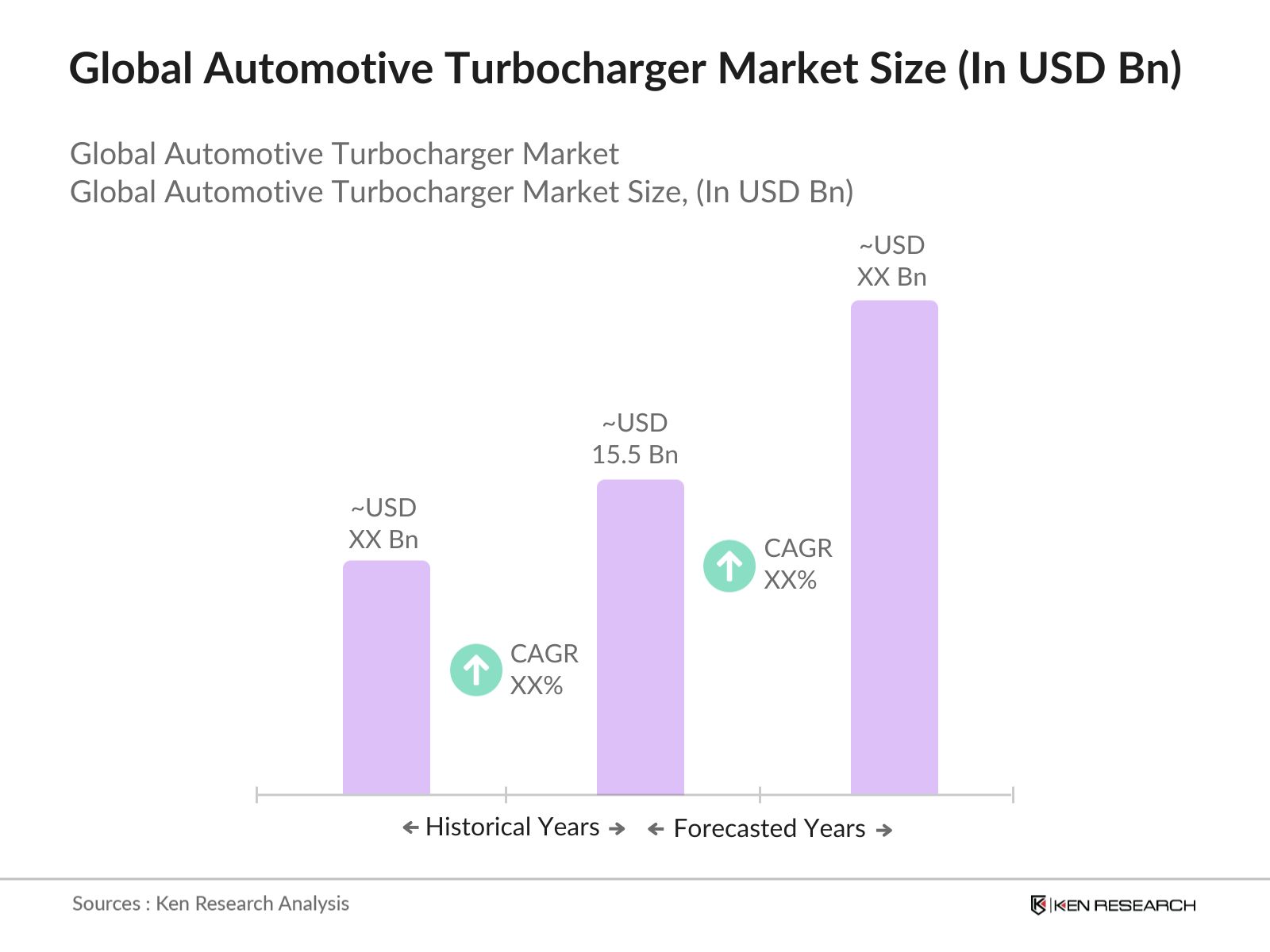
- The global automotive turbocharger market is valued at USD 15.5 billion based on a five-year historical analysis. This market is primarily driven by the growing demand for fuel-efficient vehicles and stringent emission regulations globally. Automotive turbochargers play a crucial role in improving engine efficiency and reducing exhaust emissions, making them indispensable in modern internal combustion engines. Additionally, advancements in electric turbocharging technologies are further boosting the demand in this sector.
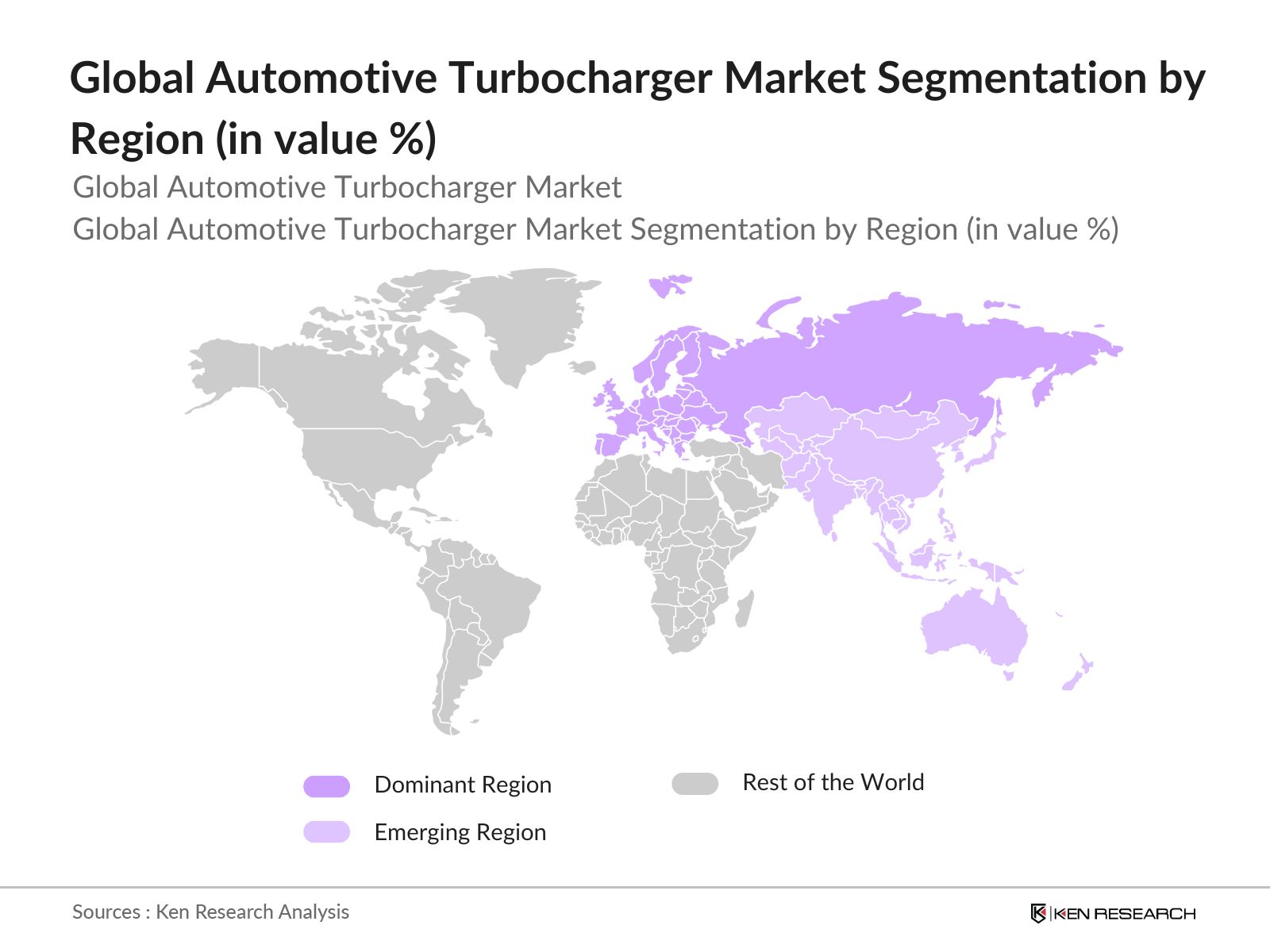
- In terms of geographic dominance, Europe and Asia-Pacific are leading regions in the automotive turbocharger market. Countries such as Germany and Japan are at the forefront due to their strong automotive industries, extensive research and development, and stringent emissions standards. These regions are home to major automotive manufacturers and suppliers, which contribute to their dominance in the market.
- The European Union has enacted stringent CO emission standards under Regulation (EU) 2019/631, targeting a reduction in CO emissions to 95 grams per kilometer for new passenger cars. This regulation directly drives the adoption of turbochargers, as they are instrumental in helping automakers meet these ambitious targets by improving engine efficiency. The EU is set to review and possibly tighten these emission limits in 2025, encouraging further advancements in turbocharging technology and its integration in automobiles.
Global Automotive Turbocharger Market Segmentation
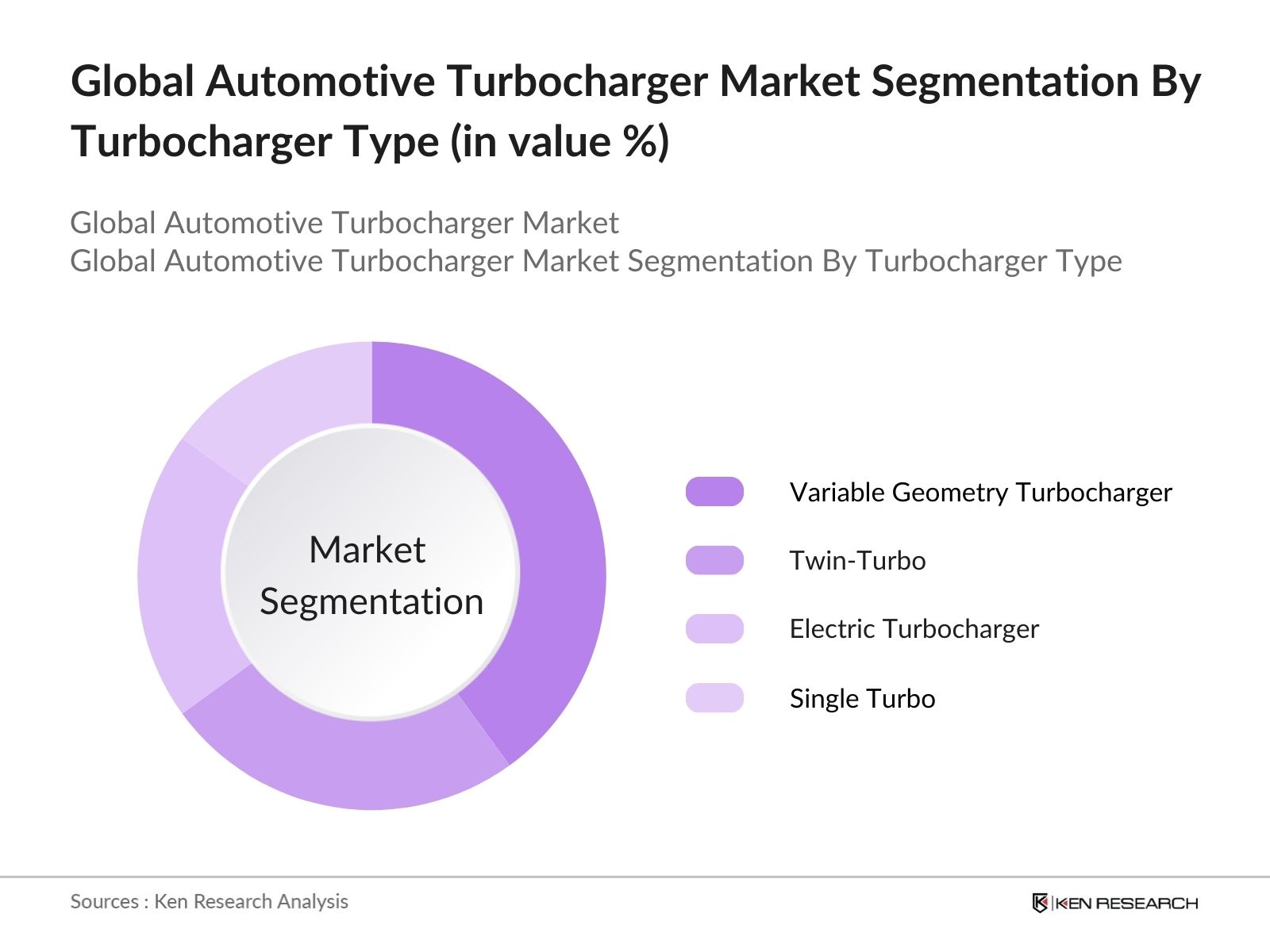
By Turbocharger Type: The automotive turbocharger market is segmented into single turbo, twin-turbo, variable geometry turbochargers (VGT), and electric turbochargers. Currently, VGT holds a dominant market share within the segmentation of turbocharger type due to its efficiency in optimizing performance at different engine speeds. VGTs allow for better fuel economy and lower emissions, aligning with the global trend toward stricter environmental regulations and demand for higher vehicle performance.
By Region: The market is segmented regionally into North America, Europe, Asia-Pacific, Latin America, and the Middle East & Africa. Europe dominates the market due to its advanced automotive manufacturing capabilities, strict emissions standards, and technological innovations. The regions focus on reducing carbon footprints has also accelerated the adoption of turbochargers in both gasoline and diesel vehicles. Asia-Pacific is also experiencing rapid growth, driven by increasing automotive production and sales in countries like China and India.
Global Automotive Turbocharger Market Competitive Landscape
The global automotive turbocharger market is dominated by a few key players, with major companies like Garrett Motion Inc., BorgWarner Inc., and Mitsubishi Heavy Industries leading the way. These companies leverage their extensive technological expertise and large-scale manufacturing capabilities to maintain a competitive edge. The market is also characterized by strategic collaborations and mergers to enhance product portfolios and expand into emerging markets.
|
Company Name |
Establishment Year |
Headquarters |
Number of Employees |
R&D Investments (USD) |
Revenue (USD) |
Global Presence (Countries) |
Product Portfolio |
Patents |
|
Garrett Motion Inc. |
1936 |
Rolle, Switzerland |
- | - | - | - | - | - |
|
BorgWarner Inc. |
1928 |
Michigan, USA |
- | - | - | - | - | - |
|
Mitsubishi Heavy Industries |
1884 |
Tokyo, Japan |
- | - | - | - | - | - |
|
Continental AG |
1871 |
Hanover, Germany |
- | - | - | - | - | - |
|
Cummins Inc. |
1919 |
Indiana, USA |
- | - | - | - | - | - |
Global Automotive Turbocharger Market Analysis
Growth Drivers
- Increasing Adoption of Engine Downsizing: With global regulatory bodies pushing for improved fuel efficiency and reduced emissions, engine downsizing has become a key trend in the automotive industry. Downsized engines equipped with turbochargers maintain performance while improving fuel economy. The U.S. Department of Energy reports that turbocharged downsized engines deliver around 20% better fuel efficiency than larger naturally aspirated engines. This trend has been critical for automakers to meet the U.S. Corporate Average Fuel Economy (CAFE) standards, which target 54.5 miles per gallon by 2025. Engine downsizing, particularly in the U.S. and European markets, will continue driving the adoption of turbochargers in 2024.
- Stricter Emission Regulations: Global emission standards are becoming increasingly stringent, propelling the demand for turbochargers. According to the European Unions Regulation (EU) 2019/631, carbon dioxide (CO) emissions for passenger vehicles must be capped at 95 grams per kilometer, encouraging the integration of turbochargers to meet these targets. The U.S. Environmental Protection Agency (EPA) also notes that turbocharged engines reduce CO emissions by 10-20 grams per kilometer, making them a preferred choice for automakers looking to comply with regulations. This shift toward more stringent emission standards, especially in North America and Europe, is a significant growth driver.
- Shift Toward Hybrid Vehicles: The hybrid vehicle market continues to expand, with turbochargers playing a key role in plug-in hybrid electric vehicles (PHEVs). The International Energy Agency (IEA) reports that nearly 3 million PHEVs were sold globally in 2022, a figure expected to grow further in 2024. Turbochargers, by improving engine efficiency and reducing emissions, are integral to maintaining the performance of hybrid systems. With the PHEV market growing in regions such as North America, Europe, and Asia, the demand for turbocharged engines will likely see a significant rise in the coming years.
Market Challenges
- High Manufacturing and Integration Costs: Turbochargers are complex components requiring precision engineering and high-grade materials, leading to increased production costs. According to the U.S. Bureau of Labor Statistics, the average cost of producing turbochargers has risen annually since 2020 due to increasing raw material costs. Furthermore, integrating turbochargers into vehicle systems requires additional engineering efforts and technical expertise, further adding to costs. These factors make it challenging for cost-sensitive automakers to implement turbochargers, especially in entry-level vehicle models, which could slow down their widespread adoption.
- Compatibility Issues with Electric Vehicles: While turbochargers are widely used in internal combustion engines (ICEs) and hybrid vehicles, they are largely irrelevant for fully electric vehicles (EVs) due to the absence of an engine. The International Energy Agency reports that global electric vehicle sales exceeded 12.5 million units in 2022, with strong growth expected in 2024. This trend poses a challenge for the turbocharger market, as the rising adoption of fully electric vehicles reduces the potential market for turbocharged engines. However, plug-in hybrid electric vehicles (PHEVs) still provide opportunities for turbochargers.
Global Automotive Turbocharger Market Future Outlook
The global automotive turbocharger market is expected to experience significant growth over the next five years. This growth will be driven by stringent emission norms, the increasing adoption of electric and hybrid vehicles, and advancements in turbocharging technologies. With the push toward reducing carbon footprints and improving fuel efficiency, turbochargers are likely to become more prevalent across various vehicle types, including passenger cars, commercial vehicles, and electric vehicles.
Market Opportunities
- Advancements in Electric Turbochargers: Electric turbochargers represent a significant technological advancement, particularly in reducing turbo lag and improving efficiency. According to the European Union Intellectual Property Office, patent applications for electric turbocharger technologies increased by 15% from 2021 to 2023, highlighting growing innovation in this area. Major automakers are developing electric turbochargers to offer improved responsiveness and fuel efficiency. These advancements align with government policies such as the European Green Deal, which targets a 55% reduction in greenhouse gas emissions by 2030. The development of electric turbochargers creates an opportunity for manufacturers to cater to the evolving demand for cleaner and more efficient vehicle technologies.
- Growth in Electric Vehicle Market: Although turbochargers are primarily associated with internal combustion engines, they still have a role to play in the transition toward electrification. The World Bank highlights that 12.5 million electric vehicles were sold globally in 2022, and although fully electric vehicles dont require turbochargers, the growth in plug-in hybrid vehicles (PHEVs) provides a critical opportunity for turbocharger manufacturers. In markets like China, Europe, and the United States, where the adoption of PHEVs is robust, turbochargers can help these vehicles meet stringent emission and fuel efficiency standards while maintaining high performance levels.
Scope of the Report
|
By Turbocharger Type |
Single Turbo Twin-Turbo VGT Electric Turbocharger |
|
By Engine Type |
Diesel Engine Gasoline Engine Hybrid Engine |
|
By Fuel Type |
Gasoline Diesel Alternative Fuels (CNG, Hydrogen) |
|
By Vehicle Type |
Passenger Cars Light Commercial Vehicles Heavy Commercial Vehicles |
|
By Region |
North America Europe Asia-Pacific Latin America Middle East & Africa |
Products
Key Target Audience
Automotive Manufacturers
Turbocharger Suppliers and Manufacturers
Engine Component Manufacturers
Vehicle Performance Enthusiasts
Investments and Venture Capitalist Firms
Government and Regulatory Bodies (EPA, European Commission)
Automotive Research Institutions
Environmental Advocacy Groups
Companies
Players Mentioedn in the Report:
Garrett Motion Inc.
BorgWarner Inc.
Mitsubishi Heavy Industries
Cummins Inc.
Continental AG
Bosch Mahle Turbo Systems GmbH & Co.
Turbo Energy Pvt. Ltd.
Rotomaster
Honeywell International
Precision Turbo & Engine
Turbo International
IHI Corporation
BMTS Technology
Magnum Performance Turbochargers
HKS Co. Ltd.
Table of Contents
1. Global Automotive Turbocharger Market Overview
1.1. Definition and Scope
1.2. Market Taxonomy
1.3. Market Growth Rate (CAGR, Growth Trends)
1.4. Market Segmentation Overview
2. Global Automotive Turbocharger Market Size (in USD Billion)
2.1. Historical Market Size
2.2. Year-on-Year Growth Analysis (Performance Metrics, Growth Fluctuations)
2.3. Key Market Developments and Milestones (Technological Advancements, Regulatory Changes, Key Product Launches)
3. Global Automotive Turbocharger Market Analysis
3.1. Growth Drivers (Fuel Efficiency Demand, Emission Regulations, Engine Downsizing)
3.2. Market Challenges (High Costs of Turbochargers, Complex Integration with Hybrid/Electric Vehicles)
3.3. Opportunities (Advancements in Electric Turbochargers, Growth in Electric Vehicle Market)
3.4. Trends (Adoption of Variable Geometry Turbochargers, Focus on Hybrid Powertrains)
3.5. Government Regulation (Emission Standards, Fuel Economy Regulations, Incentives for Green Technology)
3.6. SWOT Analysis (Market-Specific Parameters: Strength, Weakness, Opportunities, Threats)
3.7. Stake Ecosystem (Suppliers, OEMs, Aftermarket Players, Tier-1 and Tier-2 Manufacturers)
3.8. Porters Five Forces Analysis (Bargaining Power of Suppliers, Buyers, Industry Rivalry)
3.9. Competition Ecosystem (Competitive Landscape, Market Positioning)
4. Global Automotive Turbocharger Market Segmentation
4.1. By Turbocharger Type (In Value %)
4.1.1. Single Turbo
4.1.2. Twin-Turbo
4.1.3. Variable Geometry Turbocharger (VGT)
4.1.4. Electric Turbocharger
4.2. By Engine Type (In Value %)
4.2.1. Diesel Engine
4.2.2. Gasoline Engine
4.2.3. Hybrid Engine
4.3. By Fuel Type (In Value %)
4.3.1. Gasoline
4.3.2. Diesel
4.3.3. Alternative Fuels (CNG, Hydrogen)
4.4. By Vehicle Type (In Value %)
4.4.1. Passenger Cars
4.4.2. Light Commercial Vehicles
4.4.3. Heavy Commercial Vehicles
4.5. By Region (In Value %)
4.5.1. North America
4.5.2. Europe
4.5.3. Asia-Pacific
4.5.4. Latin America
4.5.5. Middle East & Africa
5. Global Automotive Turbocharger Market Competitive Analysis
5.1. Detailed Profiles of Major Companies
5.1.1. Garrett Motion Inc.
5.1.2. BorgWarner Inc.
5.1.3. Continental AG
5.1.4. IHI Corporation
5.1.5. Mitsubishi Heavy Industries
5.1.6. Cummins Inc.
5.1.7. Honeywell International
5.1.8. Bosch Mahle Turbo Systems GmbH & Co.
5.1.9. Turbo Energy Pvt. Ltd.
5.1.10. Rotomaster
5.1.11. Precision Turbo & Engine
5.1.12. Turbo International
5.1.13. BMTS Technology
5.1.14. Magnum Performance Turbochargers
5.1.15. HKS Co. Ltd.
5.2. Cross Comparison Parameters (Market-Specific: Turbo Efficiency, Product Portfolio, R&D Investments, Distribution Network, Manufacturing Capacity, Technological Innovations, Patents, Global Presence)
5.3. Market Share Analysis (Regional and Global Market Leaders, Fragmentation Level)
5.4. Strategic Initiatives (Product Innovations, Collaborations, Partnerships)
5.5. Mergers and Acquisitions (Key Transactions, Strategic Fit, Impact on Market)
5.6. Investment Analysis (Venture Capital, Private Equity, Government Funding)
5.7. Technology Licensing and Intellectual Property Developments
5.8. Global Expansion and Product Diversification Strategies
6. Global Automotive Turbocharger Market Regulatory Framework
6.1. Emission Standards (Euro, CAFE, EPA)
6.2. Compliance Requirements (Certification, Product Testing)
6.3. Global and Regional Automotive Regulations
7. Global Automotive Turbocharger Market Future Market Size (in USD Billion)
7.1. Future Market Size Projections
7.2. Key Factors Driving Future Market Growth (Hybrid and Electric Vehicle Integration, New Fuel Types)
8. Global Automotive Turbocharger Market Future Market Segmentation
8.1. By Turbocharger Type (In Value %)
8.2. By Engine Type (In Value %)
8.3. By Fuel Type (In Value %)
8.4. By Vehicle Type (In Value %)
8.5. By Region (In Value %)
9. Global Automotive Turbocharger Market Analysts' Recommendations
9.1. TAM/SAM/SOM Analysis (Total Addressable Market, Serviceable Available Market, Serviceable Obtainable Market)
9.2. Marketing Strategies (OEM Partnerships, Brand Positioning, Product Innovation)
9.3. White Space Opportunity Analysis (Emerging Markets, Untapped Vehicle Segments)
9.4. Technology Integration and Future Innovation Trends
Research Methodology
Step 1: Identification of Key Variables
The first step involved creating an ecosystem map of stakeholders in the global automotive turbocharger market. Desk research using secondary and proprietary databases provided comprehensive insights into market dynamics and emerging trends.
Step 2: Market Analysis and Construction
Next, historical data on market penetration, revenue generation, and adoption rates was compiled and analyzed. An in-depth review of turbocharger technology trends and government regulations further enriched the data pool.
Step 3: Hypothesis Validation and Expert Consultation
Market hypotheses were developed and validated through interviews with industry experts and executives from leading automotive companies. This step provided operational insights crucial for verifying revenue projections and market trends.
Step 4: Research Synthesis and Final Output
Finally, data was synthesized through interactions with turbocharger manufacturers and OEMs. This enabled cross-verification of key statistics and ensured an accurate, validated report on the global automotive turbocharger market.
Frequently Asked Questions
01. How big is the global automotive turbocharger market?
The global automotive turbocharger market is valued at USD 15.5 billion, driven by stringent emission regulations and a growing demand for fuel-efficient vehicles.
02. What are the challenges in the global automotive turbocharger market?
Challenges in the global automotive turbocharger market include the high costs of turbocharging systems, integration issues with hybrid and electric vehicles, and complex manufacturing processes.
03. Who are the major players in the global automotive turbocharger market?
Key players in the global automotive turbocharger market include Garrett Motion Inc., BorgWarner Inc., Mitsubishi Heavy Industries, Cummins Inc., and Continental AG, all dominating due to their strong technological expertise and large-scale production capabilities.
04. What are the growth drivers in the global automotive turbocharger market?
The global automotive turbocharger market is driven by the increasing demand for fuel efficiency, stricter emissions standards, and advancements in turbocharging technologies, particularly electric turbochargers.
Why Buy From Us?

What makes us stand out is that our consultants follows Robust, Refine and Result (RRR) methodology. i.e. Robust for clear definitions, approaches and sanity checking, Refine for differentiating respondents facts and opinions and Result for presenting data with story

We have set a benchmark in the industry by offering our clients with syndicated and customized market research reports featuring coverage of entire market as well as meticulous research and analyst insights.

While we don't replace traditional research, we flip the method upside down. Our dual approach of Top Bottom & Bottom Top ensures quality deliverable by not just verifying company fundamentals but also looking at the sector and macroeconomic factors.

With one step in the future, our research team constantly tries to show you the bigger picture. We help with some of the tough questions you may encounter along the way: How is the industry positioned? Best marketing channel? KPI's of competitors? By aligning every element, we help maximize success.

Our report gives you instant access to the answers and sources that other companies might choose to hide. We elaborate each steps of research methodology we have used and showcase you the sample size to earn your trust.

If you need any support, we are here! We pride ourselves on universe strength, data quality, and quick, friendly, and professional service.