















Global Robotics Software Market Size, Segments, Outlook, and Revenue Forecast 2022-2028 by Software Type (Recognition Software, Simulation Software, Predictive Maintenance Software, Data Management & Analysis Software, and Communication Management Software), Robot Type (Industrial Robots and Service Robots), Deployment (On-Premise and On-Demand), Enterprise Size (Small & Medium Enterprises and Large Enterprises), End User (Automotive, Retail & E-commerce, Government & Defense, Healthcare, Transportation & Logistics, Manufacturing, IT & Telecommunications), and Region (North America, Europe, Asia Pacific, Latin America Middle East and Africa (LAMEA))
Region:Global
Product Code:KRBR140
Invalid Date
150
About the Report
Market Overview
The set of inputs given as a program to the robot to get a specific task done at the desired output level is called Robotics Software. This software is used to automate processes, improve operational efficiency, lower operational risks and costs as well as improve internal processes. It enables the robots to function safely with intelligence and productively. Due to the above-mentioned benefits and the ever-growing installations of robots across all major end-user industries such as Automotive, Retail & E-commerce, Government & Defense, Healthcare, Transportation & Logistics, Manufacturing, IT & Telecommunications, robotics software is widely used.
According to Ken Research Analysis, the Global Robotics Software Market is expected to record a positive CAGR of ~15% during the forecast period (2022-2028) and is expected to reach approximately US$ 15 billion by 2028.
The investment in various countries by the governments and the high adoption of Robotics Software in various end-user industries is positively impacting the market growth.
- Developed markets such as European regions and developing markets such as the Asia-Pacific region are witnessing huge investments by start-ups, and existing large players and governments which are driving the market growth.
Concerns about data privacy and malware attacks along with the high costs associated with the implementation of industrial robots and robotics software are factors that act as constraints for market growth.
- Increasing cyber-attacks and robot crimes are major hindrances to the market’s growth. These factors are still a major concern for some end-user industries which are worried by data theft and hence they are taking a cautious approach when it comes to the adoption of robotic software.
The COVID-19 outbreak had a positive impact on the demand for Robotics Software as various companies installed robots to disinfect factory areas as well as it helped them to deliver food to their customers without risking any health-related issues during the pandemic for their employees.
Scope of the Report
The Robotics Software Market is segmented by software type, robot, deployment, enterprise size, and end user. In addition, the report also covers market size and forecasts for the four major regions’ Robotics Software Market. The revenue used to size and forecast the market for each segment is US$ billion.
|
By Software Type |
|
|
By Robot Type |
|
|
By Deployment Mode |
|
|
By Enterprise Size |
|
|
By End User |
|
|
By Geography |
|
|
Key Players |
|
Key Trends by Market Segment
By Software Type: The Recognition Software segment held the largest market share in the Global Robotics Software Market in 2021.
- The recognition software in the robots enables them with cognitive ability. This software is integrated behind the robots and helps them to identify an object and give its response accordingly.

By Robot Type: The Industrial Robots segment held the larger share of the Global Robotics Software Market in 2021.
- The significant growth in demand for industrial robots can be attributed to the fact that they can perform dangerous tasks repeatedly with more accuracy than human beings and have a longer life span to perform such tasks.
- These robots also help companies in achieving higher operational efficiency and lowering labor costs which are encouraging more and more organizations to install these robots.
- According to data provided by the International Federation of Robotics, a total of 3.5 million industrial robots have been installed worldwide by 2021 with a growth rate of 15% from 2020 and a CAGR of 14% for the five-year period 2016-2021.
By Deployment Mode: The On-Demand segment held the larger share of the Global Robotics Software Market in 2021.
- The on-demand deployment mode or the cloud-based deployment mode is more adopted because it is a cost-effective method by which the companies are able to save a lot of costs related to data, personnel, software, hardware, and maintenance.
By Enterprise Size: The Large Enterprises segment held the larger share of the Global Robotics Software Market in 2021.
- The covid-19 pandemic made a lot of large enterprises make changes in their manufacturing facilities and deployed automated robots to mitigate any such risks in the future. Also, as the investment costs are a bit high so large enterprises have been quicker to adapt to such models faster than their small and medium enterprise counterparts.
By End-user: The Manufacturing segment held the larger share of the Global Robotics Software Market in 2021.
- The rising need for the adoption of automation, shortage of labor for factories, and robot simulation software that is making robotic automation a feasible option for the sector aided by the necessity to complete repetitive hazardous tasks more accurately & safely are the major factors for this segment to dominate the market.
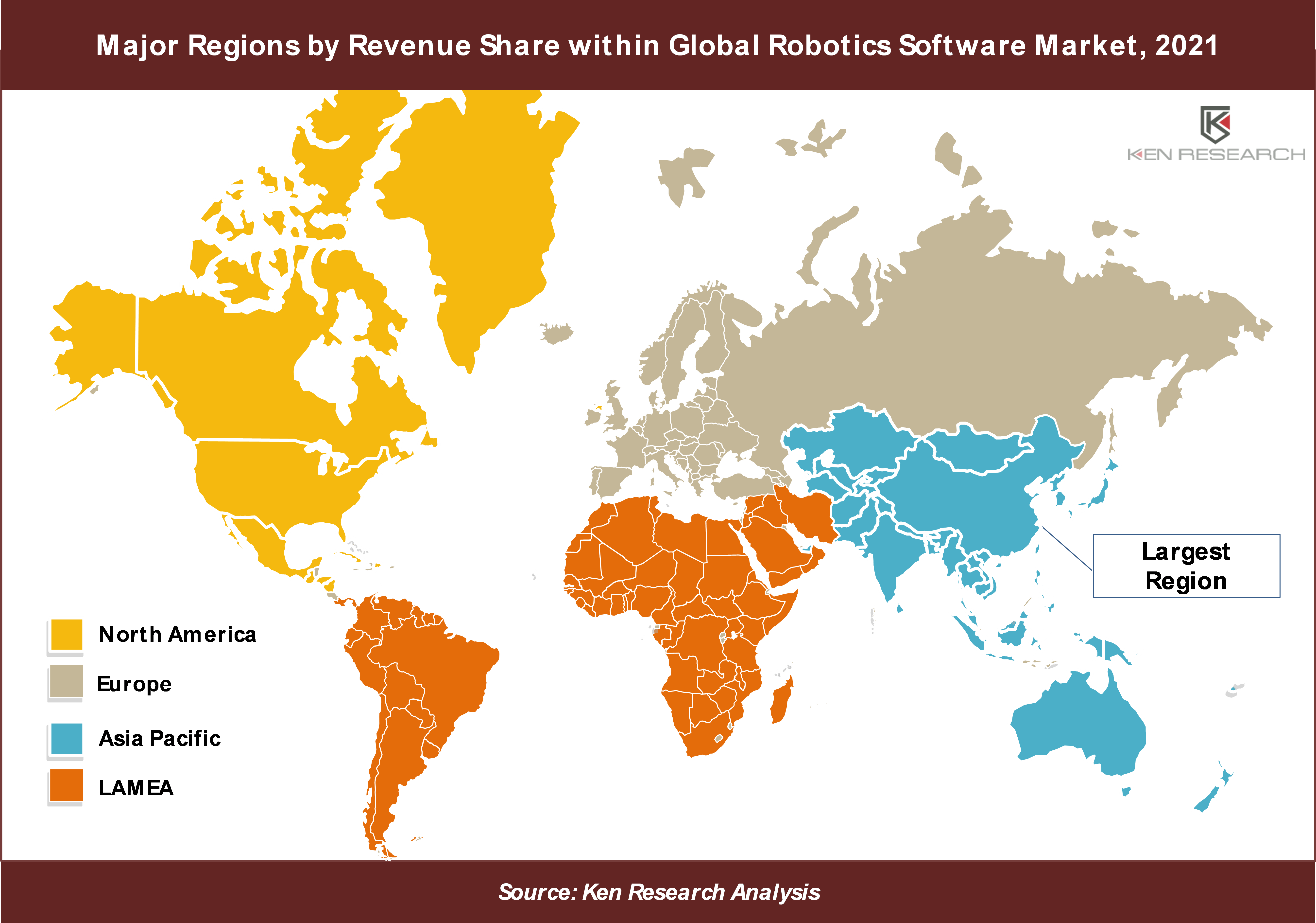
By Geography: Asia Pacific accounted for the largest market share in 2021 within the total Global Robotics Software Market.
- Asia-Pacific region has some established manufacturing markets in countries such as China, Japan, and South Korea. These countries have been very bullish on innovating and modernizing their existing manufacturing facilities which have seen the large-scale installation of industrial robots.
- The region is also seeing increasing investments by the governments and many start-ups in robotics software of some countries such as China, India, and Thailand which is going to help the region maintain its dominant position during the forecast period.
Competitive Landscape
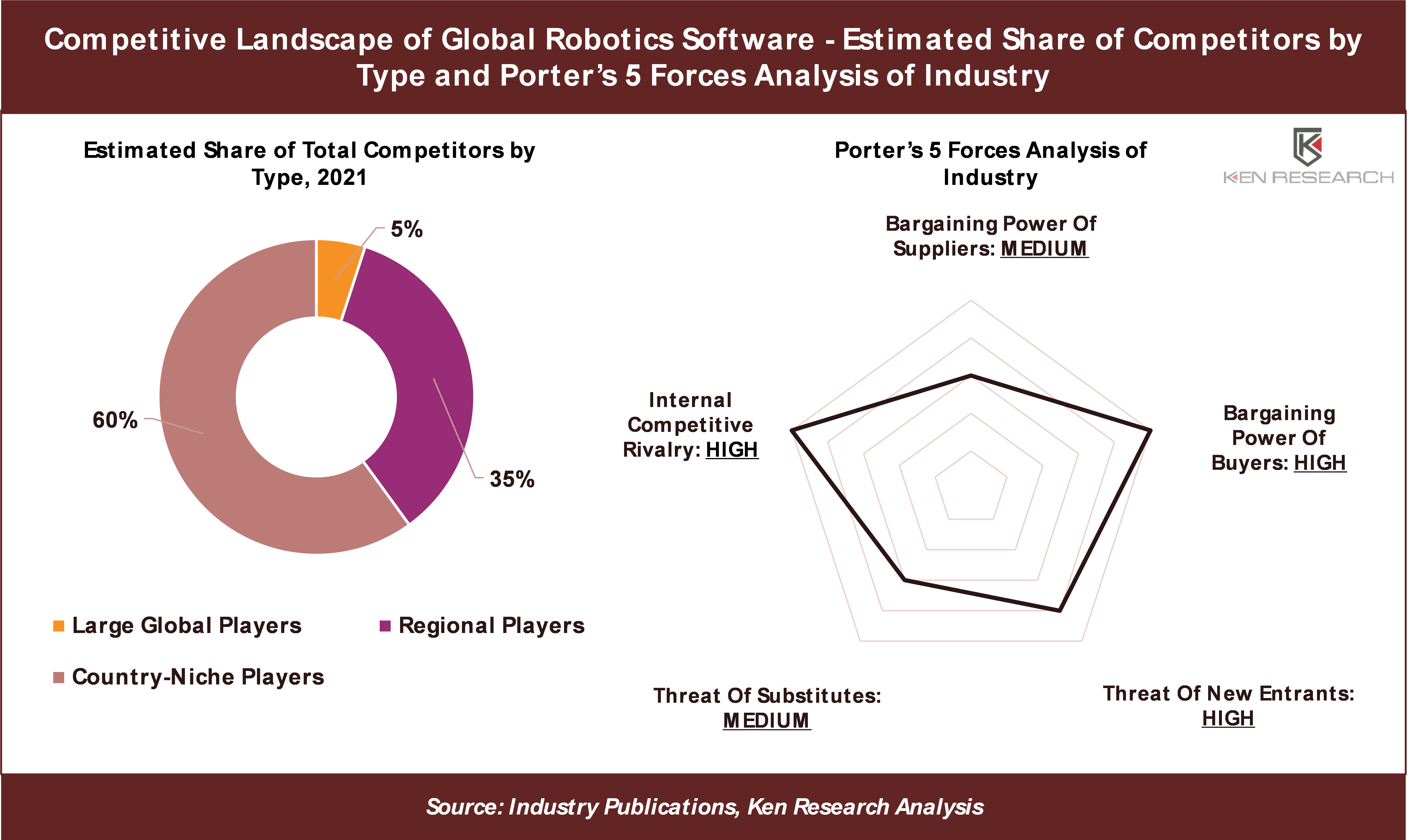
The Global Robotics Software Market is highly competitive with ~500 players which include globally diversified players, regional players as well as a large number of country-niche players.
Approximately, the large global players constitute 5%, the regional players 35%, and country-niche players 60% of the market by type of companies operating in the market. Some of the major players in the market include ABB Ltd., Clearpath Robotics, NVIDIA Corporation, CloudMinds Technology, Inc., Liquid Robotics, Inc., Brain Corporation, AIBrain, Inc., Furhat Corporation, Neurala, Inc. and IBM Corporation among others.

Recent Developments Related to Major and Emerging Companies
- In December 2020, ABB launched its Wizard Easy Programming software for industrial robots which does not require any special programming skills and rapid code knowledge. With this software, a robot can be made up and running within a few minutes and it allows error handling such as collisions which can be even managed by an amateur programmer.
- In March 2022, Nvidia Corp. launched the Nvidia Jetson AGX Orin developer kit. This is an artificial intelligence supercomputer that is compact, energy-efficient, and targeted towards power autonomous machines and robots. These also help robots to identify, avoid and navigate through obstacles that a robot finds in their pathway.
- In November 2022, Brain Corp launched the next generation BrainOS® autonomy platform for autonomous commercial robots. The company has partnered with Flex to deploy its new robotic solutions with an initial focus on retail sector and later rolling out the same to the other commercial sectors.
Conclusion
The Global Robotics Software Market is forecasted to continue a strong growth that is witnessed during the forecast period. Key trends driving market expansion include demand from end-user industries, growing installation of industrial robots for manufacturing set-ups, adoption of emerging technologies such as the Industrial Internet of Things (IIoT), and growing investments by countries as well as start-ups. The market is highly competitive with ~500 participants concentrating on expansion strategies through product innovations as well as acquisitions and mergers.
Note: This is an On-Demand/Planned report, so the figures quoted here for a market size estimate, forecast, growth, segment share, and competitive landscape are based on initial findings and might vary slightly in the actual report. Also, any required customizations can be covered to the best feasible extent for Pre-booking clients, and the report delivered within a maximum of two working weeks.
Key Topics Covered in the Report
- Snapshot of the Global Robotics Software Market
- Industry Value Chain and Ecosystem Analysis
- Market size and Segmentation of the Global Robotics Software Market
- Historic Growth of the Overall Global Robotics Software Market and Segments
- Competition Scenario of the Market and Key Developments of Competitors
- Porter’s 5 Forces Analysis of the Global Robotics Software Market
- Overview, Product Offerings, and SWOT Analysis of Key Competitors
- COVID-19 Impact on the Overall Global Robotics Software Market
- Future Market Forecast and Growth Rates of the Total Global Robotics Software Market and by Segments
- Market Size of Fiber Type / End User Segments with Historical CAGR and Future Forecasts
- Analysis of the Robotics Software Market in Major Regions
- Major Production / Consumption Hubs in the Major Regions
- Major Country-wise Historic and Future Market Growth Rates of the Total Market and Segments
- Overview of Notable Emerging Competitor Companies within Each Major Region
Major Players Mentioned in the report
- ABB Ltd.
- Clearpath Robotics
- NVIDIA Corporation
- CloudMinds Technology, Inc.
- Liquid Robotics, Inc.
- Brain Corporation
- AIBrain, Inc.
- Furhat Corporation
- Neurala, Inc.
- IBM Corporation
Notable Emerging Companies Mentioned in the Report
- Realtime Robotics, Inc.
- HAL Robotics
- Vyorius
- Quale Infotech
- Anscer Robotics
Key Target Audience – Organizations and Entities Who Can Benefit by Subscribing This Report
- Robot Manufacturers
- Robotics Software Developers
- Software and Application Developers for Robotics Industry
- Third-party Service and Maintenance Providers
- Investors and Venture Capitalists in the Robot and Robotic Software Industry
- Market Research & Consulting Firms
- Start-ups & Incumbents in Robotics Industry
- Company Research and Development Institutes
- Government & Regulatory Authorities
- Commercial and Industrial Robots Manufacturers
- Commercial and Industrial Robots Product Assemblers
- Commercial and Industrial Robots Component suppliers
- Raw Material Suppliers for Commercial and Industrial Robots
- Potential Investors in Commercial and Industrial Robots Companies
- Value Added Resellers of Robots
- Industrial OEMs of Commercial and Industrial Robots
- Industrial Automation Solutions Providers
- Robotics Industry Associations
- Robotics Research Groups
- Government Ministries of Electronics
- Government Ministries of Heavy Industries
- Regulatory Organizations for Robots
Time Period Captured in the Report
- Historical Period: 2017-2021
- Forecast Period: 2022E-2028F
Frequently Asked Questions
- What is the Study Period of this Market Report?
The Global Robotics Software Market is covered from 2017-2028 in this report, which includes a forecast for the period 2022E-2028F.
- What is the Future Growth Rate of the Global Robotics Software Market?
The Global Robotics Software Market is expected to witness a CAGR of about 15% over the next six years.
- What are the Key Factors Driving the Global Robotics Software Market?
The rise in demand from end-user industries, growing installation of industrial robots for manufacturing set-ups, adoption of emerging technologies such as the Industrial Internet of Things (IIoT), and growing investments by countries as well as start-ups are expected to be the key drivers of the market’s growth.
- Which is the Largest Software Type Segment within the Global Robotics Software Market?
The Recognition Software segment held the largest share of the Global Robotics Software Market in 2021.
- Who are the Key Players in Global Robotics Software Market?
ABB Ltd., Clearpath Robotics, NVIDIA Corporation, CloudMinds Technology, Inc., Liquid Robotics, Inc., Brain Corporation, AIBrain, Inc., Furhat Corporation, Neurala, Inc., IBM Corporation, among others are the major companies operating in the Global Robotics Software Market.
Products
Companies
Major Players Mentioned in the report
ABB Ltd.
Clearpath Robotics
NVIDIA Corporation
CloudMinds Technology, Inc.
Liquid Robotics, Inc.
Brain Corporation
AIBrain, Inc.
Furhat Corporation
Neurala, Inc.
IBM Corporation
Notable Emerging Companies Mentioned in the Report
Realtime Robotics, Inc.
HAL Robotics
Vyorius
Quale Infotech
Anscer Robotics
Table of Contents
- 1. Executive Summary
1.1 Highlights of Global Robotics Software Market Historic Growth & Forecast
1.2 Highlights of Market Trends, Challenges, and Competition
1.3 Highlights of Market Revenue Share by Segments
- 2. Market Overview and Key Trends Impacting Growth
2.1 Global Robotics Software Market Taxonomy
2.2 Industry Value Chain
2.3 The Ecosystem of Major Entities in the Global Robotics Software Market
2.4 Government Regulations & Developments
2.5 Key Growth Drivers & Challenges Impacting the Market
2.6 COVID-19 Impact on the Global Robotics Software Market
2.7 Total Global Robotics Software Market Historic Growth by Segment Type, 2017-2021
2.7.1 By Software Type
2.7.2 By Robot Type
2.7.3 By Deployment Mode
2.7.4 By Enterprise Size
2.7.5 By End User
2.7.6 By Regions
2.8 Total Global Robotics Software Market Historic Growth and Forecast, 2017-2028
2.9 Key Takeaways
- 3. Global - Market Segmentation by Product, Historic Growth, Outlook & Forecasts
3.1 Market Definition - Segmentation by Software Type
3.2 Market Revenue Share, Historic Growth, Outlook, and Forecasts by Software Type, 2017-2028
3.2.1 Recognition Software
3.2.2 Simulation Software
3.2.3 Predictive Maintenance Software
3.2.4 Data Management & Analysis Software
3.2.5 Communication Management Software
3.3 Key Takeaways from Market Segmentation by Software Type
- 4. Global - Market Segmentation by Robot Type, Historic Growth, Outlook & Forecasts
4.1 Market Definition - Segmentation by Robot Type
4.2 Market Revenue Share, Historic Growth, Outlook, and Forecasts by Robot Type, 2017-2028
4.2.1 Industrial Robots
4.2.2 Service Robots
4.3 Key Takeaways from Market Segmentation by Robot Type
- 5. Global - Market Segmentation by Deployment Mode, Historic Growth, Outlook & Forecasts
5.1 Market Definition - Segmentation by Deployment Mode
5.2 Market Revenue Share, Historic Growth, Outlook, and Forecasts by Deployment Mode, 2017-2028
5.2.1 On-Premise
5.2.2 On-Demand
5.3 Key Takeaways from Market Segmentation by Deployment Mode
- 6. Global - Market Segmentation by Enterprise Size, Historic Growth, Outlook & Forecasts
6.1 Market Definition - Segmentation by Enterprise Size
6.2 Market Revenue Share, Historic Growth, Outlook, and Forecasts by Enterprise Size, 2017-2028
6.2.1 Small & Medium Enterprises
6.2.2 Large Enterprises
6.3 Key Takeaways from Market Segmentation by Enterprise Size
- 7. Global - Market Segmentation by End User, Historic Growth, Outlook & Forecasts
7.1 Market Definition - Segmentation by End User
7.2 Market Revenue Share, Historic Growth, Outlook, and Forecasts by End User, 2017-2028
7.2.1 Automotive
7.2.2 Retail and E-commerce
7.2.3 Government and Defense
7.2.4 Healthcare
7.2.5 Transportation and Logistics
7.2.6 Manufacturing
7.2.7 IT and Telecommunications
7.2.8 Others
7.3 Key Takeaways from Market Segmentation by End User
- 8. Industry / Competition Analysis - Competitive Landscape
8.1 Products of Players (Competitors) & Share of Competition
8.2 Porter’s 5 Forces Analysis of Global Robotics Software Competitors
8.3 Key Developments in the Global Robotics Software Sector Impacting Market Growth
8.4 Comparison of Leading Competitors within the Global Robotics Software Market, 2021
8.5 Comparison of Leading Competitors within the Global Robotics Software Market by Coverage of Software Type, 2021
8.6 Comparison of Leading Competitors within the Global Robotics Software Market by Coverage of Robot Type, 2021
8.7 Comparison of Leading Competitors within the Global Robotics Software Market by Coverage of Deployment Mode, 2021
8.8 Comparison of Leading Competitors within the Global Robotics Software Market by Coverage of Enterprise Size, 2021
8.9 Comparison of Leading Competitors within the Global Robotics Software Market by Coverage of End User, 2021
8.10 Comparison of Leading Competitors within the Global Robotics Software Market by Coverage of Regions, 2021
8.11 Key Takeaways from Competitive Landscape
- 9. Key Competitor Profiles (Company Overview, Product Offerings, SWOT Analysis)
9.1 ABB Ltd.
9.2 Clearpath Robotics
9.3 NVIDIA Corporation
9.4 CloudMinds Technology, Inc.
9.5 Liquid Robotics, Inc.
9.6 Brain Corporation
9.7 AIBrain, Inc.
9.8 Furhat Corporation
9.9 Neurala, Inc.
9.10 IBM Corporation
- 10. Geographic Analysis & Major Regions Market Historic Growth, Outlook, and Forecasts
10.1 Major Region Comparison of Macroeconomic Factors
10.2 Total Global - Market Revenue Share, Historic Growth, Outlook and Forecasts by Geography, 2017-2028
10.3 Major Region Market Analysis, Historic Growth, Outlook & Forecasts, 2017-2028
10.4 North America – Robotics Software Market Analysis
10.4.1 Major Production and Consumption Hubs in North America
10.4.2 Notable Emerging Robotics Software Companies in North America
10.4.3 Market Revenue Share, Historic Growth, Outlook, and Forecasts by Software Type, 2017-2028
10.4.4 Market Revenue Share, Historic Growth, Outlook, and Forecasts by Robot Type, 2017-2028
10.4.5 Market Revenue Share, Historic Growth, Outlook, and Forecasts by Deployment Mode, 2017-2028
10.4.6 Market Revenue Share, Historic Growth, Outlook, and Forecasts by Enterprise Size, 2017-2028
10.4.7 Market Revenue Share, Historic Growth, Outlook, and Forecasts by End User, 2017-2028
10.4.8 Market Revenue Share, Historic Growth, Outlook, and Forecasts by Major Countries, 2017-2028
10.4.8.1 USA
10.4.8.2 Canada
10.4.8.3 Mexico
10.5 Europe – Robotics Software Market Analysis
10.5.1 Major Production and Consumption Hubs in Europe
10.5.2 Notable Emerging Robotics Software Companies in Europe
10.5.3 Market Revenue Share, Historic Growth, Outlook, and Forecasts by Software Type, 2017-2028
10.5.4 Market Revenue Share, Historic Growth, Outlook, and Forecasts by Robot Type, 2017-2028
10.5.5 Market Revenue Share, Historic Growth, Outlook, and Forecasts by Deployment Mode, 2017-2028
10.5.6 Market Revenue Share, Historic Growth, Outlook, and Forecasts by Enterprise Size, 2017-2028
10.5.7 Market Revenue Share, Historic Growth, Outlook, and Forecasts by End User, 2017-2028
10.5.8 Market Revenue Share, Historic Growth, Outlook, and Forecasts by Major Countries, 2017-2028
10.5.8.1 Germany
10.5.8.2 UK
10.5.8.3 France
10.5.8.4 Spain
10.5.8.5 Italy
10.5.8.6 Rest of Europe
10.6 Asia-Pacific – Robotics Software Market Analysis
10.6.1 Major Production and Consumption Hubs in Asia-Pacific
10.6.2 Notable Emerging Robotics Software Companies in Asia-Pacific
10.6.3 Market Revenue Share, Historic Growth, Outlook, and Forecasts by Software Type, 2017-2028
10.6.4 Market Revenue Share, Historic Growth, Outlook, and Forecasts by Robot Type, 2017-2028
10.6.5 Market Revenue Share, Historic Growth, Outlook, and Forecasts by Deployment Mode, 2017-2028
10.6.6 Market Revenue Share, Historic Growth, Outlook, and Forecasts by Enterprise Size, 2017-2028
10.6.7 Market Revenue Share, Historic Growth, Outlook, and Forecasts by End User, 2017-2028
10.6.8 Market Revenue Share, Historic Growth, Outlook, and Forecasts by Major Countries, 2017-2028
10.6.8.1 China
10.6.8.2 Japan
10.6.8.3 South Korea
10.6.8.4 India
10.6.8.5 Singapore
10.6.8.6 Thailand
10.6.8.7 Rest of Asia Pacific
10.7 LAMEA – Robotics Software Market Analysis
10.7.1 Major Production and Consumption Hubs in LAMEA
10.7.2 Notable Emerging Robotics Software Companies in LAMEA
10.7.3 Market Revenue Share, Historic Growth, Outlook, and Forecasts by Software Type, 2017-2028
10.7.4 Market Revenue Share, Historic Growth, Outlook, and Forecasts by Robot Type, 2017-2028
10.7.5 Market Revenue Share, Historic Growth, Outlook, and Forecasts by Deployment Mode, 2017-2028
10.7.6 Market Revenue Share, Historic Growth, Outlook, and Forecasts by Enterprise Size, 2017-2028
10.7.7 Market Revenue Share, Historic Growth, Outlook, and Forecasts by End User, 2017-2028
10.7.8 Market Revenue Share, Historic Growth, Outlook, and Forecasts by Major Sub-Regions, 2017-2028
10.7.8.1 Latin America
10.7.8.2 Middle East
10.7.8.3 Africa
- 11. Industry Expert’s Opinions/Perspectives
11.1 Notable Statements/Quotes from Industry Experts and C-Level Executives on Current Status and Future Outlook of the Market
- 12. Analyst Recommendation
12.1 Analyst Recommendations on Identified Major Opportunities and Potential Strategies to Gain from Opportunities
- 13. Appendix
13.1 Research Methodology - Market Size Estimation, Forecast, and Sanity Check Approach
13.2 Sample Discussion Guide
Disclaimer
Why Buy From Us?

What makes us stand out is that our consultants follows Robust, Refine and Result (RRR) methodology. i.e. Robust for clear definitions, approaches and sanity checking, Refine for differentiating respondents facts and opinions and Result for presenting data with story

We have set a benchmark in the industry by offering our clients with syndicated and customized market research reports featuring coverage of entire market as well as meticulous research and analyst insights.

While we don't replace traditional research, we flip the method upside down. Our dual approach of Top Bottom & Bottom Top ensures quality deliverable by not just verifying company fundamentals but also looking at the sector and macroeconomic factors.

With one step in the future, our research team constantly tries to show you the bigger picture. We help with some of the tough questions you may encounter along the way: How is the industry positioned? Best marketing channel? KPI's of competitors? By aligning every element, we help maximize success.

Our report gives you instant access to the answers and sources that other companies might choose to hide. We elaborate each steps of research methodology we have used and showcase you the sample size to earn your trust.

If you need any support, we are here! We pride ourselves on universe strength, data quality, and quick, friendly, and professional service.