















India Automated Material Handling Market
Region:Asia
Author(s):Paribhasha Tiwari
Product Code:KROD2900
October 2024
85
About the Report
India Automated Material Handling Market Overview
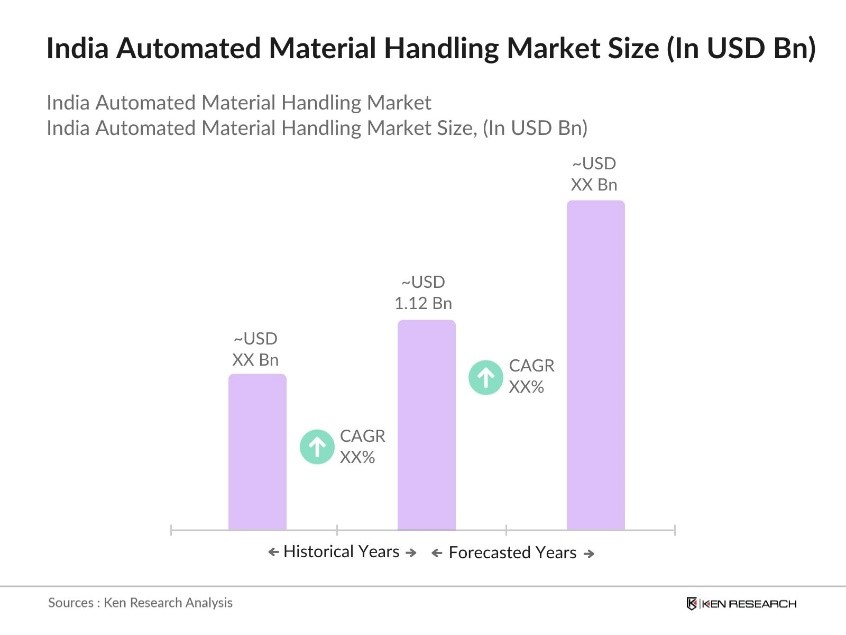
- The Indian automated material handling (AMH) market is valued at USD 1.12 billion in 2023. The growth of this market is primarily driven by increasing demand for automation in sectors such as manufacturing, warehousing, and logistics. The market has experienced a rapid growth, mainly due to the increasing emphasis on improving efficiency and reducing labor costs. The rapid adoption of technologies such as robotics and artificial intelligence in logistics is a key contributor to this market's expansion.
- Major players dominating the market include Daifuku India Pvt. Ltd., Schaefer Systems International Pvt. Ltd., Honeywell Automation India Ltd., Murata Machinery India Pvt. Ltd., and KION India Pvt. Ltd. These companies have invested in research and development and set up manufacturing bases within India to meet the growing demand for automated systems. Daifuku India, with its robust portfolio of AMH solutions, leads the market by providing solutions across manufacturing and logistics industries.
- In 2024, Daifuku India formed a strategic partnership with a top logistics company to implement its advanced automated storage and retrieval systems (AS/RS) in key warehousing hubs. This collaboration strengthens Daifuku's position as a market leader in India's automated material handling sector.
- Cities such as Mumbai, Bengaluru, and Chennai dominate the market due to their established industrial and logistics sectors. Mumbai, with its large port and extensive warehousing infrastructure, is a hub for automated solutions in both the logistics and manufacturing sectors. Bengaluru, with its growing tech ecosystem, has become a focal point for the integration of AI-driven automation in handling systems, while Chennai’s automobile and manufacturing industries drive significant demand for material handling automation.
India Automated Material Handling Market Segmentation
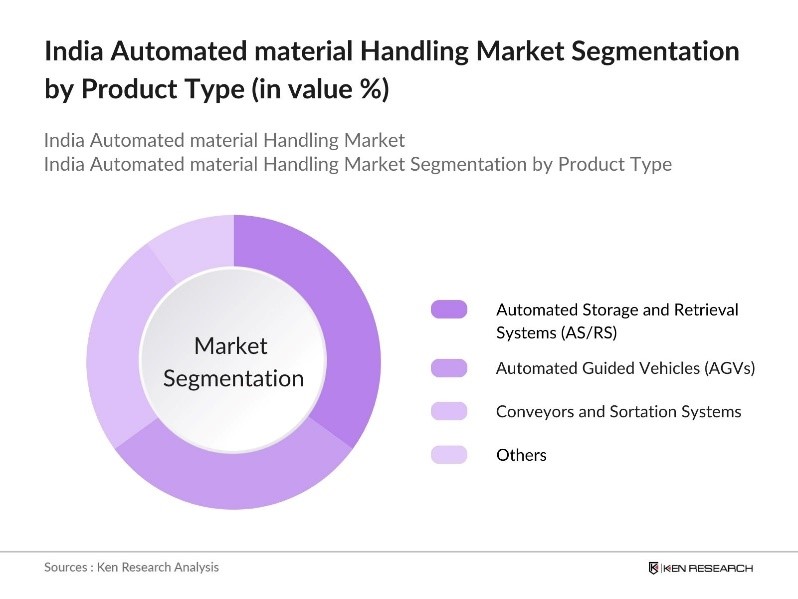
By Product Type: India's automated material handling market is segmented by product type into automated storage and retrieval systems (AS/RS), automated guided vehicles (AGVs), and conveyors and sortation systems. In 2023, AS/RS systems dominate the market, accounting for 35% of the market share. This is due to their widespread adoption in industries such as warehousing, pharmaceuticals, and retail. The flexibility, high throughput, and improved space utilization offered by these systems make them a popular choice for Indian companies looking to optimize their storage operations.
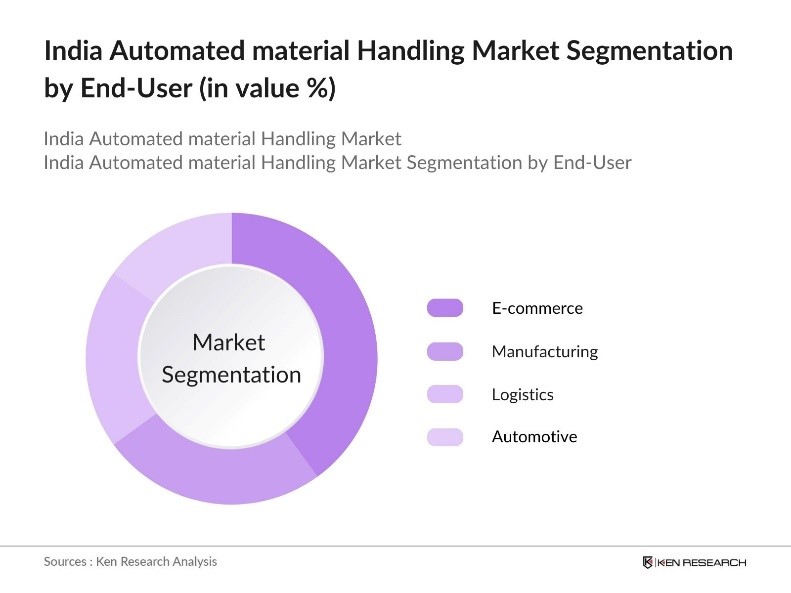
By End-User Industry: The market is segmented by end-user industries into manufacturing, e-commerce, logistics, and automotive. In 2023, the e-commerce industry dominated the market. The rapid growth of e-commerce giants such as Amazon and Flipkart, coupled with the increasing consumer demand for faster delivery times, has led to extensive deployment of automation systems in fulfillment centers. Additionally, the integration of robotics and AI technologies to handle high-volume operations efficiently has contributed to the dominance of this segment.
By Region: The market is segmented by region into North, South, East, and West. The southern region dominates in 2023. This is largely due to the presence of major manufacturing hubs and technology companies. These cities are home to many large-scale manufacturing and warehousing operations, driving demand for automated handling systems. Furthermore, the increasing focus on infrastructure development in the southern states has contributed to the region’s dominance.
India Automated Material Handling Market Competitive Landscape
|
Company Name |
Year of Establishment |
Headquarters |
|
Daifuku India Pvt. Ltd. |
1937 |
Osaka, Japan |
|
Schaefer Systems International |
1937 |
Neunkirchen, Germany |
|
Honeywell Automation India Ltd. |
1984 |
Pune, India |
|
Murata Machinery India Pvt. Ltd. |
1935 |
Kyoto, Japan |
|
KION India Pvt. Ltd. |
2012 |
Pune, India |
- Schaefer Systems International: SSI Schaefer India collaborated with Amul Dairy to optimize its cheese storage facility using a high-density single-level shuttle automated storage and retrieval system (ASRS). This solution addresses Amul’s need for efficient storage of over 6,000 pallet locations, combining mobile racking and high-density ASRS. This project highlights SSI Schaefer’s ability to deliver customized automated material handling solutions tailored to specific client needs in the Indian market.
- Honeywell Automation India Ltd.: In March 2023, Honeywell expanded its automation capabilities by introducing the Honeywell Universal Robotics Controller (HURC), designed to address interoperability gaps between various robotics systems in warehouses. This solution enhances data exchange and communication between systems, improving efficiency and laying the foundation for future "dark warehouses" with minimal human intervention. Honeywell's new technologies, including AI-driven Automated Storage and Retrieval Systems (AS/RS), significantly boost warehouse efficiency and productivity.
India Automated Material Handling Market Analysis
Growth Drivers
- Rising Demand in E-commerce Sector: The increasing demand from the e-commerce and retail sectors, which require faster and more efficient order fulfillment, is driving the market. Automation technologies like automated storage and retrieval systems (AS/RS) and robotic systems are being adopted to streamline operations, improve accuracy, and reduce labor costs. This demand is further propelled by the rise of same-day and next-day delivery services.
- Government's National Logistics Policy: The Indian automated material handling market is expanding due to the National Logistics Policy, which aims to reduce logistics costs and improve efficiency by promoting the adoption of advanced technologies like automation and robotics in warehousing. This policy encourages investments in infrastructure and automation to streamline supply chains, driving the demand for automated systems in various sectors, including e-commerce and manufacturing.
- Manufacturing Sector Automation: India’s manufacturing sector, which contributed USD 450 billion to the GDP in 2023, is increasingly automating its operations to remain competitive globally. Automation of material handling processes, particularly in industries such as automotive, pharmaceuticals, and electronics, has been essential in reducing labor costs and increasing production efficiency. The government’s Make in India initiative has encouraged domestic and international companies to invest in smart manufacturing, which has fueled the demand for material handling automation.
Challenges
- High Initial Investment Costs: Automated material handling systems require a significant upfront investment, which poses a challenge, especially for small and medium-sized enterprises (SMEs). The cost of integrating automated storage and retrieval systems (AS/RS) and automated guided vehicles (AGVs) into existing operations can range from INR 20 million to INR 50 million, depending on the scale of the business. This high capital expenditure prevents smaller companies from adopting automation on a large scale.
- Skill Shortage in Managing Automation: India faces a shortage of skilled labor capable of managing and maintaining automated systems. According to a 2023 survey by the Ministry of Skill Development and Entrepreneurship, some companies reported difficulties in finding qualified personnel to operate advanced material handling systems. This gap in technical expertise can slow the adoption of automation, especially in sectors like logistics and manufacturing where efficiency depends heavily on proper system management.
Government Initiatives
- National Logistics Policy (2022): India's National Logistics Policy, launched in 2022, aims to reduce logistics costs, improve efficiency, and streamline supply chains through the adoption of automation and advanced technology. The policy promotes infrastructure upgrades and supports investments in robotics, artificial intelligence, and warehouse automation to drive operational efficiency across industries.
- Make in India Campaign: The Make in India program is the provision of incentives to promote local production and automation. These include fiscal incentives, such as tax breaks, subsidies, and funding support, specifically aimed at companies that adopt advanced technologies like automated material handling systems. This initiative is designed to boost manufacturing efficiency and competitiveness in India, encouraging both domestic and international companies to invest in automation technologies.
India Automated Material Handling Market Future Outlook
The India Automated Material Handling Marketis projected to grow exponentially in the future. This growth will be driven by rising demand in e-commerce sector, government's national logistics policy and manufacturing sector automation.
Future Trends
- Expansion of Robotics and AI: By 2028, the Indian automated material handling market will be increasingly driven by the integration of robotics and AI-based solutions. As companies continue to adopt AI-driven warehouse management systems and robotic arms for picking, sorting, and packaging tasks, operational efficiency will increase. The continuous push for faster and more accurate order fulfillment, particularly in the e-commerce sector, will be a key driver of this trend.
- Shift Towards Green Automation: Sustainability will become a major focus for Indian companies by 2028. As part of the National Green Hydrogen Mission, the government is promoting eco-friendly automated material handling solutions that use green energy. By 2025, new material handling equipment deployed in India will be powered by renewable energy sources, helping companies reduce their carbon footprint while maintaining operational efficiency.
Scope of the Report
|
By Product Type |
Automated storage and retrieval systems (AS/RS) Automated guided vehicles (AGVS) Conveyors and sortation systems |
|
By End User |
Manufacturing E-commerce Logistics Automotive |
|
By Region |
North South East West |
Products
Key Target Audience:
- Logistics and supply chain companies
- E-commerce companies
- Manufacturing industries
- Automotive sector
- Pharmaceuticals companies
- Large retail corporations
- Technology providers (AI and robotics)
- Warehouse and storage solution providers
- Investors and venture capitalist firms
- Government and regulatory bodies (e.g., Ministry of Heavy Industries, Ministry of Commerce and Industry)
Companies
- Daifuku India Pvt. Ltd.
- Schaefer Systems International Pvt. Ltd.
- Honeywell Automation India Ltd.
- Murata Machinery India Pvt. Ltd.
- KION India Pvt. Ltd.
- Toyota Material Handling India Pvt. Ltd.
- Godrej Material Handling
- Jungheinrich India Pvt. Ltd.
- Mecalux India Pvt. Ltd.
- Dematic India Pvt. Ltd.
- BEUMER India Pvt. Ltd.
- Vanderlande India Pvt. Ltd.
- SSI Schaefer Systems India Pvt. Ltd.
- FlexLink Systems India Pvt. Ltd.
- Fives India Engineering & Projects Pvt. Ltd.
Table of Contents
1. India Automated Material Handling Market Overview
1.1. Definition and Scope
1.2. Market Taxonomy
1.3. Industry Value Chain Analysis
1.4. Market Segmentation Overview
1.5. Key Developments and Milestones
2. India Automated Material Handling Market Size
2.1. Historical Market Size Analysis (in INR billion)
2.2. Year-on-Year Growth Analysis
2.3. Market Share Analysis by Company
2.4. Market Share by Industry Vertical
2.5. Market Contribution by Segment
3. India Automated Material Handling Market Analysis
3.1. Growth Drivers
3.1.1. Rising E-commerce and Warehouse Automation
3.1.2. National Logistics Policy Impact
3.1.3. Adoption of AI and Robotics in Manufacturing
3.2. Challenges
3.2.1. High Initial Costs of Automation Systems
3.2.2. Lack of Skilled Workforce in Automation Management
3.2.3. Integration Issues with Legacy Systems
3.3. Opportunities
3.3.1. Government Support for Manufacturing Automation
3.3.2. Emerging Markets for AGVs and AS/RS Systems
3.3.3. Expansion of Smart Warehousing Solutions
3.4. Trends
3.4.1. Increased Use of AGVs in Logistics
3.4.2. AI-driven Automated Warehousing Solutions
3.4.3. Growing Focus on Sustainability and Green Logistics
3.5. Government Regulation
3.5.1. National Logistics Policy Framework
3.5.2. Incentives for Automation under Make in India
3.5.3. Compliance Requirements for AMH Solutions
3.6. SWOT Analysis
3.7. Stakeholder Ecosystem
3.8. Competition Ecosystem
4. India Automated Material Handling Market Segmentation
4.1. By Product Type (in value %)
4.1.1. Automated Storage and Retrieval Systems (AS/RS)
4.1.2. Automated Guided Vehicles (AGVs)
4.1.3. Conveyors and Sortation Systems
4.1.4. Palletizers and Depalletizers
4.1.5. Others
4.2. By End User (in value %)
4.2.1. E-commerce
4.2.2. Automotive
4.2.3. Logistics
4.2.5. Manufacturing
4.3. By Region (in value %)
4.3.1. North
4.3.2. South
4.3.3. East
4.3.4. West
5. India Automated Material Handling Market Cross Comparison
5.1. Detailed Profiles of Major Companies
5.1.1. Daifuku India Pvt. Ltd.
5.1.2. Schaefer Systems International Pvt. Ltd.
5.1.3. Honeywell Automation India Ltd.
5.1.4. KION India Pvt. Ltd.
5.1.5. Toyota Material Handling India Pvt. Ltd.
5.1.6. Godrej Material Handling
5.1.7. FlexLink Systems India Pvt. Ltd.
5.1.8. BEUMER India Pvt. Ltd.
5.1.9. Vanderlande India Pvt. Ltd.
5.1.10. Dematic India Pvt. Ltd.
5.1.11. SSI Schaefer Systems India Pvt. Ltd.
5.1.12. Murata Machinery India Pvt. Ltd.
5.1.13. Jungheinrich India Pvt. Ltd.
5.1.14. Mecalux India Pvt. Ltd.
5.1.15. Fives India Engineering & Projects Pvt. Ltd.
5.2. Cross Comparison Parameters (Establishment Year, Headquarters, Revenue, No. of Employees)
5.3. Market Share Analysis by Major Companies
5.4. Strategic Initiatives (Investments, Partnerships, Expansions)
6. India Automated Material Handling Market Competitive Landscape
6.1. Company Market Share Analysis
6.2. Key Competitor Strategies
6.3. Mergers and Acquisitions
6.4. Investment and Funding Analysis
6.4.1. Government Funding and Incentives
6.4.2. Private Equity and Venture Capital Investments
6.4.3. Technology Integration Investments
6.5. Technological Advancements by Key Players
7. India Automated Material Handling Market Regulatory Framework
7.1. Industry Compliance Standards
7.2. Safety and Environmental Regulations
7.3. Certification and Approval Processes
7.4. Government Incentives for Automation
8. India Automated Material Handling Future Market Outlook
8.1. Future Market Size Projections
8.2. Factors Driving Future Market Growth
8.3. Future Investment Opportunities
8.4. Strategic Recommendations for Market Players
9. India Automated Material Handling Future Market Segmentation
9.1. By Product Type (in value %)
9.2. By Industry Vertical (in value %)
9.3. By Region (in value %)
9.4. By Technology (in value %)
9.5. By Function (in value %)
10. India Automated Material Handling Market Analysts’ Recommendations
10.1. TAM/SAM/SOM Analysis
10.2. Market Entry Strategies
10.3. Customer Segmentation and Targeting
10.4. White Space Opportunity Analysis
Disclaimer
Contact Us
Research Methodology
Step: 1 Identifying Key Variables:
Ecosystem creation for all the major entities and referring to multiple secondary and proprietary databases to perform desk research around market to collate industry level information.????
Step: 2 Market Building:
Collating statistics on India Automated Material Handling Market over the years, penetration of marketplaces and service providers ratio to compute revenue generated for India Automated Material Handling Industry. We will also review service quality statistics to understand revenue generated which can ensure accuracy behind the data points shared.????
Step: 3 Validating and Finalizing:
Building market hypothesis and conducting CATIs with industry experts belonging to different companies to validate statistics and seek operational and financial information from company representatives.????
Step: 4 Research Output:
Our team will approach multiple automation companies and understand nature of product segments and sales, consumer preference and other parameters, which will support us validate statistics derived through bottom to top approach from automation companies.????
Frequently Asked Questions
1. How big is the India Automated Material Handling Market?
The India automated material handling market was valued at USD 1.12 billion in 2023, driven by increased demand for automation in sectors such as manufacturing, logistics, and e-commerce.
2. What are the challenges in the India Automated Material Handling Market?
Challenges in the India Automated Material Handling Market include high initial investment costs, a shortage of skilled labor to manage automated systems, and integration difficulties with existing infrastructure in traditional industries.
3. Who are the major players in the India Automated Material Handling Market?
Key players in the India Automated Material Handling Market include Daifuku India, Honeywell Automation India, Schaefer Systems International, KION India, and Toyota Material Handling. These companies lead due to their extensive portfolios and strong client bases.
4. What are the growth drivers of the India Automated Material Handling Market?
The India Automated Material Handling Market is driven by factors such as the rapid growth of the e-commerce industry, the Indian government’s National Logistics Policy, and the increasing adoption of automation in the manufacturing sector.
Why Buy From Us?

What makes us stand out is that our consultants follows Robust, Refine and Result (RRR) methodology. i.e. Robust for clear definitions, approaches and sanity checking, Refine for differentiating respondents facts and opinions and Result for presenting data with story

We have set a benchmark in the industry by offering our clients with syndicated and customized market research reports featuring coverage of entire market as well as meticulous research and analyst insights.

While we don't replace traditional research, we flip the method upside down. Our dual approach of Top Bottom & Bottom Top ensures quality deliverable by not just verifying company fundamentals but also looking at the sector and macroeconomic factors.

With one step in the future, our research team constantly tries to show you the bigger picture. We help with some of the tough questions you may encounter along the way: How is the industry positioned? Best marketing channel? KPI's of competitors? By aligning every element, we help maximize success.

Our report gives you instant access to the answers and sources that other companies might choose to hide. We elaborate each steps of research methodology we have used and showcase you the sample size to earn your trust.

If you need any support, we are here! We pride ourselves on universe strength, data quality, and quick, friendly, and professional service.