















India Luxury Car Market Outlook to 2030
Region:Asia
Author(s):Naman Rohilla
Product Code:KROD7249
December 2024
91
About the Report
India Luxury Car Market Overview
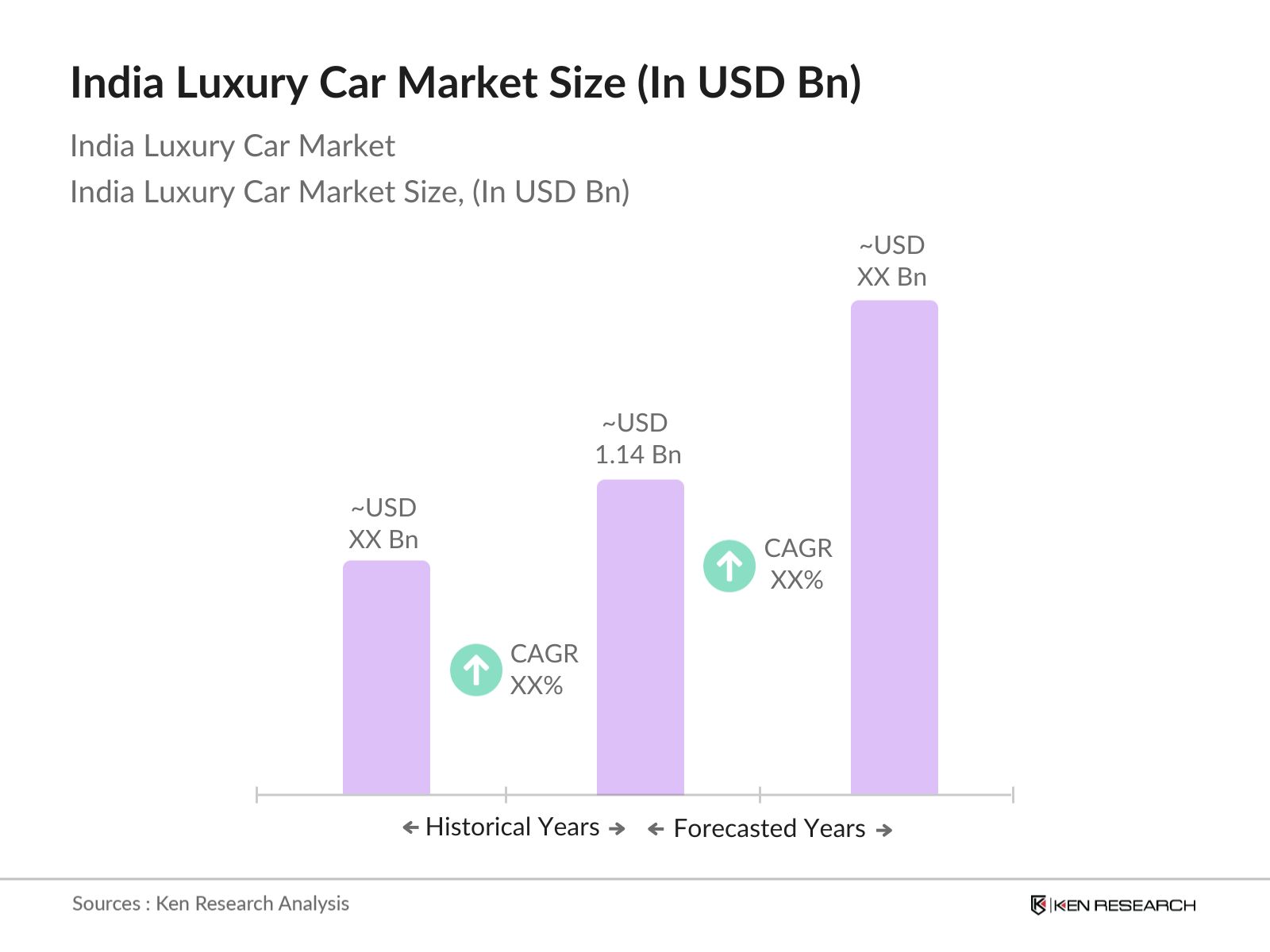
- The India luxury car market is valued at USD 1.14 billion, supported by a growing consumer base and rising disposable income across urban centers. A historical analysis over five years reveals that the market is driven by a shift in consumer preferences towards premium vehicles that offer advanced features, superior performance, and status appeal. The growth of finance schemes and increased accessibility to luxury cars have further contributed to the market's expansion, supported by robust demand in metro cities and tier-1 regions.
- Key metropolitan cities like Delhi, Mumbai, and Bangalore dominate the luxury car market due to their higher concentration of high-net-worth individuals (HNIs), urbanization, and a developed automotive infrastructure. These regions have a growing demand for premium vehicles as consumers seek exclusivity and brand prestige. Furthermore, the rising presence of global luxury car manufacturers in these cities, combined with higher economic growth, drives market dominance.
- Luxury car buyers in India increasingly demand personalized features. A report by the Society of Indian Automobile Manufacturers (SIAM) states that up to 40% of luxury car buyers in 2023 opted for custom interiors and bespoke vehicle configurations. This trend towards personalization allows manufacturers to offer unique, high-margin services, enhancing customer satisfaction and brand loyalty.
India Luxury Car Market Segmentation
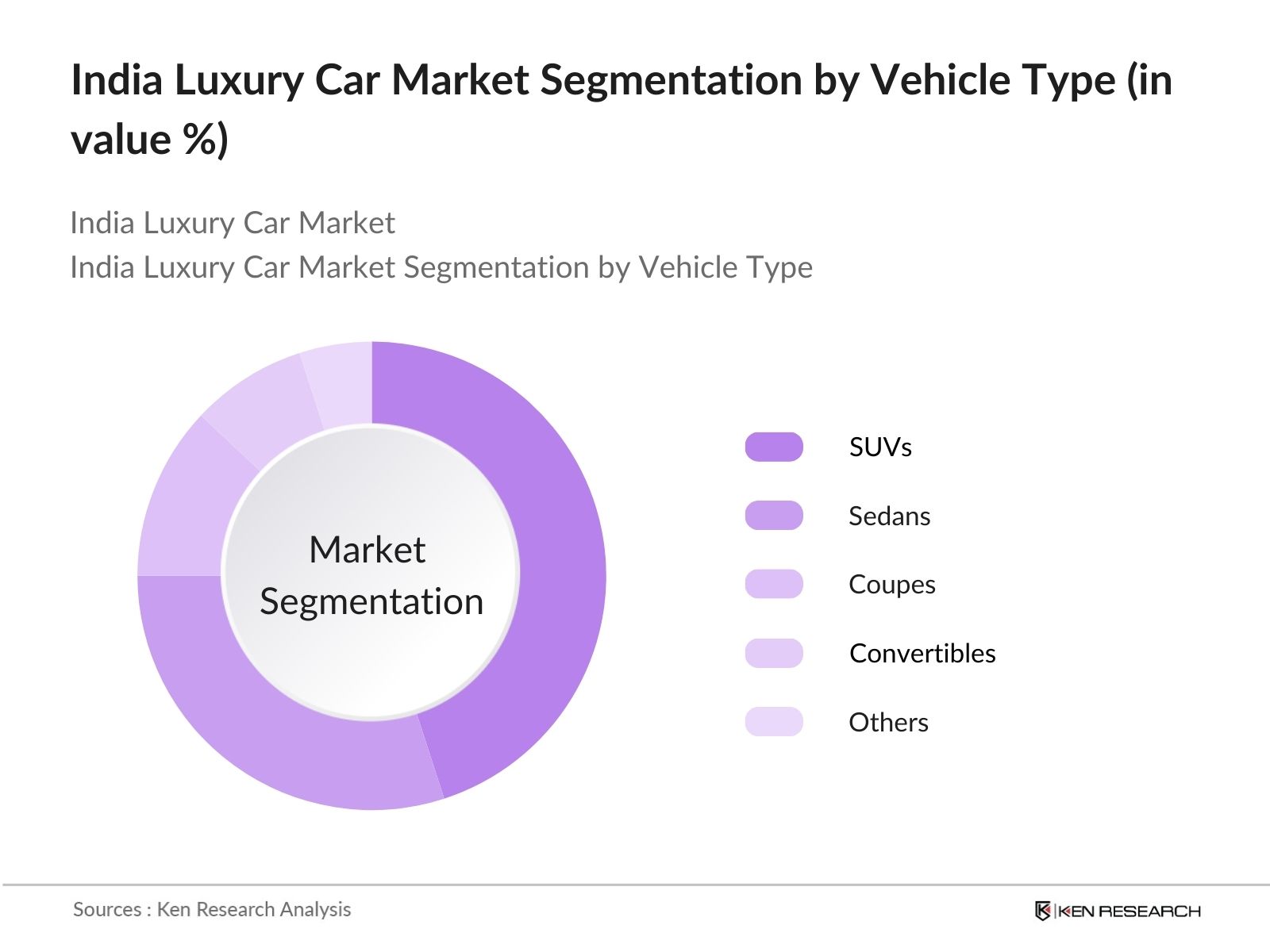
- By Vehicle Type: The India luxury car market is segmented by vehicle type into SUVs, sedans, coupes, convertibles, and others. Recently, SUVs have dominated the market under the vehicle type segmentation due to their ruggedness, comfort, and spacious interiors, which are preferred by Indian consumers. The higher seating position and superior road presence of luxury SUVs have garnered strong demand, especially in urban regions where roads can be challenging for low-ground clearance vehicles like sedans.
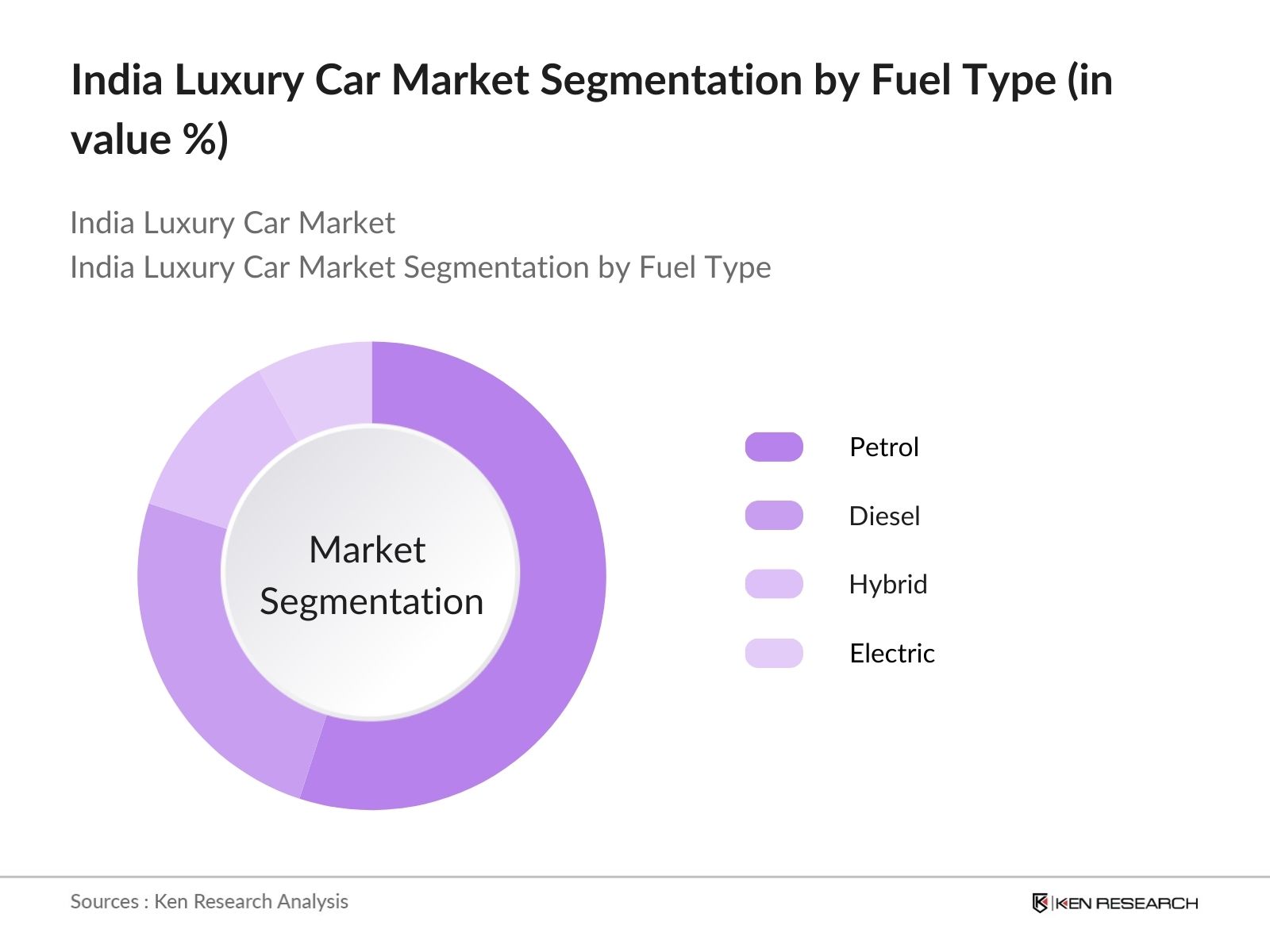
- By Fuel Type: The market is also segmented by fuel type into petrol, diesel, hybrid, and electric vehicles. Petrol luxury cars continue to lead the market due to their smooth performance, low maintenance costs, and wider availability of fuel infrastructure across India. However, hybrid and electric luxury vehicles are gaining traction as consumers become more environmentally conscious and seek lower emissions without compromising on luxury features.
India Luxury Car Market Competitive Landscape
The India luxury car market is dominated by a few key players, both global and domestic. Brands like Mercedes-Benz, BMW, and Audi lead the market with their extensive distribution networks, strong brand equity, and a wide range of offerings across various segments. These companies invest heavily in marketing and after-sales services to maintain their competitive edge. The competitive landscape also includes newer entrants like Tesla, who are pushing electric vehicle sales in the luxury segment, marking a shift in consumer preferences towards sustainable luxury.
|
Company |
Year Established |
Headquarters |
Revenue (USD Bn) |
No. of Dealerships |
Brand Portfolio |
Electric Model Offerings |
Market Penetration (Regions) |
Customer Base (HNIs) |
After-Sales Service Quality |
|
Mercedes-Benz |
1926 |
Germany |
- |
- |
- |
- |
- |
- |
- |
|
BMW |
1916 |
Germany |
- |
- |
- |
- |
- |
- |
- |
|
Audi |
1909 |
Germany |
- |
- |
- |
- |
- |
- |
- |
|
Jaguar Land Rover |
2008 |
UK |
- |
- |
- |
- |
- |
- |
- |
|
Tesla |
2003 |
USA |
- |
- |
- |
- |
- |
- |
- |
India Luxury Car Market Analysis
India Luxury Car Market Growth Drivers
- Rising Disposable Income: India's economy has experienced robust growth, with gross national income (GNI) per capita reaching USD 2,170 in 2022, as reported by the World Bank. The rising disposable income of the Indian population is a growth driver for luxury car purchases. As of 2024, the number of high-net-worth individuals (HNIs) in India has crossed 350,000, according to government data. With an expanding affluent middle class, more individuals are looking to invest in premium products, including luxury cars, making income growth a crucial factor.
- Increasing Demand for Premium Cars: The demand for premium cars in India has surged due to the growing aspirational mindset of the affluent population. According to the Ministry of Road Transport and Highways, luxury cars now account for over 2% of all new car registrations in urban centers like Delhi, Mumbai, and Bangalore. The demand for premium sedans and SUVs has particularly grown in tier-1 and tier-2 cities, supported by an expanding upper-middle-class population. This growing desire for status-symbol products reflects India's rising demand for premium vehicles.
- Expanding Urbanization: Urbanization in India has grown rapidly, with 35% of the population residing in urban areas in 2022, as reported by the United Nations. By 2024, this figure is expected to rise to 37%, translating into millions of potential new customers for luxury goods, including cars. Urban centers are home to more high-income individuals, and luxury car dealerships are expanding their networks in these areas. The rise in urbanization is therefore creating a larger market for premium vehicle sales.
India Luxury Car Market Challenges
- High Import Duties: India's import duties on luxury cars are some of the highest in the world, with rates of up to 100% on completely built units (CBUs), according to the Ministry of Commerce. This raises the cost of luxury cars in the country, which can act as a deterrent to potential buyers. Automakers are lobbying for a reduction in these taxes, but current policies make importing luxury vehicles a challenge.
- Lack of Adequate Infrastructure: Indias road infrastructure, while improving, remains a major challenge for the luxury car market. The World Bank notes that only 2.7 million kilometers of Indias 5.9 million kilometers of roadways are paved, which limits the optimal use of luxury vehicles, especially in rural or semi-urban areas. The ongoing development of highways and smart city projects is helping, but current limitations in infrastructure continue to hinder the luxury car market.
India Luxury Car Market Future Outlook
Over the next five years, the India luxury car market is expected to witness substantial growth driven by several factors, including increasing economic prosperity, rising consumer awareness of premium brands, and the expansion of luxury car financing options. The shift towards electric vehicles in the luxury segment is expected to gain momentum as manufacturers ramp up production and charging infrastructure continues to improve. Additionally, the demand for personalized and connected vehicle features will further drive the adoption of luxury vehicles across key cities in India.
India Luxury Car Market Opportunities
- Emerging Middle Class: India's emerging middle class presents a key growth opportunity for luxury car manufacturers. The Economic Survey of India 2023 reported that the middle class now constitutes 50% of the population, a sharp rise from previous years. As their disposable incomes rise, this demographic is increasingly opting for aspirational purchases, such as premium cars, creating a lucrative market for luxury car brands looking to expand beyond traditional wealthy buyers.
- Growth in Luxury Car Financing: The rise of vehicle financing options in India, specifically tailored for luxury cars, has made premium vehicle ownership more accessible. According to the Reserve Bank of India, auto loans have seen a 15% increase year-on-year as of 2024, and many financial institutions now offer specialized loans for luxury vehicles. Additionally, luxury car manufacturers are partnering with banks to offer zero down payment and low-interest loans, further fueling market growth.
Scope of the Report
|
Vehicle Type |
SUVs Sedans Coupes Convertibles Others |
|
Fuel Type |
Petrol Diesel Hybrid Electric |
|
Price Range |
Mid-Range Luxury High-End Luxury Ultra-Luxury |
|
Engine Capacity |
Below 3000 cc Above 3000 cc |
|
Region |
North India South India West India East India |
Products
Key Target Audience
Luxury Car Dealerships
Automotive Component Manufacturers
High-Net-Worth Individuals (HNIs)
Luxury Car Financing Companies
Banks and Financial Institutions
Government and Regulatory Bodies (Ministry of Road Transport and Highways)
Electric Vehicle Charging Infrastructure Providers
Investor and Venture Capitalist Firms
Insurance Providers for Premium Vehicles
Companies
Players Mentioned in the Report
Mercedes-Benz
BMW
Audi
Jaguar Land Rover
Tesla
Volvo
Porsche
Lexus
Ferrari
Maserati
Table of Contents
1. India Luxury Car Market Overview
1.1 Definition and Scope
1.2 Market Taxonomy
1.3 Market Growth Rate
1.4 Market Segmentation Overview
2. India Luxury Car Market Size (In USD Bn)
2.1 Historical Market Size
2.2 Year-On-Year Growth Analysis
2.3 Key Market Developments and Milestones
3. India Luxury Car Market Analysis
3.1 Growth Drivers
3.1.1 Rising Disposable Income
3.1.2 Increasing Demand for Premium Cars
3.1.3 Expanding Urbanization
3.1.4 Influence of Western Lifestyle
3.2 Market Challenges
3.2.1 High Import Duties
3.2.2 Lack of Adequate Infrastructure
3.2.3 Rising Competition from Electric Vehicles
3.2.4 Environmental Regulations (Emission Standards)
3.3 Opportunities
3.3.1 Emerging Middle Class
3.3.2 Growth in Luxury Car Financing
3.3.3 Expansion of Electric and Hybrid Luxury Vehicles
3.3.4 New Brand Entries
3.4 Trends
3.4.1 Personalization and Customization
3.4.2 Integration of Advanced Driver Assistance Systems (ADAS)
3.4.3 Introduction of Subscription-Based Ownership Models
3.4.4 Increasing Focus on Sustainability
3.5 Government Regulations
3.5.1 Luxury Goods Taxation
3.5.2 Bharat Stage Emission Norms (BS-VI)
3.5.3 Vehicle Safety Standards
3.5.4 Policies on Electric Mobility
4. India Luxury Car Market Segmentation
4.1 By Vehicle Type (In Value %)
4.1.1 SUVs
4.1.2 Sedans
4.1.3 Coupes
4.1.4 Convertibles
4.1.5 Others
4.2 By Fuel Type (In Value %)
4.2.1 Petrol
4.2.2 Diesel
4.2.3 Hybrid
4.2.4 Electric
4.3 By Price Range (In Value %)
4.3.1 Mid-Range Luxury
4.3.2 High-End Luxury
4.3.3 Ultra-Luxury
4.4 By Engine Capacity (In Value %)
4.4.1 Below 3000 cc
4.4.2 Above 3000 cc
4.5 By Region (In Value %)
4.5.1 North India
4.5.2 South India
4.5.3 West India
4.5.4 East India
5. India Luxury Car Market Competitive Analysis
5.1 Detailed Profiles of Major Companies
5.1.1 Mercedes-Benz
5.1.2 BMW
5.1.3 Audi
5.1.4 Jaguar Land Rover
5.1.5 Volvo
5.1.6 Lexus
5.1.7 Porsche
5.1.8 Ferrari
5.1.9 Maserati
5.1.10 Lamborghini
5.1.11 Rolls-Royce
5.1.12 Aston Martin
5.1.13 Bentley
5.1.14 Tesla
5.1.15 McLaren
5.2 Cross Comparison Parameters
5.2.1 Headquarters
5.2.2 Inception Year
5.2.3 Market Share
5.2.4 Revenue
5.2.5 No. of Employees
5.2.6 Geographic Reach
5.2.7 Product Portfolio
5.2.8 Customer Base
5.3 Market Share Analysis
5.4 Strategic Initiatives
5.5 Mergers and Acquisitions
5.6 Investment Analysis
5.7 Product Launches
5.8 Expansion Strategies
6. India Luxury Car Market Regulatory Framework
6.1 Vehicle Import Regulations
6.2 Emission Norms Compliance
6.3 Luxury Goods Tax Policies
6.4 Safety and Certification Standards
7. India Luxury Car Future Market Size (In USD Bn)
7.1 Future Market Size Projections
7.2 Key Factors Driving Future Market Growth
8. India Luxury Car Future Market Segmentation
8.1 By Vehicle Type (In Value %)
8.2 By Fuel Type (In Value %)
8.3 By Price Range (In Value %)
8.4 By Engine Capacity (In Value %)
8.5 By Region (In Value %)
9. India Luxury Car Market Analysts' Recommendations
9.1 TAM/SAM/SOM Analysis
9.2 Consumer Preferences Analysis
9.3 White Space Opportunity
9.4 Product Differentiation Strategies
Disclaimer Contact UsResearch Methodology
Step 1: Identification of Key Variables
The initial phase of research involves mapping out the major stakeholders within the India luxury car market. This step is based on detailed desk research, incorporating secondary data and proprietary databases. The focus is to define the variables influencing market trends and performance.
Step 2: Market Analysis and Construction
In this step, historical data on luxury car sales, brand penetration, and consumer demographics are analyzed. This includes evaluating regional demand trends, key customer segments, and the impact of external factors like economic conditions and fuel prices on market dynamics.
Step 3: Hypothesis Validation and Expert Consultation
Market hypotheses are established based on desk research and are then validated through interviews with industry experts, such as luxury car dealers and automotive finance executives. These insights help refine market data and ensure accuracy in projections.
Step 4: Research Synthesis and Final Output
The final phase includes consolidating the data gathered from primary and secondary sources, providing a comprehensive analysis of market trends, sales forecasts, consumer preferences, and competitive dynamics in the India luxury car market.
Frequently Asked Questions
01. How big is the India Luxury Car Market?
The India luxury car market is valued at USD 1.14 billion, driven by rising disposable income, urbanization, and growing demand for premium features.
02. What are the key challenges in the India Luxury Car Market?
Challenges in the India luxury car market include high import duties, limited infrastructure for electric vehicles, and stringent emission norms. The high cost of luxury cars also limits market expansion in rural areas.
03. Who are the major players in the India Luxury Car Market?
Key players in the India luxury car market include Mercedes-Benz, BMW, Audi, Jaguar Land Rover, and Tesla, each offering a diverse range of luxury vehicles tailored to Indian preferences.
04. What are the growth drivers for the India Luxury Car Market?
The India luxury car market is driven by the rising number of high-net-worth individuals, improved financing options for luxury vehicles, and increased consumer demand for exclusive features and advanced technology.
Why Buy From Us?

What makes us stand out is that our consultants follows Robust, Refine and Result (RRR) methodology. i.e. Robust for clear definitions, approaches and sanity checking, Refine for differentiating respondents facts and opinions and Result for presenting data with story

We have set a benchmark in the industry by offering our clients with syndicated and customized market research reports featuring coverage of entire market as well as meticulous research and analyst insights.

While we don't replace traditional research, we flip the method upside down. Our dual approach of Top Bottom & Bottom Top ensures quality deliverable by not just verifying company fundamentals but also looking at the sector and macroeconomic factors.

With one step in the future, our research team constantly tries to show you the bigger picture. We help with some of the tough questions you may encounter along the way: How is the industry positioned? Best marketing channel? KPI's of competitors? By aligning every element, we help maximize success.

Our report gives you instant access to the answers and sources that other companies might choose to hide. We elaborate each steps of research methodology we have used and showcase you the sample size to earn your trust.

If you need any support, we are here! We pride ourselves on universe strength, data quality, and quick, friendly, and professional service.