















Indonesia Solar Energy Market Outlook to 2030
Region:Asia
Author(s):Yogita Sahu
Product Code:KROD5443
November 2024
85
About the Report
Indonesia Solar Energy Market Overview
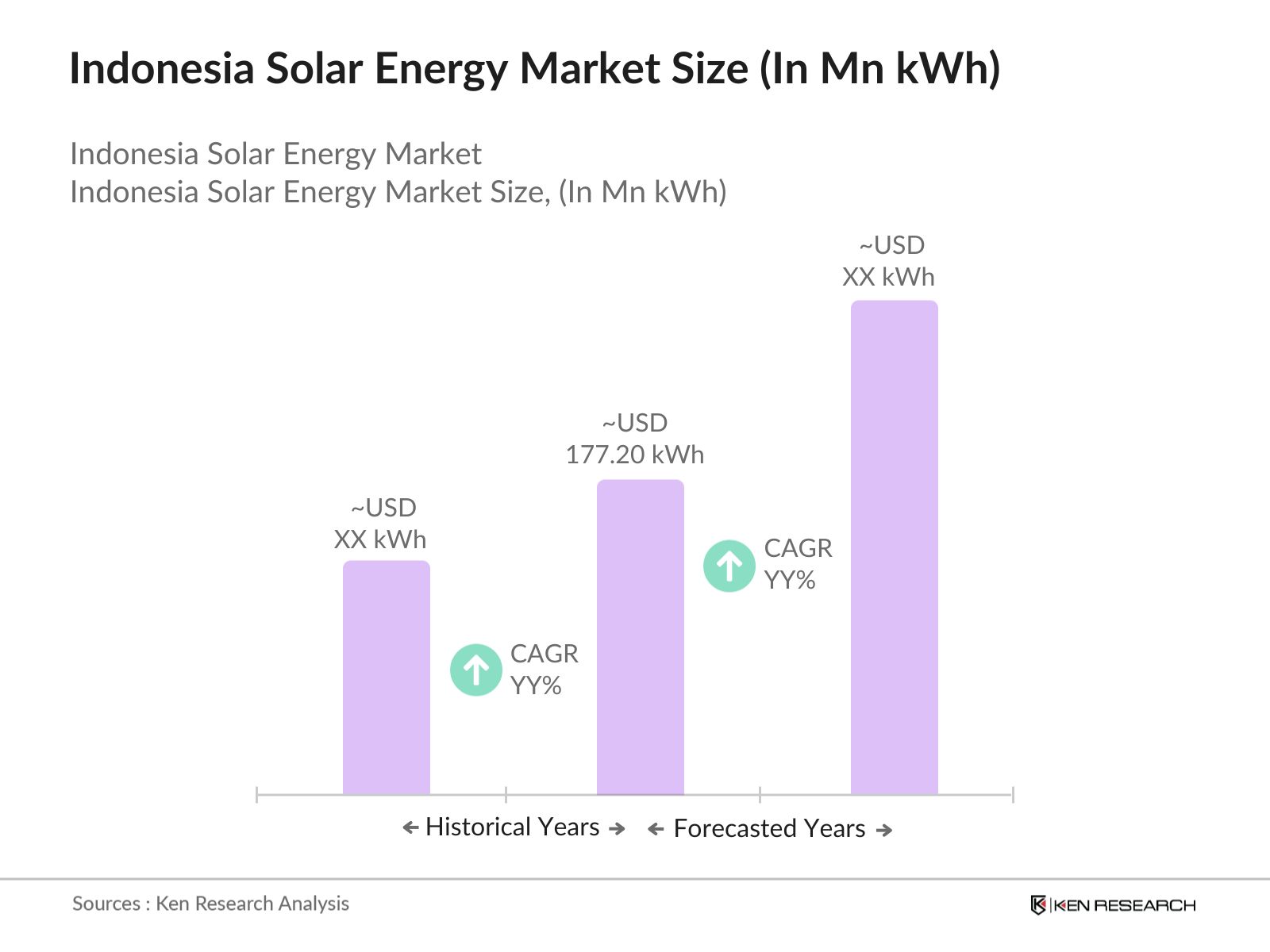
- The Indonesia Solar Energy market is valued at 177.20m kWh based on a five-year historical analysis. This growth is driven by government policies aimed at achieving energy independence, increasing demand for renewable energy, and declining solar panel costs. The integration of solar power into Indonesias energy mix is being accelerated through favorable subsidies, tax incentives, and supportive legislation.
- The dominant regions within the market include Java and Sumatra. These areas benefit from high population densities, rapidly growing urbanization, and industrial development, which increase energy demand. Java, in particular, stands out due to its established infrastructure and proximity to large energy consumers.
- The Indonesian government, through its National Energy Policy, set a goal to generate 23% of its total energy from renewable sources by 2025. A major component of this policy includes increasing solar power capacity, with financial and policy support for utility-scale and distributed solar power projects. The government has allocated over 15 trillion IDR to renewable energy initiatives, including solar, in its 2024 budget, emphasizing the importance of solar energy in achieving energy transition goals.
Indonesia Solar Energy Market Segmentation
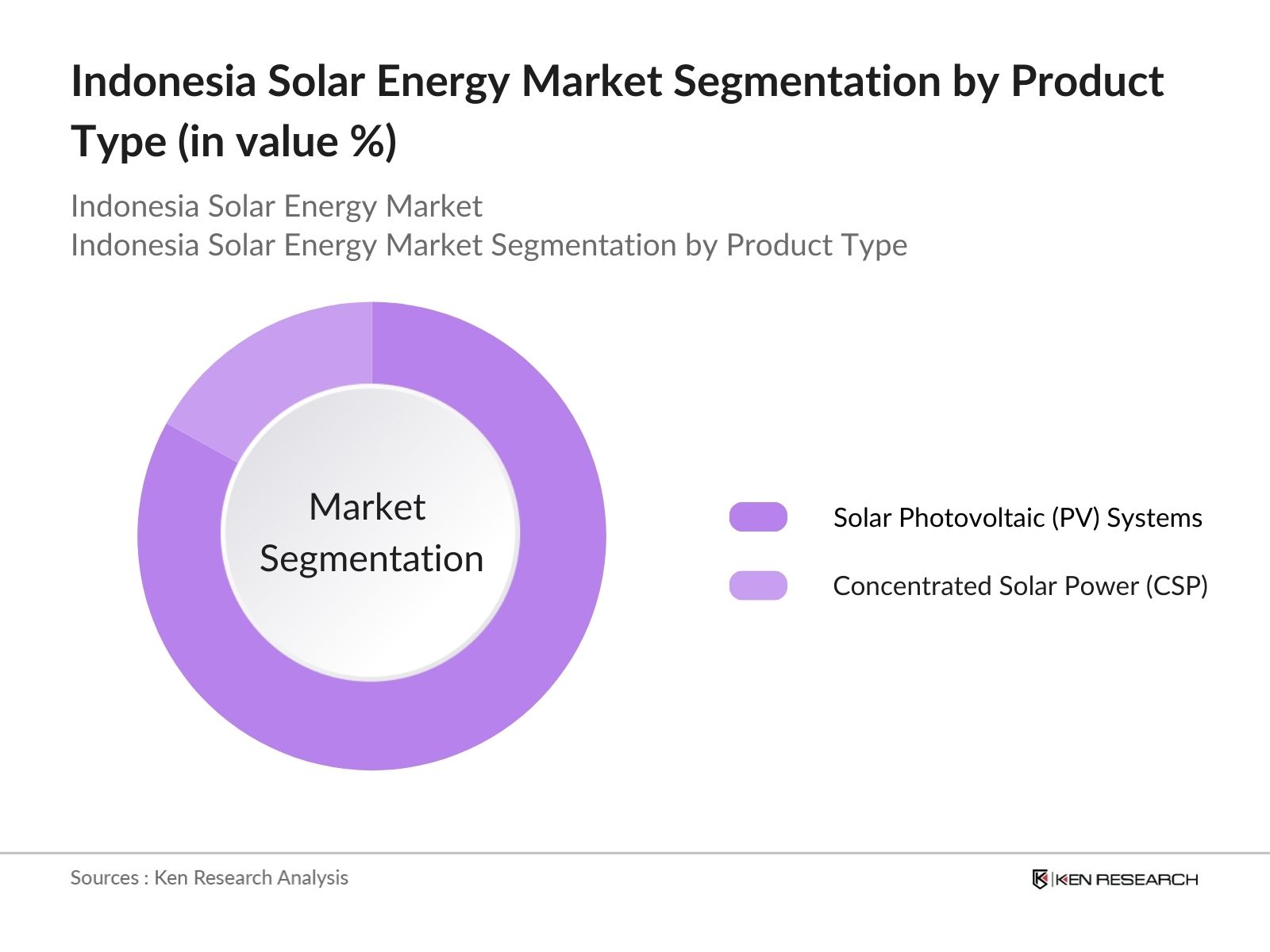
By Product Type: The market is segmented by product type into solar photovoltaic (PV) systems and concentrated solar power (CSP). Recently, solar photovoltaic (PV) systems have dominated the product type segment. This dominance is due to the growing demand for on-grid solar power solutions and increasing installation of solar rooftops for residential, commercial, and industrial use.
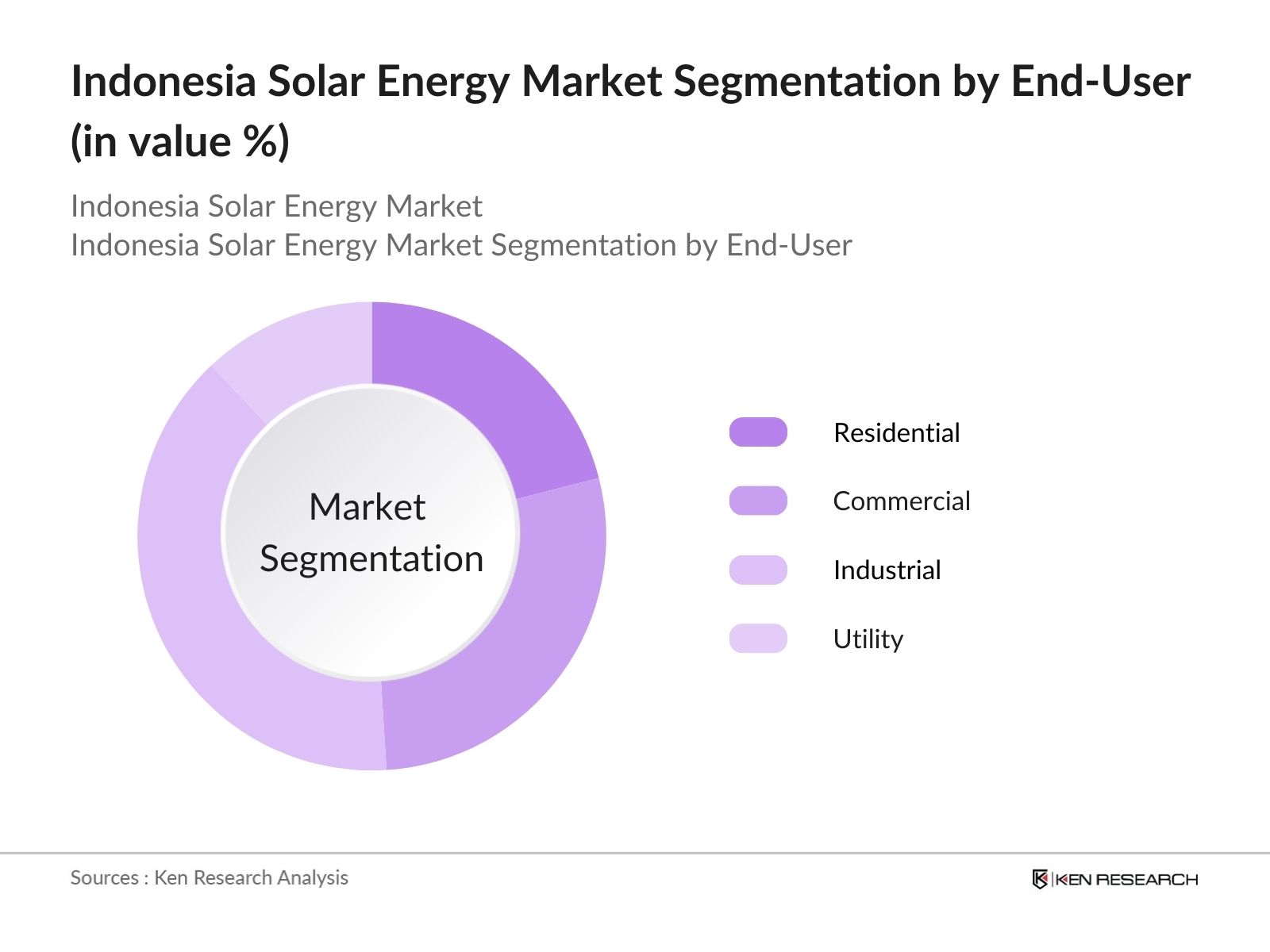
By End-User: The market is segmented by end-users into residential, commercial, industrial, and utility sectors. The industrial sector currently holds the largest share, driven by the growing demand for cost-effective energy solutions in manufacturing and heavy industries. Many large corporations are transitioning to renewable energy to meet sustainability goals, with industrial solar farms becoming a vital energy source in reducing operational costs.
By Region: The market is segmented by region, with Java, Sumatra, Bali & Nusa Tenggara, Kalimantan, and Sulawesi contributing significantly. Java leads the market due to its extensive infrastructure and favorable government policies that support the development of solar projects. The region's high population density and growing demand for energy have further solidified its role as a leader in the country's solar energy market.
Indonesia Solar Energy Market Competitive Landscape
The market is dominated by key players that play a crucial role in shaping the market dynamics. The market shows a trend of consolidation, with both local and international firms expanding their presence through joint ventures, partnerships, and large-scale solar projects.
|
Company |
Establishment Year |
Headquarters |
Installed Capacity |
International Projects |
Revenue |
Technological Partnerships |
R&D Investment |
Expansion Strategy |
|
PT. Adaro Energy |
2004 |
Jakarta, Indonesia |
||||||
|
First Solar Inc. |
1999 |
Arizona, USA |
||||||
|
PT. Indonesia Power |
1995 |
Jakarta, Indonesia |
||||||
|
Total Eren |
2012 |
Paris, France |
||||||
|
Trina Solar Limited |
1997 |
Changzhou, China |
Indonesia Solar Energy Market Analysis
Market Growth Drivers
- Government Policy Support: In August 2024, Indonesia's Energy Ministry reduced the local content requirement for solar power plants from approximately 40% to 20%. This policy change aims to attract foreign investment and expedite the deployment of renewable energy projects, including solar power.
- International Collaboration: In September 2024, Singapore announced plans to import an additional 1.4 gigawatts (GW) of low-carbon power from Indonesia, supplementing a previously agreed 2 GW. This initiative underscores Indonesia's potential as a key exporter of renewable energy, particularly solar power, to neighboring countries.
- Private Sector Investment: In November 2024, Indonesian President Prabowo Subianto announced plans to retire all coal and fossil-fuel power plants within the next 15 years and significantly boost renewable energy capacity by over 75 gigawatts. This ambitious plan is expected to attract substantial private sector investment into the solar energy market.
Market Challenges
- Regulatory Hurdles: Despite recent policy changes, Indonesia's solar energy sector still faces regulatory challenges, including complex permitting processes and inconsistent implementation of policies, which can delay project development and deter potential investors.
- Infrastructure Limitations: The existing energy infrastructure in Indonesia is primarily designed for fossil fuel-based power generation. Integrating a significant share of solar energy requires substantial upgrades to the grid to handle intermittent power generation and ensure reliable distribution.
Indonesia Solar Energy Market Future Outlook
Over the next five years, the Indonesia Solar Energy industry is expected to experience growth, driven by continuous government support, declining solar technology costs, and a rising emphasis on renewable energy to meet national energy targets.
Future Market Opportunities
- Adoption of Floating Solar Projects: Over the next five years, Indonesia is expected to become a leader in floating solar projects due to its vast water resources. By 2029, the total installed capacity of floating solar plants in Indonesia is expected to exceed 1,000 MW. This trend is supported by the governments commitment to diversify its solar portfolio, with several floating solar projects already in the pipeline in 2024. Floating solar projects will help mitigate land-use challenges while providing clean energy to both rural and urban regions.
- Development of Large-Scale Solar Farms in Eastern Indonesia: Between 2024 and 2029, large-scale solar farms are expected to proliferate in eastern Indonesia, particularly in regions such as Papua and Maluku, which have high solar irradiance levels. Government plans and foreign investments amounting to 10 trillion IDR have already been allocated for these projects. These regions are targeted due to their underdeveloped energy infrastructure, and large-scale solar farms will help meet the rising energy demand in the coming years.
Scope of the Report
|
By Product Type |
Solar Photovoltaic (PV) Systems Concentrated Solar Power (CSP) |
|
By End-User |
Residential Commercial Industrial Utility |
|
By Technology |
Thin Film Solar Cells Crystalline Silicon Solar Cells Multijunction Solar Cells |
|
By Installation Type |
Rooftop Ground-Mounted Floating Solar |
|
By Region |
North East West South |
Products
Key Target Audience Organizations and Entities Who Can Benefit by Subscribing This Report:
Banks and Financial Institution
Government and Regulatory Bodies (Ministry of Energy and Mineral Resources, National Energy Council)
Energy Infrastructure Companies
Solar Equipment Manufacturers
Utility Providers
Investments and Venture Capitalist Firms
Industrial and Commercial Solar Consumers
Private Equity Firms
Companies
Players Mentioned in the Report:
PT. Adaro Energy
First Solar Inc.
PT. Indonesia Power
Total Eren
Trina Solar Limited
PT. Surya Utama Nuansa
ACWA Power
PT. Wika Industri Energi
PT. Len Industri
PT. Bayu Buana Gemilang
SunPower Corporation
Canadian Solar Inc.
PT. Terregra Asia Energy
Panasonic Corporation
PT. Tunas Surya Energi
Table of Contents
Indonesia Solar Energy Market Overview
1.1. Definition and Scope
1.2. Market Taxonomy
1.3. Market Growth Rate
1.4. Market Segmentation Overview
Indonesia Solar Energy Market Size (In kWh)
2.1. Historical Market Size
2.2. Year-On-Year Growth Analysis
2.3. Key Market Developments and Milestones
Indonesia Solar Energy Market Analysis
3.1. Growth Drivers (Renewable Energy Adoption Rate, Government Subsidies, Infrastructure Development, Energy Independence Initiatives)
3.2. Market Challenges (Grid Integration Issues, High Capital Investment, Regulatory Hurdles, Limited Skilled Workforce)
3.3. Opportunities (Expanding Off-Grid Solar Systems, Increasing Private Sector Investment, Declining Solar Module Prices, Growth of Solar Farms)
3.4. Trends (Energy Storage Solutions, Solar Hybrid Systems, Solar Panel Recycling, Technological Innovations in Photovoltaics)
3.5. Government Initiatives (National Energy Policy, Green Energy Programs, Public-Private Partnerships, Solar Feed-in Tariffs)
3.6. SWOT Analysis
3.7. Stakeholder Ecosystem
3.8. Porters Five Forces
3.9. Competitive Ecosystem
Indonesia Solar Energy Market Segmentation
4.1. By Product Type (In Value %)
4.1.1. Solar Photovoltaic (PV) Systems
4.1.2. Concentrated Solar Power (CSP)
4.2. By End-User (In Value %)
4.2.1. Residential
4.2.2. Commercial
4.2.3. Industrial
4.2.4. Utility
4.3. By Technology (In Value %)
4.3.1. Thin Film Solar Cells
4.3.2. Crystalline Silicon Solar Cells
4.3.3. Multijunction Solar Cells
4.4. By Installation Type (In Value %)
4.4.1. Rooftop
4.4.2. Ground-Mounted
4.4.3. Floating Solar
4.5. By Region (In Value %)
4.5.1. North
4.5.2. East
4.5.3. West
4.5.4. South
Indonesia Solar Energy Market Competitive Analysis
5.1. Detailed Profiles of Major Companies
5.1.1. PT. Adaro Energy
5.1.2. First Solar Inc.
5.1.3. PT. Indonesia Power
5.1.4. Total Eren
5.1.5. PT. Surya Utama Nuansa
5.1.6. ACWA Power
5.1.7. PT. Wika Industri Energi
5.1.8. PT. Len Industri
5.1.9. Trina Solar Limited
5.1.10. PT. Bayu Buana Gemilang
5.1.11. SunPower Corporation
5.1.12. Canadian Solar Inc.
5.1.13. PT. Terregra Asia Energy
5.1.14. Panasonic Corporation
5.1.15. PT. Tunas Surya Energi
5.2. Cross Comparison Parameters (Revenue, Installed Capacity, Solar Projects in Indonesia, Total Solar Farm Area, International Projects, R&D Investment, Technological Partnerships, Expansion Strategies)
5.3. Market Share Analysis
5.4. Strategic Initiatives
5.5. Mergers And Acquisitions
5.6. Investment Analysis
5.7. Venture Capital Funding
5.8. Government Grants
5.9. Private Equity Investments
Indonesia Solar Energy Market Regulatory Framework
6.1. Environmental Standards
6.2. Compliance Requirements
6.3. Certification Processes
Indonesia Solar Energy Future Market Size (In kWh)
7.1. Future Market Size Projections
7.2. Key Factors Driving Future Market Growth
Indonesia Solar Energy Future Market Segmentation
8.1. By Product Type (In Value %)
8.2. By End-User (In Value %)
8.3. By Technology (In Value %)
8.4. By Installation Type (In Value %)
8.5. By Region (In Value %)
Indonesia Solar Energy Market Analysts Recommendations
9.1. TAM/SAM/SOM Analysis
9.2. Customer Cohort Analysis
9.3. Marketing Initiatives
9.4. White Space Opportunity Analysis
Disclaimer Contact UsResearch Methodology
Step 1: Identification of Key Variables
The initial phase involves creating an in-depth market framework, identifying all critical market players and their influence on the Indonesia Solar Energy market. This process is supported by desk research, with data sourced from government reports, market databases, and industry white papers.
Step 2: Market Analysis and Construction
In this step, historical data on solar energy adoption and deployment in Indonesia is collected. Key factors, such as energy production rates, solar power generation statistics, and geographical deployment patterns, are analyzed to understand the market's growth trajectory.
Step 3: Hypothesis Validation and Expert Consultation
Hypotheses are developed based on the data collected and are tested through discussions with industry experts, government agencies, and key stakeholders. These consultations offer practical insights and validate the market assumptions.
Step 4: Research Synthesis and Final Output
Finally, direct interactions with major solar energy providers and stakeholders ensure a comprehensive understanding of market conditions, challenges, and future opportunities. This data is refined to provide a final output, ensuring a highly reliable and accurate market report.
Frequently Asked Questions
How big is the Indonesia Solar Energy Market?
The Indonesia Solar Energy market is valued at 177.20m kWh, supported by a strong governmental push for renewable energy and the increasing installation of solar projects across key regions.
What are the challenges in the Indonesia Solar Energy Market?
Challenges in the Indonesia Solar Energy market include high upfront capital costs for solar installations, regulatory barriers, and the need for better grid integration to handle fluctuating solar power generation.
Who are the major players in the Indonesia Solar Energy Market?
Key players in the Indonesia Solar Energy market include PT. Adaro Energy, First Solar Inc., PT. Indonesia Power, Total Eren, and Trina Solar Limited. These companies dominate through large-scale projects and extensive R&D investment.
What are the growth drivers of the Indonesia Solar Energy Market?
The Indonesia Solar Energy market is driven by falling solar technology costs, government subsidies, and the national goal to increase renewable energy's share in the overall energy mix.
Which regions are leading in the Indonesia Solar Energy Market?
Java and Sumatra are the leading regions due to their established infrastructure, energy demand, and government investment in renewable energy projects.
Why Buy From Us?

What makes us stand out is that our consultants follows Robust, Refine and Result (RRR) methodology. i.e. Robust for clear definitions, approaches and sanity checking, Refine for differentiating respondents facts and opinions and Result for presenting data with story

We have set a benchmark in the industry by offering our clients with syndicated and customized market research reports featuring coverage of entire market as well as meticulous research and analyst insights.

While we don't replace traditional research, we flip the method upside down. Our dual approach of Top Bottom & Bottom Top ensures quality deliverable by not just verifying company fundamentals but also looking at the sector and macroeconomic factors.

With one step in the future, our research team constantly tries to show you the bigger picture. We help with some of the tough questions you may encounter along the way: How is the industry positioned? Best marketing channel? KPI's of competitors? By aligning every element, we help maximize success.

Our report gives you instant access to the answers and sources that other companies might choose to hide. We elaborate each steps of research methodology we have used and showcase you the sample size to earn your trust.

If you need any support, we are here! We pride ourselves on universe strength, data quality, and quick, friendly, and professional service.