















KSA Electrical Insulator Market Outlook 2030
Region:Middle East
Author(s):Shivani Mehra
Product Code:KROD1106
November 2024
82
About the Report
KSA Electrical Insulator Market Overview
- The KSA electrical insulator market is valued at USD 13.24 billion, driven primarily by robust investments in power infrastructure and a significant push towards renewable energy initiatives. The demand for reliable electrical insulation solutions is heightened by the growing need for safety and efficiency in electrical systems, particularly as the Kingdom enhances its grid capabilities. Additionally, rising urbanization and industrialization are key factors contributing to the market's expansion, emphasizing the necessity for high-quality insulation products.
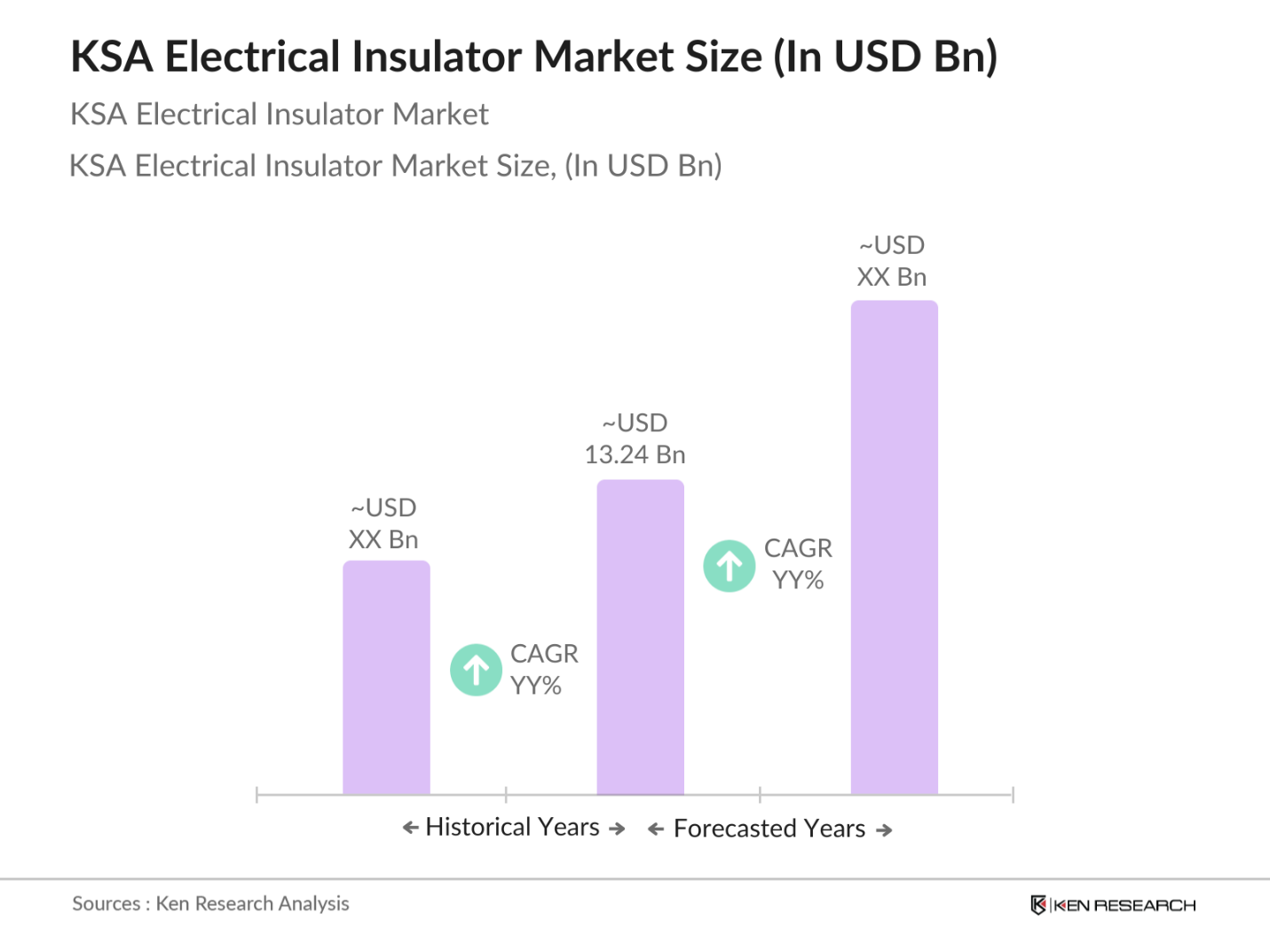
- Key cities dominating the KSA electrical insulator market include Riyadh, Jeddah, and Dammam, primarily due to their strategic importance in the country's energy infrastructure. Riyadh, being the capital, serves as a central hub for major electrical projects, while Jeddah and Dammam are critical for industrial activities and port operations. The continuous development in these regions, coupled with government initiatives, promotes substantial growth in electrical infrastructure, thus reinforcing the demand for electrical insulators.
- Saudi Arabia has established rigorous safety standards and certifications for electrical products to ensure reliability and public safety. In 2022, the implementation of these standards became mandatory for all manufacturers, requiring them to conduct thorough testing and obtain certifications before marketing their products. This regulatory environment is crucial in maintaining high-quality standards in the electrical insulator market, fostering consumer confidence.
KSA Electrical Insulator Market Segmentation
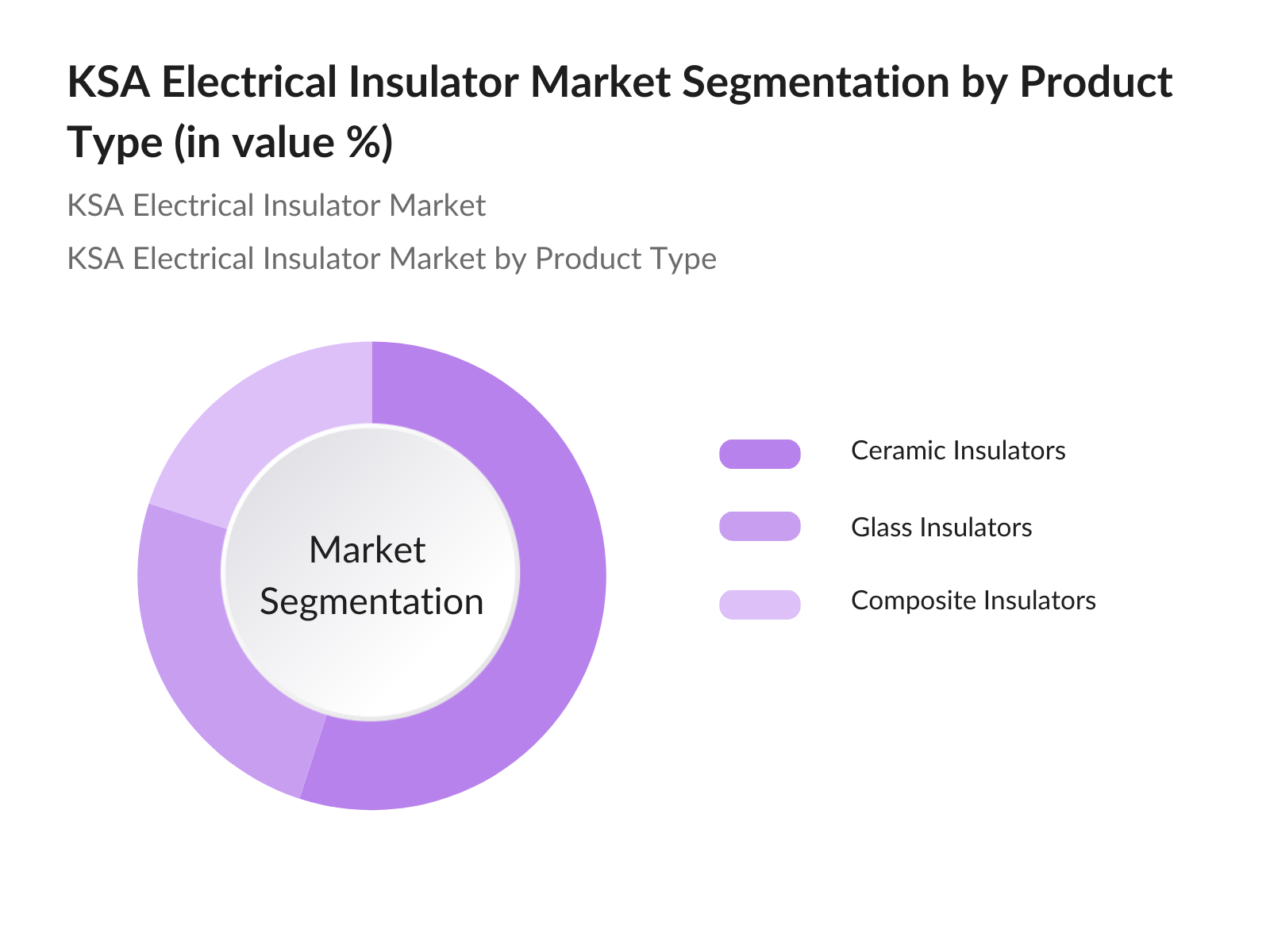
- By Product Type: The KSA electrical insulator market is segmented by product type into ceramic insulators, glass insulators, and composite insulators. Among these, ceramic insulators dominate the market share due to their long-standing reliability and performance under varying environmental conditions. Their robust nature allows them to withstand high voltage and extreme weather, making them ideal for transmission and distribution applications. Furthermore, established manufacturers have built strong brand loyalty and trust, which solidifies the preference for ceramic insulators in the market.
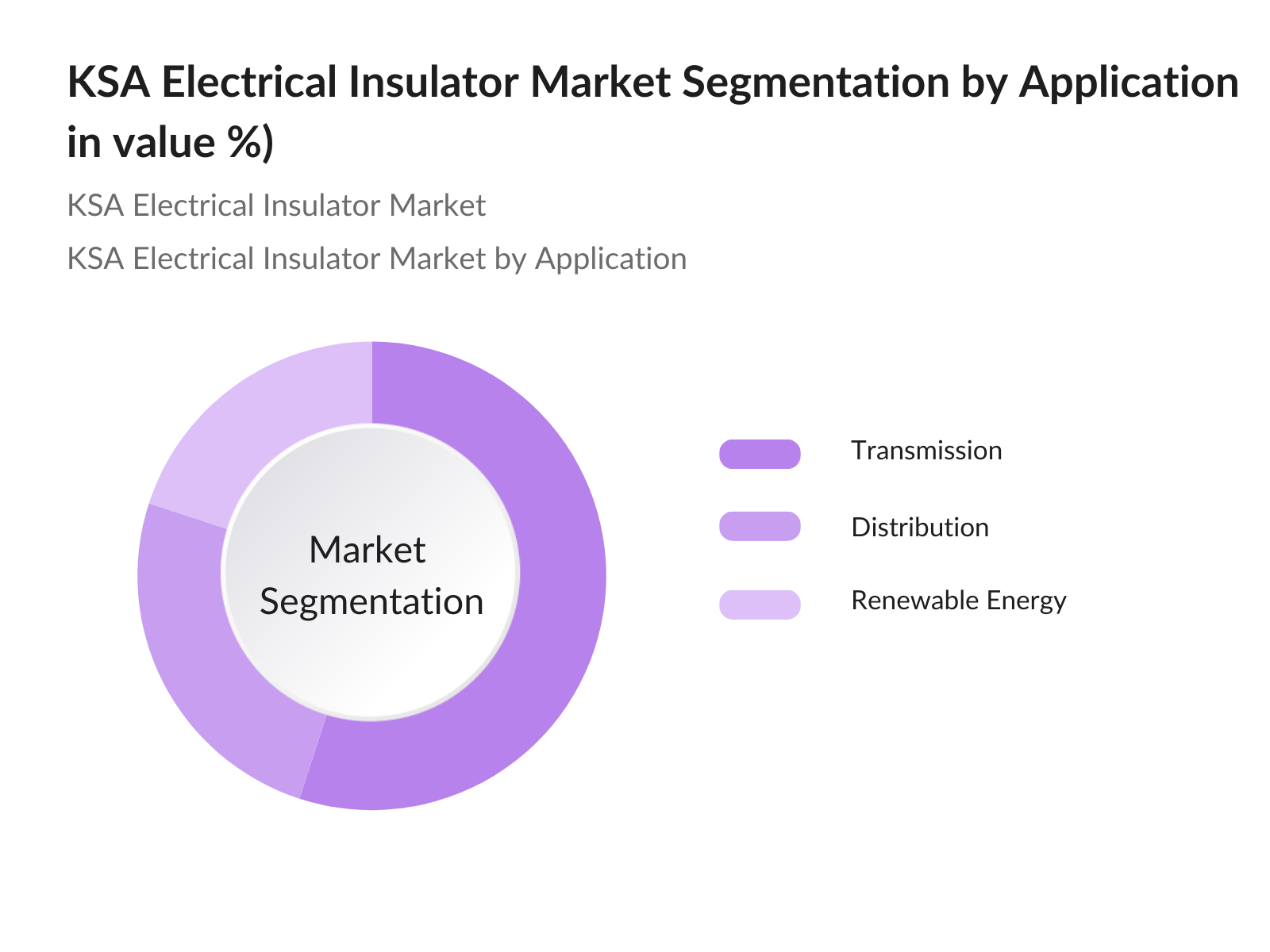
- By Application: The market is also segmented by application into transmission, distribution, and renewable energy. The transmission segment holds a substantial market share, driven by the increasing need for efficient power transmission over long distances. As Saudi Arabia expands its power grid to accommodate growing electricity demand, the focus on high-voltage transmission lines necessitates the use of robust electrical insulators to ensure safety and reliability. This growing infrastructure development in the transmission sector fuels the segment's dominance.
KSA Electrical Insulator Market Competitive Landscape
The KSA electrical insulator market is characterized by the presence of several key players, creating a competitive environment that fosters innovation and quality improvements. Major players include local and global manufacturers that leverage their strengths in technology, distribution, and market knowledge. The leading companies often collaborate with government and private sectors to meet the rising demand for advanced electrical solutions.
|
Company |
Establishment Year |
Headquarters |
Revenue (USD) |
Product Portfolio |
Market Presence |
R&D Expenditure (USD) |
|
Siemens AG |
1847 |
Munich, Germany |
- |
- |
- |
- |
|
General Electric |
1892 |
Boston, USA |
- |
- |
- |
- |
|
TE Connectivity |
2007 |
Schaffhausen, Switzerland |
- |
- |
- |
- |
|
NEXANS |
2000 |
Paris, France |
- |
- |
- |
- |
|
ABB Ltd. |
1988 |
Zurich, Switzerland |
- |
- |
- |
- |
KSA Electrical Insulator Industry Analysis
Market Growth Drivers
- Rising Power Demand: The demand for electricity in Saudi Arabia has seen significant growth, with the countrys total installed capacity reaching approximately 80 gigawatts in 2022. This surge in demand is driven by population growth and increased urbanization. Additionally, the World Bank projects that the electricity consumption in Saudi Arabia will rise significantly due to expanding residential and commercial sectors, which are crucial for the nation's Vision 2030 initiative. The government plans to enhance its power generation capacity further, ensuring the need for reliable insulators in power infrastructure.
- Infrastructure Development Initiatives: Saudi Arabias commitment to extensive infrastructure development is evidenced by its investment of over $500 billion in various sectors, including energy, transportation, and urban development, as outlined in the National Industrial Development and Logistics Program. This investment is aimed at modernizing the country's infrastructure, which directly correlates with increased demand for electrical insulators to support new energy projects and construction developments. With major projects like NEOM and the Red Sea Project underway, the need for efficient and durable electrical insulation solutions is paramount.
- Technological Advancements: Innovations in materials and technology, such as the development of polymeric insulators, are enhancing the performance of electrical insulation. In 2022, the global investment in smart grid technologies exceeded $30 billion, and Saudi Arabia is increasingly adopting these technologies to improve grid reliability and efficiency. As utilities modernize their infrastructures, the demand for high-performance insulators that can meet the challenges posed by smart grid systems is likely to grow, driving market expansion.
Market Challenges:
- Regulatory Compliance: The electrical insulator market in Saudi Arabia faces stringent regulatory frameworks aimed at ensuring safety and efficiency. Compliance with these regulations often requires additional investments in testing and certification processes. In 2022, the Saudi Standards, Metrology and Quality Organization introduced new regulations that necessitate manufacturers to adhere to international quality standards, adding to operational complexities and costs.
- Availability of Alternatives: The emergence of alternative insulation materials, such as composite insulators, poses a challenge to traditional insulator manufacturers. In 2022, the market for composite insulators grew significantly, with manufacturers reporting that these alternatives provide improved performance under specific conditions, influencing customer preferences. The increasing adoption of these alternatives can lead to a shift in market dynamics, impacting the demand for conventional electrical insulators.
KSA Electrical Insulator Market Future Outlook
Over the next five years, the KSA electrical insulator market is expected to experience significant growth, driven by continuous government support for infrastructure development and increasing investments in renewable energy projects. The shift towards smart grids and advanced electrical systems will necessitate the adoption of innovative insulation technologies, enhancing the reliability and efficiency of electrical networks. Additionally, as urbanization continues, the demand for robust electrical solutions is likely to rise, further fueling market expansion.
Market Opportunities:
- Export Potential in MENA Region: Saudi Arabias strategic location and robust manufacturing capabilities position it as a key player in the MENA electrical insulator market. In 2022, the country's electrical exports to neighboring countries reached $1 billion, driven by regional demand for infrastructure projects. This trend indicates substantial opportunities for local manufacturers to expand their market share and export capabilities in the rapidly growing regional market.
- Sustainable Insulation Materials: With increasing environmental awareness, the demand for sustainable and eco-friendly insulation materials is rising. In 2022, the global green building materials market was valued at over $200 billion, reflecting a growing trend towards sustainability in construction. Saudi manufacturers are increasingly exploring the production of biodegradable and recyclable insulators to meet this demand, which represents a significant growth opportunity in the coming years.
Scope of the Report
|
By Product Type |
Ceramic Insulators Glass Insulators Composite Insulators |
|
By Application |
Transmission Distribution Renewable Energy |
|
By Voltage Level |
Low Voltage Medium Voltage High Voltage |
|
By End-User Industry |
Utilities Industrial Commercial |
|
By Region |
North-East Midwest West Coast Southern States |
Products
Key Target Audience
Utilities and Power Generation Companies
Electrical Contractors and Installers
Construction Firms
Energy Sector Investors and Venture Capitalist Firms
Government and Regulatory Bodies (Saudi Electricity Company, Ministry of Energy)
Industrial Manufacturers
Renewable Energy Developers
Infrastructure Development Agencies
Companies
Players Mentioned in the report
Siemens AG
General Electric
TE Connectivity
NEXANS
ABB Ltd.
Schneider Electric
Hubbell Power Systems
LAPP Group
MacLean-Fogg
SGB-SMIT Group
Insulator Company
Porcelain Insulators Inc.
BINSUL
BSI Group
JNC Corporation
Table of Contents
1. KSA Electrical Insulator Market Overview
1.1. Definition and Scope
1.2. Market Taxonomy
1.3. Market Growth Rate
1.4. Market Segmentation Overview
2. KSA Electrical Insulator Market Size (In USD Mn)
2.1. Historical Market Size
2.2. Year-On-Year Growth Analysis
2.3. Key Market Developments and Milestones
3. KSA Electrical Insulator Market Analysis
3.1. Growth Drivers
3.1.1. Rising Power Demand
3.1.2. Infrastructure Development Initiatives
3.1.3. Renewable Energy Integration
3.1.4. Technological Advancements
3.2. Market Challenges
3.2.1. High Material Costs
3.2.2. Regulatory Compliance
3.2.3. Availability of Alternatives
3.3. Opportunities
3.3.1. Smart Grid Deployment
3.3.2. Export Potential in MENA Region
3.3.3. Sustainable Insulation Materials
3.4. Trends
3.4.1. Increased Adoption of Composite Insulators
3.4.2. Digitalization of Utilities
3.4.3. Focus on Eco-Friendly Solutions
3.5. Government Regulation
3.5.1. National Energy Efficiency Program
3.5.2. Safety Standards and Certifications
3.5.3. Incentives for Renewable Projects
3.6. SWOT Analysis
3.7. Stakeholder Ecosystem
3.8. Porters Five Forces
3.9. Competition Ecosystem
4. KSA Electrical Insulator Market Segmentation
4.1. By Product Type (In Value %)
4.1.1. Ceramic Insulators
4.1.2. Glass Insulators
4.1.3. Composite Insulators
4.2. By Application (In Value %)
4.2.1. Transmission
4.2.2. Distribution
4.2.3. Renewable Energy
4.3. By Voltage Level (In Value %)
4.3.1. Low Voltage
4.3.2. Medium Voltage
4.3.3. High Voltage
4.4. By End-User Industry (In Value %)
4.4.1. Utilities
4.4.2. Industrial
4.4.3. Commercial
4.5. By Region (In Value %)
4.5.1. Eastern Province
4.5.2. Riyadh
4.5.3. Western Province
4.5.4. Southern Region
5. KSA Electrical Insulator Market Competitive Analysis
5.1. Detailed Profiles of Major Companies
5.1.1. Siemens AG
5.1.2. General Electric
5.1.3. TE Connectivity
5.1.4. NEXANS
5.1.5. ABB Ltd.
5.1.6. Schneider Electric
5.1.7. Hubbell Power Systems
5.1.8. LAPP Group
5.1.9. MacLean-Fogg
5.1.10. SGB-SMIT Group
5.1.11. Insulator Company
5.1.12. Porcelain Insulators Inc.
5.1.13. BINSUL
5.1.14. BSI Group
5.1.15. JNC Corporation
5.2. Cross Comparison Parameters (Headquarters, Revenue, Number of Employees, Inception Year, Product Portfolio, Market Share, Geographic Presence, R&D Expenditure)
5.3. Market Share Analysis
5.4. Strategic Initiatives
5.5. Mergers and Acquisitions
5.6. Investment Analysis
5.7. Venture Capital Funding
5.8. Government Grants
5.9. Private Equity Investments
6. KSA Electrical Insulator Market Regulatory Framework
6.1. Environmental Standards
6.2. Compliance Requirements
6.3. Certification Processes
7. KSA Electrical Insulator Future Market Size (In USD Mn)
7.1. Future Market Size Projections
7.2. Key Factors Driving Future Market Growth
8. KSA Electrical Insulator Future Market Segmentation
8.1. By Product Type (In Value %)
8.2. By Application (In Value %)
8.3. By Voltage Level (In Value %)
8.4. By End-User Industry (In Value %)
8.5. By Region (In Value %)
9. KSA Electrical Insulator Market Analysts Recommendations
9.1. TAM/SAM/SOM Analysis
9.2. Customer Cohort Analysis
9.3. Marketing Initiatives
9.4. White Space Opportunity Analysis
Disclaimer Contact UsResearch Methodology
Step 1: Identification of Key Variables
The initial phase involves constructing an ecosystem map encompassing all major stakeholders within the KSA electrical insulator market. This step relies on extensive desk research, utilizing a combination of secondary and proprietary databases to gather comprehensive industry-level information. The primary objective is to identify and define the critical variables that influence market dynamics.
Step 2: Market Analysis and Construction
In this phase, we compile and analyze historical data pertaining to the KSA electrical insulator market. This includes assessing market penetration, the ratio of marketplaces to service providers, and the resultant revenue generation. Furthermore, an evaluation of service quality statistics will be conducted to ensure the reliability and accuracy of the revenue estimates.
Step 3: Hypothesis Validation and Expert Consultation
Market hypotheses will be developed and subsequently validated through computer-assisted telephone interviews (CATIs) with industry experts representing a diverse array of companies. These consultations provide valuable operational and financial insights directly from industry practitioners, instrumental in refining and corroborating the market data.
Step 4: Research Synthesis and Final Output
The final phase involves direct engagement with multiple electrical insulator manufacturers to acquire detailed insights into product segments, sales performance, consumer preferences, and other pertinent factors. This interaction serves to verify and complement the statistics derived from the bottom-up approach, ensuring a comprehensive, accurate, and validated analysis of the KSA electrical insulator market.
Frequently Asked Questions
01. How big is the KSA Electrical Insulator Market?
The KSA electrical insulator market is valued at USD 13.24 billion, driven by robust investments in power infrastructure and a significant push towards renewable energy initiatives.
02. What are the challenges in the KSA Electrical Insulator Market?
Challenges include high material costs and regulatory compliance issues that may affect the profitability of manufacturers, alongside competition from alternative insulation materials.
03. Who are the major players in the KSA Electrical Insulator Market?
Key players in the market include Siemens AG, General Electric, TE Connectivity, and ABB Ltd., all of which leverage their technological advancements and extensive distribution networks to dominate the market.
04. What are the growth drivers of the KSA Electrical Insulator Market?
The market is propelled by continuous government support for infrastructure development, increasing investments in renewable energy projects, and the shift towards smart grid technology.
Why Buy From Us?

What makes us stand out is that our consultants follows Robust, Refine and Result (RRR) methodology. i.e. Robust for clear definitions, approaches and sanity checking, Refine for differentiating respondents facts and opinions and Result for presenting data with story

We have set a benchmark in the industry by offering our clients with syndicated and customized market research reports featuring coverage of entire market as well as meticulous research and analyst insights.

While we don't replace traditional research, we flip the method upside down. Our dual approach of Top Bottom & Bottom Top ensures quality deliverable by not just verifying company fundamentals but also looking at the sector and macroeconomic factors.

With one step in the future, our research team constantly tries to show you the bigger picture. We help with some of the tough questions you may encounter along the way: How is the industry positioned? Best marketing channel? KPI's of competitors? By aligning every element, we help maximize success.

Our report gives you instant access to the answers and sources that other companies might choose to hide. We elaborate each steps of research methodology we have used and showcase you the sample size to earn your trust.

If you need any support, we are here! We pride ourselves on universe strength, data quality, and quick, friendly, and professional service.