















U.S. Variable Frequency Drives (VFD) Market Outlook to 2030
Region:North America
Author(s):Sanjeev
Product Code:KROD4967
December 2024
95
About the Report
U.S. Variable Frequency Drives (VFD) Market Overview
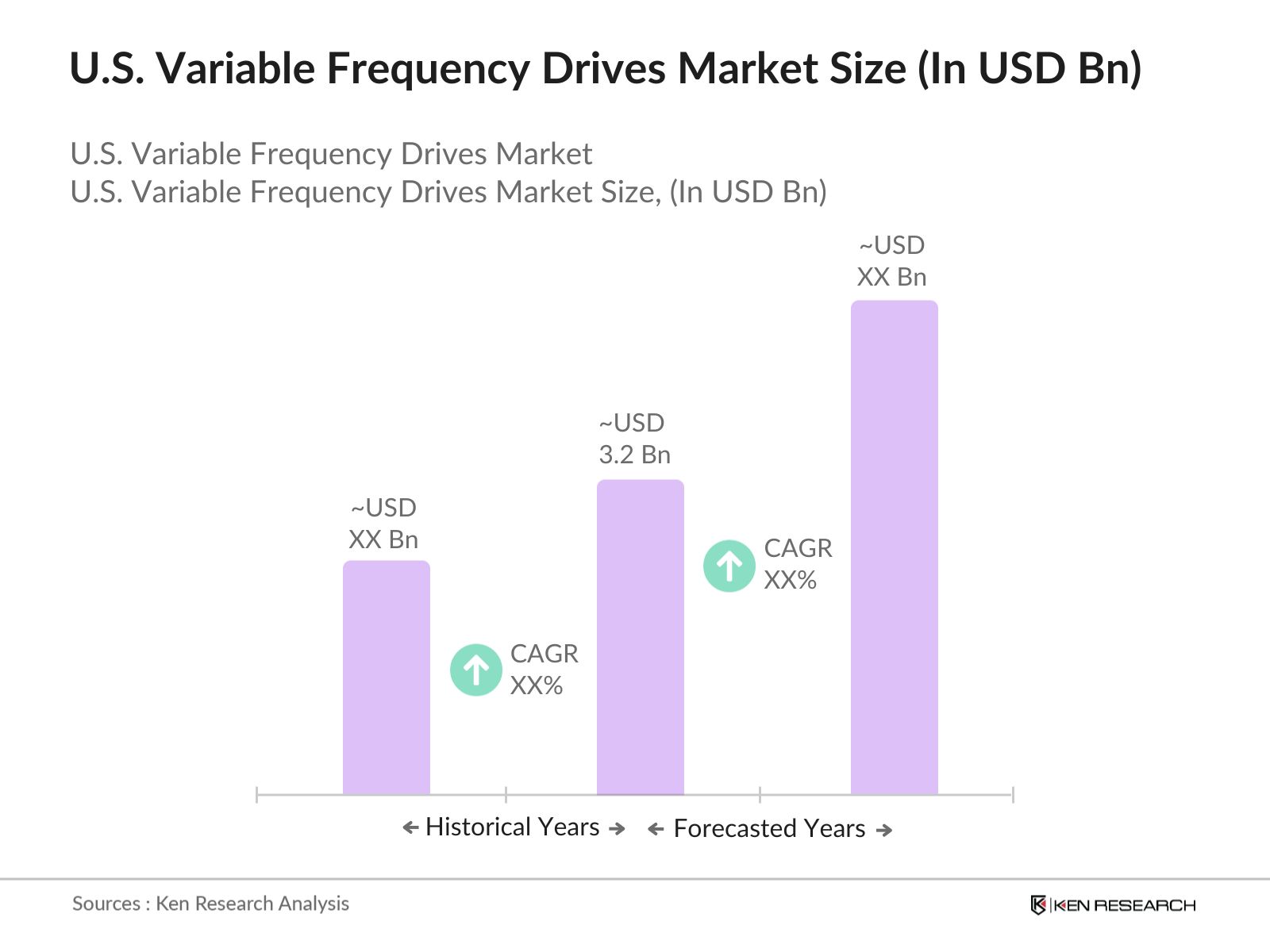
- The U.S. Variable Frequency Drives (VFD) market is valued at USD 3.2 billion, driven by the increasing adoption of energy-efficient technologies across industrial sectors. As industries such as manufacturing, automotive, and oil & gas aim to optimize operational efficiencies and reduce energy consumption, VFDs are playing a critical role in controlling motor speed, thereby lowering power consumption. The push for energy efficiency standards by government bodies like the U.S. Department of Energy has further fueled market growth.
- Major urban hubs such as Houston, New York, and Chicago dominate the VFD market due to their high concentration of energy-intensive industries like oil & gas, manufacturing, and utilities. The presence of large industrial plants in these cities, coupled with high energy consumption levels, makes them key regions for VFD adoption. Houston, in particular, leads due to its role in the oil and gas sector, where VFDs are heavily used in drilling and pumping operations.
- The U.S. Department of Energy has enforced stricter energy efficiency standards for electric motors, driving VFD adoption. In 2022, the DOE updated its conservation standards for motor efficiency, affecting over 600,000 industrial motors annually. These regulations require manufacturers to use energy-saving technologies like VFDs to comply with federal efficiency standards. Failure to meet these standards can result in penalties, further motivating businesses to adopt compliant technologies.
U.S. Variable Frequency Drives (VFD) Market Segmentation
The U.S. Variable Frequency Drives market is segmented by drive type and by end-use industry.
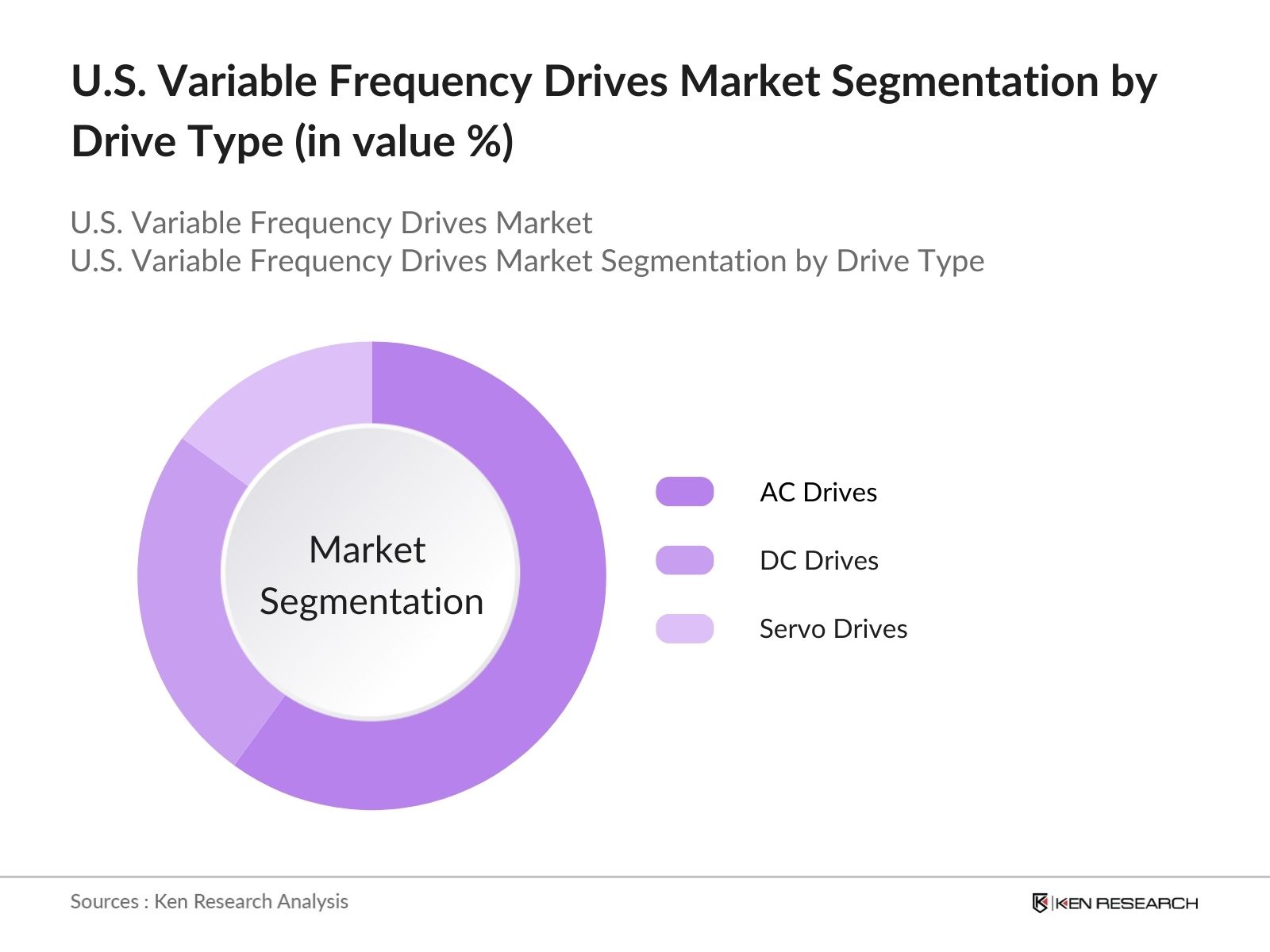
- By Drive Type: The market is segmented by drive type into AC Drives, DC Drives, and Servo Drives. Recently, AC Drives have dominated the market under the segmentation by drive type. This is due to their widespread use across multiple industries, including HVAC systems, where they are known for energy-saving capabilities. AC Drives are particularly favored for their ability to adjust motor speed efficiently in variable load applications, which is critical in industries like manufacturing and utilities.
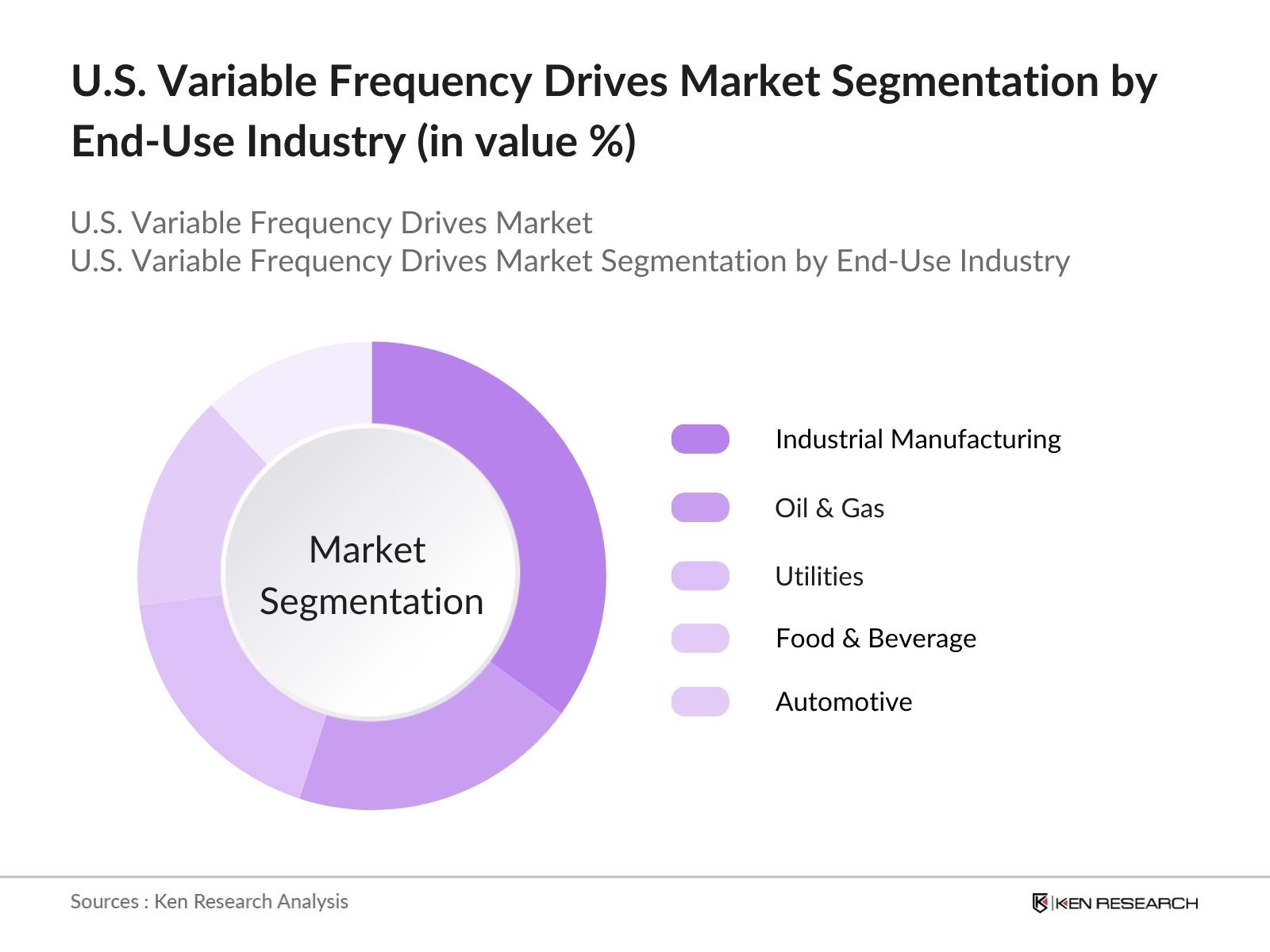
- By End-Use Industry: The market is segmented by end-use industry into Industrial Manufacturing, Oil & Gas, Utilities, Food & Beverage, and Automotive. Among these, the industrial manufacturing sector holds the dominant market share. This is largely due to the increasing focus on automation and energy efficiency within manufacturing plants. VFDs play a crucial role in reducing energy consumption by regulating motor speed, which is essential in large-scale production environments where high power consumption is a constant challenge.
U.S. Variable Frequency Drives (VFD) Competitive Landscape
The U.S. VFD market is characterized by intense competition, with a few major global players dominating the market. Companies such as ABB Ltd., Siemens AG, and Rockwell Automation have a strong presence due to their comprehensive product portfolios and focus on technological innovation. These firms continue to invest heavily in research and development to maintain their market position and expand their product offerings in energy-efficient solutions.
|
Company |
Establishment Year |
Headquarters |
Revenue (USD) |
Product Range |
Market Share |
|
ABB Ltd. |
1988 |
Zurich, Switzerland |
|||
|
Siemens AG |
1847 |
Munich, Germany |
|||
|
Rockwell Automation |
1903 |
Milwaukee, U.S. |
|||
|
Danfoss |
1933 |
Nordborg, Denmark |
|||
|
Schneider Electric |
1836 |
Rueil-Malmaison, France |
U.S. Variable Frequency Drives (VFD) Industry Analysis
Growth Drivers
- Energy Efficiency Regulations (Parameter: Regulatory Landscape): The U.S. government has implemented stringent energy efficiency regulations to reduce energy consumption across industrial sectors. The U.S. Department of Energy (DOE) enforces standards that require motors and drives, including Variable Frequency Drives (VFDs), to meet minimum efficiency standards. In 2022, DOE's updated energy conservation standards impacted approximately 3.8 million electric motors annually. These regulations have driven the adoption of VFDs, as they can reduce energy consumption by up to 40% in HVAC systems, enhancing operational efficiency. Compliance with energy regulations remains a key driver for VFD installations in various sectors, notably manufacturing and utilities.
- Industrial Automation (Parameter: Industry Demand): Industrial automation has significantly contributed to the growth of the U.S. VFD market. As of 2023, U.S. manufacturers are rapidly integrating automation technologies to increase production efficiency and reduce labor costs. In sectors like automotive and food processing, VFDs enable precise motor control, resulting in better machine operation and lower energy usage. With over 240,000 robots operational in the U.S. manufacturing sector by 2023, the need for energy-efficient motor control systems like VFDs has surged. This trend is further bolstered by the high demand for factory automation.
- Adoption of IoT in Manufacturing (Parameter: Technological Advancements): The rise of IoT (Internet of Things) within the U.S. manufacturing sector has increased the integration of smart VFDs. These drives allow real-time monitoring and control of electric motors, reducing downtime and enhancing efficiency. By 2023, over 25% of U.S. manufacturing companies had adopted IoT solutions, driven by their ability to provide predictive maintenance and operational insights. VFDs are central to this transformation, contributing to enhanced machine performance and reduced energy consumption. IoT-enabled VFDs are crucial for meeting the operational needs of connected factories.
Market Challenges
- High Initial Capital Investment (Parameter: Cost Implications): One of the primary challenges in the VFD market is the high initial cost of installation, which can deter smaller manufacturers. In 2022, the average cost of installing a VFD system, including purchase and setup, ranged from $1,500 to $3,500 for smaller systems and over $10,000 for large-scale industrial applications. This upfront expense is often a significant barrier for businesses with limited capital. Despite the long-term savings in energy costs, the high initial investment presents a substantial challenge for widespread adoption, particularly among small to medium-sized enterprises.
- Technical Complexity (Parameter: Technological Barriers): The technical complexity associated with installing and maintaining VFDs is another hurdle in the U.S. market. As of 2023, a significant portion of manufacturers report difficulties in integrating VFDs with existing systems due to compatibility issues and the need for skilled personnel. Proper VFD installation requires expertise in motor dynamics, electrical engineering, and automation systems, areas where many facilities lack in-house capabilities. The ongoing shortage of skilled labor in the U.S., with more than 500,000 manufacturing jobs remaining unfilled by mid-2023, exacerbates this issue.
U.S. Variable Frequency Drives (VFD) Future Outlook
Over the next five years, the U.S. Variable Frequency Drives market is expected to experience notable growth driven by an increasing focus on energy efficiency across industries and the integration of smart grid technologies. The rise of industrial automation and the increasing use of IoT for real-time monitoring and control are expected to further propel the market. Additionally, government regulations aimed at reducing carbon emissions will continue to encourage industries to adopt energy-efficient solutions such as VFDs to comply with stringent energy standards.
Market Opportunities
- Growth in Renewable Energy (Parameter: Sector Integration): Renewable energy growth in the U.S. offers a lucrative opportunity for VFD manufacturers. As renewable energy production increases, especially in solar and wind farms, the need for efficient motor control systems like VFDs grows. In 2023, renewable energy accounted for nearly 22% of U.S. electricity generation, and this growth necessitates advanced motor control for energy storage, distribution, and grid integration. VFDs are critical in these applications for optimizing energy usage and managing power fluctuations, making them a vital part of the renewable energy infrastructure.
- Government Incentives for Energy Saving (Parameter: Policy Incentives): Government incentives play a pivotal role in encouraging the adoption of VFDs. In 2022, the U.S. government expanded its energy efficiency tax credits for commercial and industrial facilities under the Inflation Reduction Act, providing significant financial incentives for businesses adopting energy-saving technologies. Businesses can claim up to $5,000 in tax credits for installing energy-efficient systems, including VFDs. These incentives, combined with energy cost reductions, have accelerated VFD adoption across multiple sectors, particularly manufacturing and construction.
Scope of the Report
|
AC Drives DC Drives Servo Drives |
|
|
By Power Range |
Low Power (0-0.75 kW) Medium Power (0.75-100 kW) High Power (>100 kW) |
|
By Application |
HVAC Pumping Conveying Systems Compressors Mining |
|
By End-Use Industry |
Industrial Manufacturing Oil & Gas Utilities Food & Beverage Automotive |
|
By Region |
North East West South |
Products
Key Target Audience
Investors and Venture Capital Firms
U.S. Department of Energy
Energy Efficiency Consultants
Industrial Manufacturers
HVAC Solution Providers
Banks and Financial Institutes
Oil & Gas Companies
Food and Beverage Industry Stakeholders
Automotive OEMs
Companies
Players Mention in the Report:
ABB Ltd.
Siemens AG
Rockwell Automation
Danfoss
Schneider Electric
Mitsubishi Electric
Eaton Corporation
Emerson Electric
Yaskawa Electric Corporation
Fuji Electric
General Electric
Toshiba International Corporation
Hitachi Industrial Equipment Systems
WEG Industries
Delta Electronics
Table of Contents
1. U.S. Variable Frequency Drives (VFD) Market Overview
1.1 Definition and Scope
1.2 Market Taxonomy
1.3 Market Growth Rate
1.4 Market Segmentation Overview
2. U.S. Variable Frequency Drives (VFD) Market Size (In USD Bn)
2.1 Historical Market Size
2.2 Year-on-Year Growth Analysis
2.3 Key Market Developments and Milestones
3. U.S. Variable Frequency Drives (VFD) Market Analysis
3.1 Growth Drivers
3.1.1 Energy Efficiency Regulations (Parameter: Regulatory Landscape)
3.1.2 Industrial Automation (Parameter: Industry Demand)
3.1.3 Adoption of IoT in Manufacturing (Parameter: Technological Advancements)
3.2 Market Challenges
3.2.1 High Initial Capital Investment (Parameter: Cost Implications)
3.2.2 Technical Complexity (Parameter: Technological Barriers)
3.3 Opportunities
3.3.1 Growth in Renewable Energy (Parameter: Sector Integration)
3.3.2 Government Incentives for Energy Saving (Parameter: Policy Incentives)
3.4 Trends
3.4.1 Increasing Use of Low-Voltage VFDs (Parameter: Product Trends)
3.4.2 Integration with Smart Grid Technologies (Parameter: Connectivity Trends)
3.5 Government Regulation
3.5.1 U.S. Department of Energy Standards (Parameter: Regulatory Compliance)
3.5.2 Energy Efficiency Standards for Electric Motors (Parameter: Efficiency Standards)
3.6 Stake Ecosystem
3.7 Porters Five Forces Analysis
3.8 Competition Ecosystem
4. U.S. Variable Frequency Drives (VFD) Market Segmentation
4.1 By Drive Type (In Value %)
4.1.1 AC Drives
4.1.2 DC Drives
4.1.3 Servo Drives
4.2 By Power Range (In Value %)
4.2.1 Low Power Drives (0-0.75 kW)
4.2.2 Medium Power Drives (0.75-100 kW)
4.2.3 High Power Drives (>100 kW)
4.3 By Application (In Value %)
4.3.1 HVAC
4.3.2 Pumping
4.3.3 Conveying Systems
4.3.4 Compressors
4.3.5 Mining
4.4 By End-Use Industry (In Value %)
4.4.1 Industrial Manufacturing
4.4.2 Oil & Gas
4.4.3 Utilities
4.4.4 Food and Beverage
4.4.5 Automotive
4.5 By Region (In Value %)
4.5.1 Northeast
4.5.2 Midwest
4.5.3 West
4.5.4 South
5. U.S. Variable Frequency Drives (VFD) Market Competitive Analysis
5.1 Detailed Profiles of Major Competitors
5.1.1 ABB Ltd.
5.1.2 Siemens AG
5.1.3 Schneider Electric
5.1.4 Rockwell Automation
5.1.5 Danfoss
5.1.6 Mitsubishi Electric
5.1.7 Eaton Corporation
5.1.8 Yaskawa Electric Corporation
5.1.9 Fuji Electric
5.1.10 Emerson Electric
5.1.11 General Electric
5.1.12 WEG Industries
5.1.13 Hitachi Industrial Equipment Systems
5.1.14 Toshiba International Corporation
5.1.15 Delta Electronics
5.2 Cross Comparison Parameters (Revenue, Product Range, Market Share, R&D Investment, No. of Patents, Regional Presence, Employee Count, Innovation Score)
5.3 Market Share Analysis
5.4 Strategic Initiatives
5.5 Mergers and Acquisitions
5.6 Investment Analysis
5.7 Venture Capital Funding
5.8 Government Grants
5.9 Private Equity Investments
6. U.S. Variable Frequency Drives (VFD) Market Regulatory Framework
6.1 National Energy Efficiency Policies
6.2 Environmental Compliance
6.3 Certification and Labeling Requirements
7. U.S. Variable Frequency Drives (VFD) Future Market Size (In USD Bn)
7.1 Future Market Size Projections
7.2 Key Factors Driving Future Market Growth
8. U.S. Variable Frequency Drives (VFD) Future Market Segmentation
8.1 By Drive Type (In Value %)
8.2 By Power Range (In Value %)
8.3 By Application (In Value %)
8.4 By End-Use Industry (In Value %)
8.5 By Region (In Value %)
9. U.S. Variable Frequency Drives (VFD) Market Analysts Recommendations
9.1 TAM/SAM/SOM Analysis
9.2 Customer Segmentation and Targeting
9.3 Marketing Initiatives and Branding
9.4 White Space Opportunity Analysis
Research Methodology
Step 1: Identification of Key Variables
The research begins with mapping the U.S. VFD market, identifying the major stakeholders involved, including manufacturers, end-users, and regulatory bodies. Key variables such as energy efficiency standards, industry demand, and technological advancements are analyzed using a combination of secondary and proprietary databases.
Step 2: Market Analysis and Construction
Historical data on market size and growth are analyzed to understand market trends. This includes a deep dive into the adoption rates of VFDs across industries such as oil & gas, manufacturing, and utilities. Special attention is given to technological adoption patterns and regulatory impacts.
Step 3: Hypothesis Validation and Expert Consultation
Market hypotheses are validated through direct consultations with industry experts via computer-assisted telephone interviews (CATIs). These experts provide insights into operational challenges, future trends, and demand forecasts that shape the market.
Step 4: Research Synthesis and Final Output
The final step involves synthesizing data from primary and secondary research to provide a comprehensive analysis of the U.S. VFD market. The output includes market segmentation, competitive analysis, and growth projections, verified by industry insights and empirical data.
Frequently Asked Questions
01. How big is the U.S. Variable Frequency Drives market?
The U.S. Variable Frequency Drives market is valued at USD 3.2 billion, driven by energy efficiency regulations and the increasing adoption of automation across industrial sectors. The push for optimizing operational efficiency and reducing power consumption has contributed significantly to its growth.
02. What are the challenges in the U.S. Variable Frequency Drives market?
Challenges in U.S. Variable Frequency Drives market include high initial capital investment for setting up VFD systems and technical complexities associated with integrating them into existing industrial processes. Additionally, the lack of skilled professionals to operate and maintain these advanced systems can hinder adoption.
03. Who are the major players in the U.S. Variable Frequency Drives market?
Key players in the U.S. Variable Frequency Drives market include ABB Ltd., Siemens AG, Rockwell Automation, Danfoss, and Schneider Electric. These companies dominate the market due to their extensive product portfolios, strong R&D investments, and focus on energy-efficient technologies.
04. What are the growth drivers of the U.S. Variable Frequency Drives market?
The growth of the U.S. VFD market is driven by factors such as increasing demand for energy-efficient solutions, government regulations promoting energy savings, and the rise of automation in industries like manufacturing, oil & gas, and utilities.
05. What is the future outlook for the U.S. Variable Frequency Drives market?
The U.S. VFD market is expected to grow steadily, with advancements in IoT integration and smart grid technologies driving demand. The continued push for energy-efficient solutions and industrial automation will further propel the market over the next five years.
Why Buy From Us?

What makes us stand out is that our consultants follows Robust, Refine and Result (RRR) methodology. i.e. Robust for clear definitions, approaches and sanity checking, Refine for differentiating respondents facts and opinions and Result for presenting data with story

We have set a benchmark in the industry by offering our clients with syndicated and customized market research reports featuring coverage of entire market as well as meticulous research and analyst insights.

While we don't replace traditional research, we flip the method upside down. Our dual approach of Top Bottom & Bottom Top ensures quality deliverable by not just verifying company fundamentals but also looking at the sector and macroeconomic factors.

With one step in the future, our research team constantly tries to show you the bigger picture. We help with some of the tough questions you may encounter along the way: How is the industry positioned? Best marketing channel? KPI's of competitors? By aligning every element, we help maximize success.

Our report gives you instant access to the answers and sources that other companies might choose to hide. We elaborate each steps of research methodology we have used and showcase you the sample size to earn your trust.

If you need any support, we are here! We pride ourselves on universe strength, data quality, and quick, friendly, and professional service.