















USA 3D Mapping and Modeling Market Outlook to 2030
Region:North America
Author(s):Mukul
Product Code:KROD8460
October 2024
85
About the Report
USA 3D Mapping and Modeling Market Overview
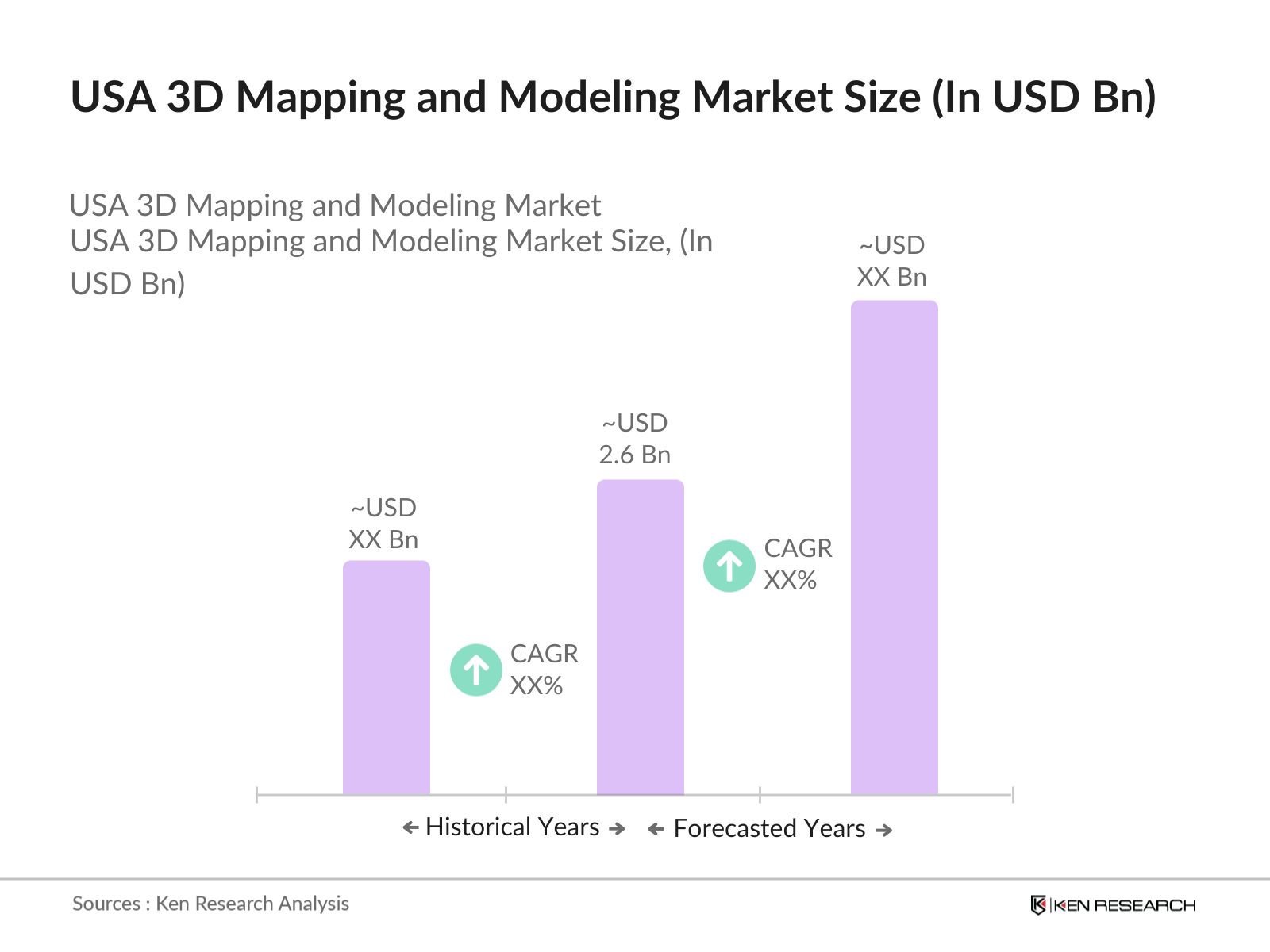
- The USA 3D Mapping and Modeling market is valued at USD 2.6 billion, driven by rapid urbanization, advancements in geospatial technology, and increasing adoption of 3D mapping in industries like construction, automotive, and gaming. The surge in smart city initiatives has further propelled the demand for 3D mapping to enhance urban planning and infrastructure management. Additionally, the increasing integration of 3D mapping with artificial intelligence (AI) and machine learning technologies has significantly boosted market growth. These drivers contribute to the growing need for real-time and high-precision 3D data across sectors.
- Dominant cities such as New York, Los Angeles, and San Francisco lead the USA 3D Mapping and Modeling market due to their advanced infrastructure development, strong adoption of smart city initiatives, and concentration of technology companies. New York, for example, has been at the forefront of utilizing 3D mapping for urban planning and public transportation optimization, while San Francisco leverages this technology for innovation in the autonomous vehicle industry.
- Federal funding programs for infrastructure development are driving the adoption of 3D mapping technologies. The U.S. Department of Transportation allocated $200 billion for infrastructure mapping in 2024, focusing on transportation systems, water resources, and environmental monitoring. This funding is accelerating the deployment of 3D mapping technologies in infrastructure projects nationwide .
Market Segmentation
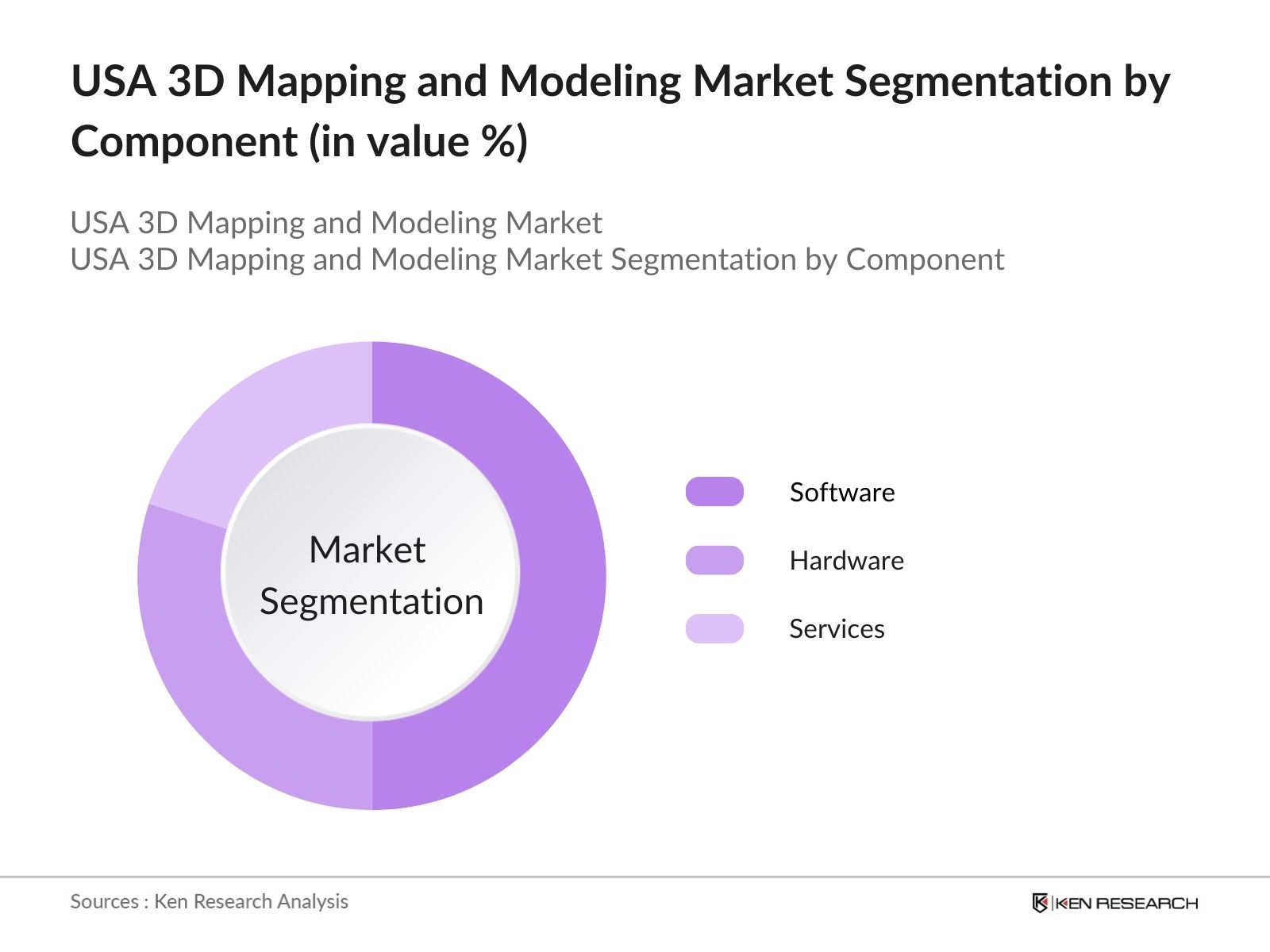
- By Component: The USA 3D Mapping and Modeling market is segmented by component into hardware, software, and services. In this segmentation, software dominates the market due to its vital role in data visualization, manipulation, and rendering. The demand for advanced software solutions that integrate with AI for automated 3D modeling and large-scale urban planning has significantly increased. Moreover, innovations in cloud computing and real-time rendering technologies have made software solutions highly scalable and cost-efficient, further driving their dominance in the market.
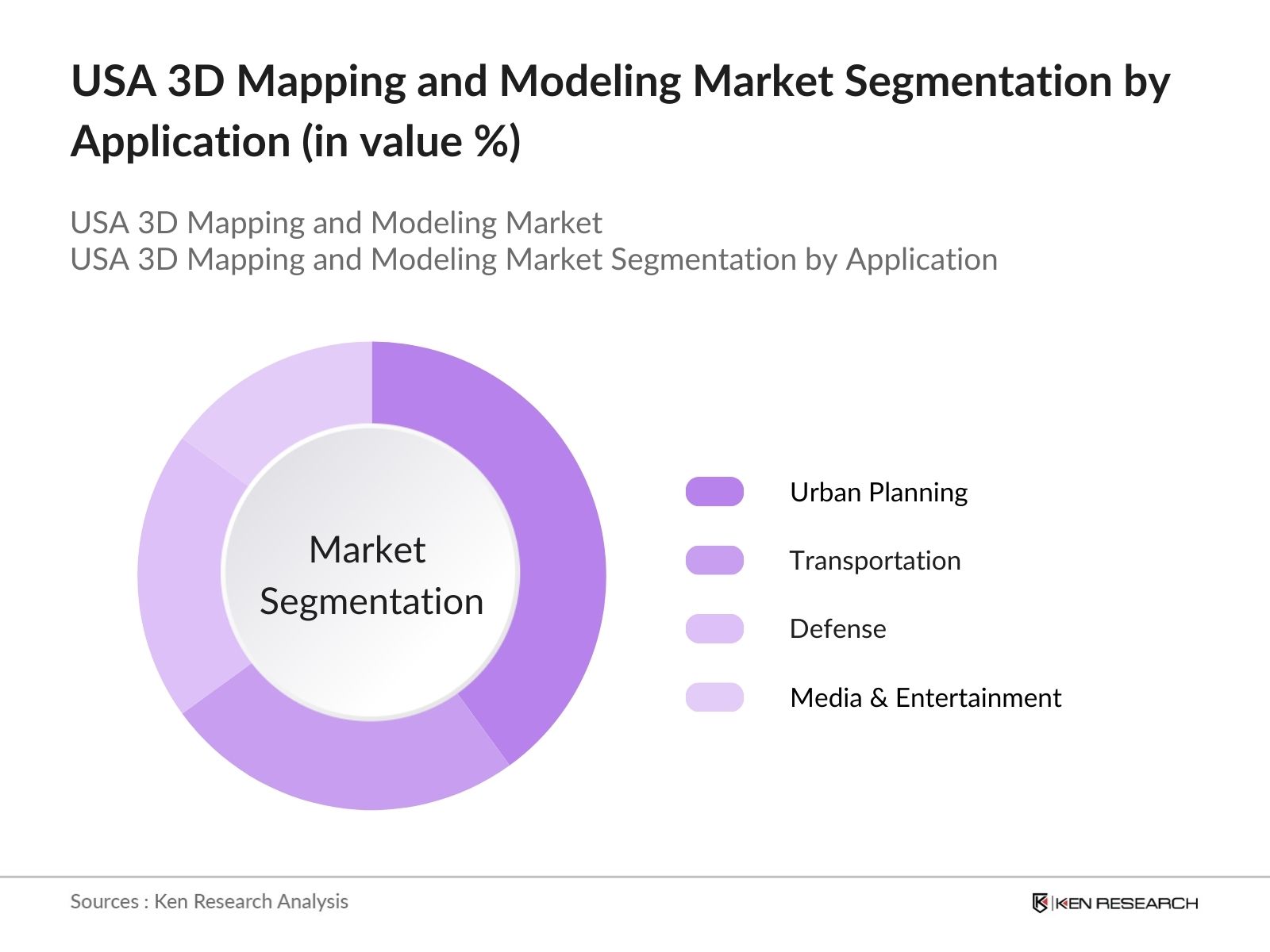
- By Application: The USA 3D Mapping and Modeling market is also segmented by application into urban planning, transportation, defense, and media & entertainment. Urban planning holds a dominant market share due to the growing demand for smart city development and infrastructure management solutions. With cities increasingly focusing on sustainability and efficient land use, 3D mapping provides crucial insights into topography, construction planning, and traffic flow management. This segment continues to gain traction as cities aim to optimize resources and accommodate growing populations.
USA 3D Mapping and Modeling Market Competitive Landscape
The USA 3D Mapping and Modeling market is dominated by a mix of established technology companies and specialized geospatial solution providers. Companies like Autodesk and Trimble have maintained a leading position by offering cutting-edge software tools and platforms. Meanwhile, firms like Apple and Google continue to influence the market through their integration of 3D mapping in consumer technologies such as mobile applications and navigation systems.
|
Company |
Establishment Year |
Headquarters |
No. of Employees |
Clinical Trials (No.) |
Revenue (USD M) |
Partnerships |
FDA Approvals |
R&D Investments |
Global Reach |
|
Autodesk, Inc. |
1982 |
San Rafael, California |
|||||||
|
Trimble Inc. |
1978 |
Sunnyvale, California |
|||||||
|
Google (Alphabet Inc.) |
1998 |
Mountain View, California |
|||||||
|
Apple Inc. |
1976 |
Cupertino, California |
|||||||
|
Esri |
1969 |
Redlands, California |
USA 3D Mapping and Modeling Industry Analysis
Growth Drivers
- Increasing Adoption in Urban Planning and Smart Cities: Urban planning and the development of smart cities in the U.S. have seen a surge in demand for 3D mapping technologies. According to data from the U.S. Department of Transportation, over $500 billion has been allocated for smart city infrastructure projects in 2024, driving the adoption of advanced 3D mapping solutions for planning and infrastructure development. Cities like New York and Chicago are integrating 3D modeling to optimize transportation networks, energy distribution, and environmental monitoring systems.
- Growing Demand in Autonomous Vehicles: The autonomous vehicle sector is rapidly adopting 3D mapping and modeling technologies to enhance navigation systems. The National Highway Traffic Safety Administration (NHTSA) has reported an increase in autonomous vehicle testing, with over 100 companies now using 3D mapping to develop self-driving systems . The demand for high-definition 3D maps to support real-time vehicle navigation is critical as autonomous driving technologies advance, especially in urban and highway settings.
- Technological Advancements in Geospatial Solutions: Technological improvements in geospatial solutions have significantly enhanced 3D mapping capabilities. According to the U.S. Geological Survey (USGS), advancements in Light Detection and Ranging (LiDAR) technology are enabling more accurate topographic and environmental mapping . In 2024, over 2,000 new geospatial projects across the U.S. are incorporating these technologies to improve data accuracy and real-time updates, especially in sectors like agriculture, transportation, and urban development.
Market Restraints
- High Implementation Costs: The initial costs of implementing 3D mapping solutions remain a barrier for many industries. According to the U.S. Census Bureau, the average cost for adopting full-scale 3D mapping and modeling solutions for urban planning projects ranges between $5 to $10 million, depending on the scale of the project . Smaller enterprises and municipalities often face budget constraints, limiting their ability to deploy these technologies.
- Data Privacy and Security Concerns: With the increasing use of geospatial data, concerns over data privacy and security have intensified. The U.S. Government Accountability Office (GAO) reported that over 65% of surveyed organizations expressed concerns regarding the secure handling of sensitive location data used in 3D mapping . Regulatory frameworks like the California Consumer Privacy Act (CCPA) are pushing for stricter data protection measures, further complicating the integration of mapping solutions .
USA 3D Mapping and Modeling Market Future Outlook
The USA 3D Mapping and Modeling market is expected to witness significant growth over the next five years, driven by continuous technological advancements, smart city projects, and increased adoption of AI-powered 3D solutions. The demand for real-time 3D data in sectors like transportation, real estate, and defense will further contribute to market expansion. Additionally, government support for infrastructure development and the integration of 3D mapping with autonomous vehicle technology is likely to play a critical role in market growth.
Market Opportunities
- Expansion in AR and VR Applications: The rise of augmented reality (AR) and virtual reality (VR) technologies is driving demand for 3D mapping in gaming, entertainment, and healthcare. According to the U.S. Department of Commerce, AR and VR applications generated over $16 billion in revenue in 2023, and 3D mapping technologies are playing a critical role in creating immersive environments . This trend presents a significant opportunity for growth in the entertainment and education sectors .
- Growing Use in Disaster Management and Response: The use of 3D mapping in disaster management is expanding rapidly in the U.S., driven by the need for real-time solutions in emergency situations. According to FEMA, 3D mapping tools were used in over 150 disaster response scenarios in 2023, helping authorities map flood zones, wildfire paths, and earthquake fault lines . This capability is crucial in accelerating recovery efforts and planning future mitigation strategies.
Scope of the Report
|
Segment |
Sub-Segment |
|
By Component |
Hardware, Software, Services |
|
By Application |
Urban Planning, Construction and BIM, Transportation, |
|
Defense and Security, Media and Entertainment |
|
|
By Technology |
3D Scanning, 3D Rendering, GIS |
|
By Vertical |
Government and Public Sector, Commercial, Defense, |
|
Real Estate, Media and Entertainment |
|
|
By Region |
North-East, West, South, Mid-West |
Products
Key Target Audience
Urban Planning Authorities
Autonomous Vehicle Manufacturers
Infrastructure Development Firms
Defense Contractors
Smart City Solution Providers
Real Estate Developers
Investor and Venture Capitalist Firms
Government and Regulatory Bodies (Federal Communications Commission, Department of Transportation)
Companies
Players Mentioned in the Report:
Autodesk, Inc.
Trimble Inc.
Google (Alphabet Inc.)
Apple Inc.
Esri
Bentley Systems, Incorporated
Dassault Systmes
Intermap Technologies
CyberCity 3D, Inc.
Topcon Corporation
Hexagon AB
The Sanborn Map Company, Inc.
Vricon
CivilMaps
GeoDigital
Table of Contents
1. USA 3D Mapping and Modeling Market Overview
1.1. Definition and Scope
1.2. Market Taxonomy
1.3. Market Growth Rate
1.4. Market Segmentation Overview
2. USA 3D Mapping and Modeling Market Size (In USD Bn)
2.1. Historical Market Size
2.2. Year-On-Year Growth Analysis
2.3. Key Market Developments and Milestones
3. USA 3D Mapping and Modeling Market Analysis
3.1. Growth Drivers
3.1.1. Increasing Adoption in Urban Planning and Smart Cities (Urban Planning, Smart Cities)
3.1.2. Growing Demand in Autonomous Vehicles (Autonomous Vehicles)
3.1.3. Technological Advancements in Geospatial Solutions (Geospatial Technology)
3.1.4. Integration with AI and Machine Learning (AI, Machine Learning Integration)
3.2. Market Challenges
3.2.1. High Implementation Costs (Cost Constraints)
3.2.2. Data Privacy and Security Concerns (Privacy, Security)
3.2.3. Technical Expertise Gap (Workforce Expertise)
3.2.4. Integration with Legacy Systems (Legacy Systems)
3.3. Opportunities
3.3.1. Expansion in AR and VR Applications (AR/VR Technologies)
3.3.2. Growing Use in Disaster Management and Response (Disaster Response)
3.3.3. Infrastructure Development Projects (Infrastructure Development)
3.4. Trends
3.4.1. Increased Use of Drone-Based 3D Mapping (Drone Technology)
3.4.2. Adoption in Real Estate and Construction (Real Estate, Construction)
3.4.3. Advances in Software and Cloud-Based Solutions (Cloud Technologies)
3.5. Government Regulations
3.5.1. Data Protection Regulations (Data Regulations)
3.5.2. Smart City Policies and Initiatives (Smart City Regulations)
3.5.3. Federal Funding for Infrastructure Mapping (Federal Infrastructure Funding)
3.6. SWOT Analysis
3.7. Stake Ecosystem
3.8. Porters Five Forces Analysis
3.9. Competition Ecosystem
4. USA 3D Mapping and Modeling Market Segmentation
4.1. By Component (In Value %)
4.1.1. Hardware
4.1.2. Software
4.1.3. Services
4.2. By Application (In Value %)
4.2.1. Urban Planning
4.2.2. Construction and Building Information Modeling (BIM)
4.2.3. Transportation and Logistics
4.2.4. Defense and Security
4.2.5. Media and Entertainment
4.3. By Technology (In Value %)
4.3.1. 3D Scanning
4.3.2. 3D Rendering
4.3.3. Geographic Information Systems (GIS)
4.4. By Vertical (In Value %)
4.4.1. Government and Public Sector
4.4.2. Commercial
4.4.3. Defense
4.4.4. Real Estate
4.4.5. Media and Entertainment
4.5. By Region (In Value %)
4.5.1. North-East
4.5.2. West
4.5.3. South
4.5.4. Mid-West
5. USA 3D Mapping and Modeling Market Competitive Analysis
5.1. Detailed Profiles of Major Companies
5.1.1. Autodesk, Inc.
5.1.2. Bentley Systems, Incorporated
5.1.3. Esri
5.1.4. Trimble Inc.
5.1.5. Dassault Systmes
5.1.6. Alphabet Inc. (Google)
5.1.7. Intermap Technologies
5.1.8. CyberCity 3D, Inc.
5.1.9. Topcon Corporation
5.1.10. Hexagon AB
5.1.11. The Sanborn Map Company, Inc.
5.1.12. Apple Inc.
5.1.13. Vricon
5.1.14. CivilMaps
5.1.15. GeoDigital
5.2. Cross Comparison Parameters (Employee Count, Headquarters, Revenue, Technology Focus, Market Reach, Key Partnerships, Strategic Initiatives, Key Innovations)
5.3. Market Share Analysis
5.4. Strategic Initiatives
5.5. Mergers and Acquisitions
5.6. Investment Analysis
5.7. Venture Capital Funding
5.8. Government Grants
5.9. Private Equity Investments
6. USA 3D Mapping and Modeling Market Regulatory Framework
6.1. Data Protection Laws
6.2. Compliance Requirements
6.3. Certification Processes
7. USA 3D Mapping and Modeling Future Market Size (In USD Bn)
7.1. Future Market Size Projections
7.2. Key Factors Driving Future Market Growth
8. USA 3D Mapping and Modeling Future Market Segmentation
8.1. By Component (In Value %)
8.2. By Application (In Value %)
8.3. By Technology (In Value %)
8.4. By Vertical (In Value %)
8.5. By Region (In Value %)
9. USA 3D Mapping and Modeling Market Analysts Recommendations
9.1. TAM/SAM/SOM Analysis
9.2. Customer Cohort Analysis
9.3. Marketing Initiatives
9.4. White Space Opportunity Analysis
Disclaimer
Contact Us
Research Methodology
Step 1: Identification of Key Variables
The first step in the research involved mapping all stakeholders in the USA 3D Mapping and Modeling market, including geospatial technology providers, urban planners, and automotive manufacturers. Extensive desk research was conducted to identify the primary variables that affect market dynamics, such as technology adoption rates and infrastructure development trends.
Step 2: Market Analysis and Construction
This phase focused on compiling historical data from the past five years on market penetration, software and hardware adoption rates, and revenue generation. The analysis aimed to quantify the impact of key drivers such as urbanization and smart city initiatives, while ensuring data accuracy through comparison with service quality metrics.
Step 3: Hypothesis Validation and Expert Consultation
Market hypotheses were tested by engaging with experts from various industries, including urban planning, automotive, and defense. These consultations were conducted via computer-assisted telephone interviews (CATIs), providing critical insights into operational challenges, financial performance, and future opportunities.
Step 4: Research Synthesis and Final Output
The final stage involved synthesizing the findings from multiple sources, including government reports and expert interviews, to create a comprehensive overview of the USA 3D Mapping and Modeling market. This approach ensured that the data was reliable, validated, and actionable for industry stakeholders.
Frequently Asked Questions
01. How big is the USA 3D Mapping and Modeling market?
The USA 3D Mapping and Modeling market is valued at USD 2.6 billion. This valuation is driven by the increasing demand for geospatial technologies across various sectors, including urban planning, automotive, and defense.
02. What are the challenges in the USA 3D Mapping and Modeling market?
Key challenges include high implementation costs, data privacy concerns, and the need for skilled technical expertise to operate and maintain 3D mapping systems. The complexity of integrating these systems with legacy infrastructure also poses a significant challenge.
03. Who are the major players in the USA 3D Mapping and Modeling market?
The market is dominated by companies such as Autodesk, Trimble, Google, Apple, and Esri. These companies leverage their expertise in geospatial technology and software development to provide cutting-edge solutions for industries like urban planning and defense.
04. What are the growth drivers of the USA 3D Mapping and Modeling market?
Growth is driven by factors such as advancements in AI and machine learning, the rise of smart city projects, and the increasing demand for real-time 3D data in sectors like transportation, defense, and media.
Why Buy From Us?

What makes us stand out is that our consultants follows Robust, Refine and Result (RRR) methodology. i.e. Robust for clear definitions, approaches and sanity checking, Refine for differentiating respondents facts and opinions and Result for presenting data with story

We have set a benchmark in the industry by offering our clients with syndicated and customized market research reports featuring coverage of entire market as well as meticulous research and analyst insights.

While we don't replace traditional research, we flip the method upside down. Our dual approach of Top Bottom & Bottom Top ensures quality deliverable by not just verifying company fundamentals but also looking at the sector and macroeconomic factors.

With one step in the future, our research team constantly tries to show you the bigger picture. We help with some of the tough questions you may encounter along the way: How is the industry positioned? Best marketing channel? KPI's of competitors? By aligning every element, we help maximize success.

Our report gives you instant access to the answers and sources that other companies might choose to hide. We elaborate each steps of research methodology we have used and showcase you the sample size to earn your trust.

If you need any support, we are here! We pride ourselves on universe strength, data quality, and quick, friendly, and professional service.