















USA Fruit Puree Market Outlook to 2030
Region:North America
Author(s):Naman Rohilla
Product Code:KROD7277
December 2024
85
About the Report
USA Fruit Puree Market Overview
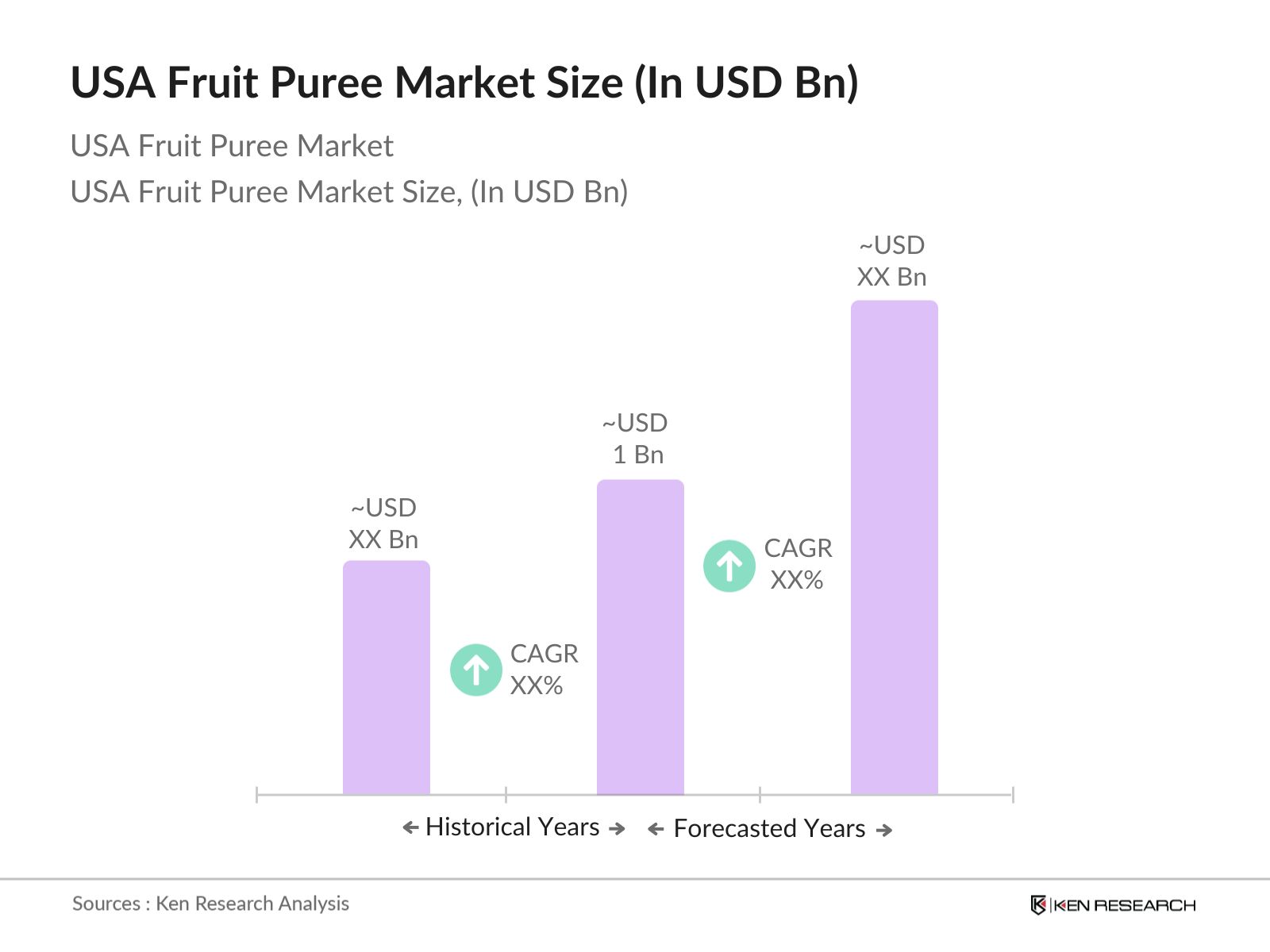
- The USA Fruit Puree market, valued at USD 1 billion, is driven by rising demand from health-conscious consumers, food and beverage manufacturers, and the baby food segment. The increasing preference for natural ingredients in processed foods, along with innovations in organic fruit products, has contributed to the market's expansion. Major food brands are also incorporating fruit puree into their product lines to cater to the growing trend of functional foods, which focus on health benefits beyond basic nutrition.
- Cities like Los Angeles, Miami, and New York dominate the USA Fruit Puree market due to their well-established food processing industries and proximity to agricultural zones. The concentration of fruit production in states like California and Florida ensures consistent availability of raw materials, while the high demand for diverse culinary products and functional beverages in these urban centers drives their dominance in the market.
- The Food and Drug Administration (FDA) enforces strict safety standards for fruit purees, ensuring they are free from contaminants and safe for consumption. The FDA's 2023 Food Safety Modernization Act (FSMA) mandates stringent controls during fruit processing to minimize contamination risks. Manufacturers must adhere to Hazard Analysis and Critical Control Points (HACCP) protocols, which require continuous monitoring and reporting. Non-compliance with these regulations can result in heavy penalties and product recalls, impacting market operations.
USA Fruit Puree Market Segmentation
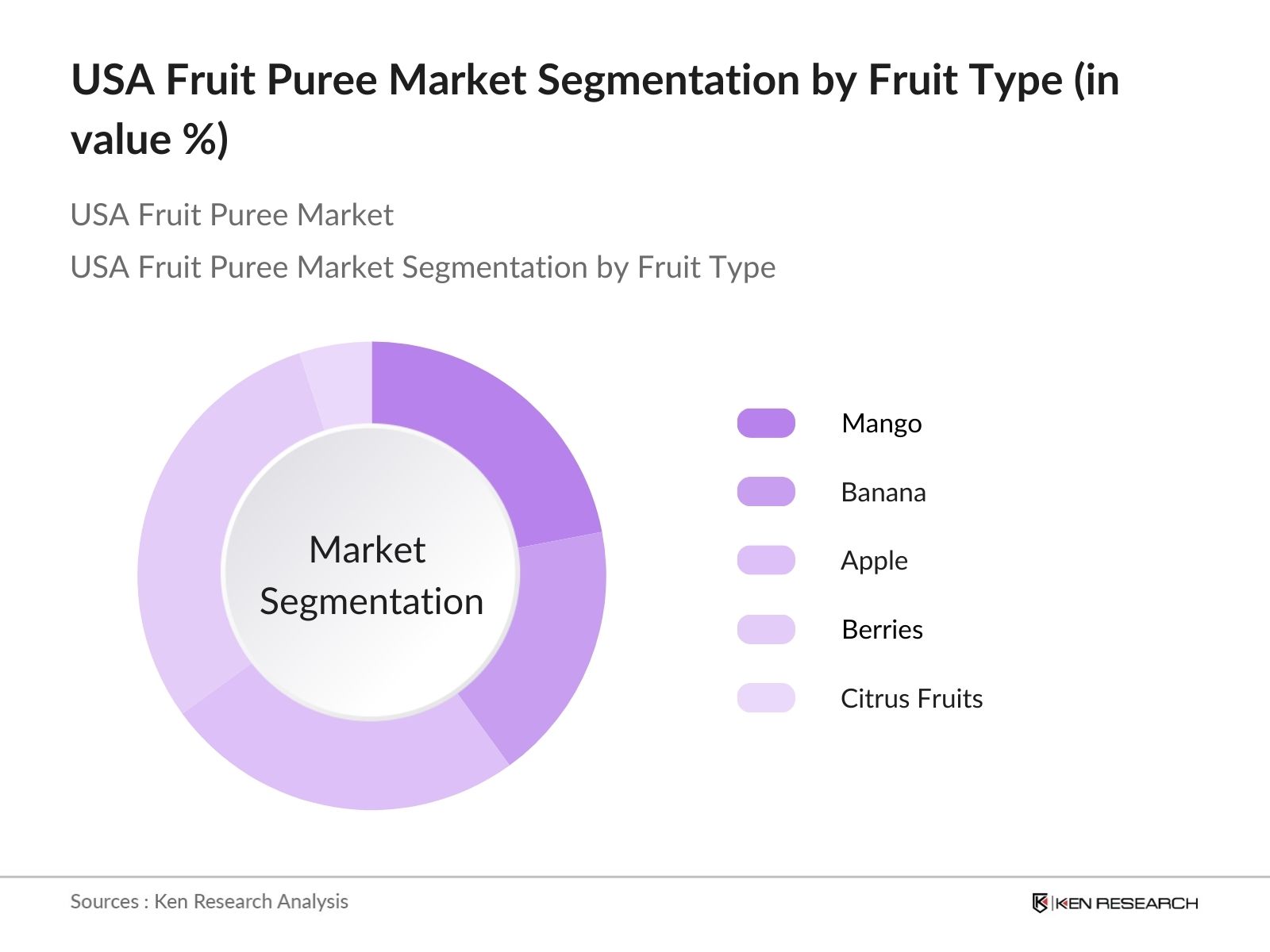
- By Fruit Type: The USA Fruit Puree market is segmented by fruit type into mango, banana, apple, berries, and citrus fruits. Among these, berries have a dominant market share due to their widespread use in smoothies, jams, and functional foods. The health benefits associated with berries, such as their high antioxidant content, have fueled consumer demand. Additionally, the popularity of exotic berry blends in beverages and desserts has further strengthened their position in the market. Berries are increasingly used by food manufacturers to meet the demand for premium, health-focused products.
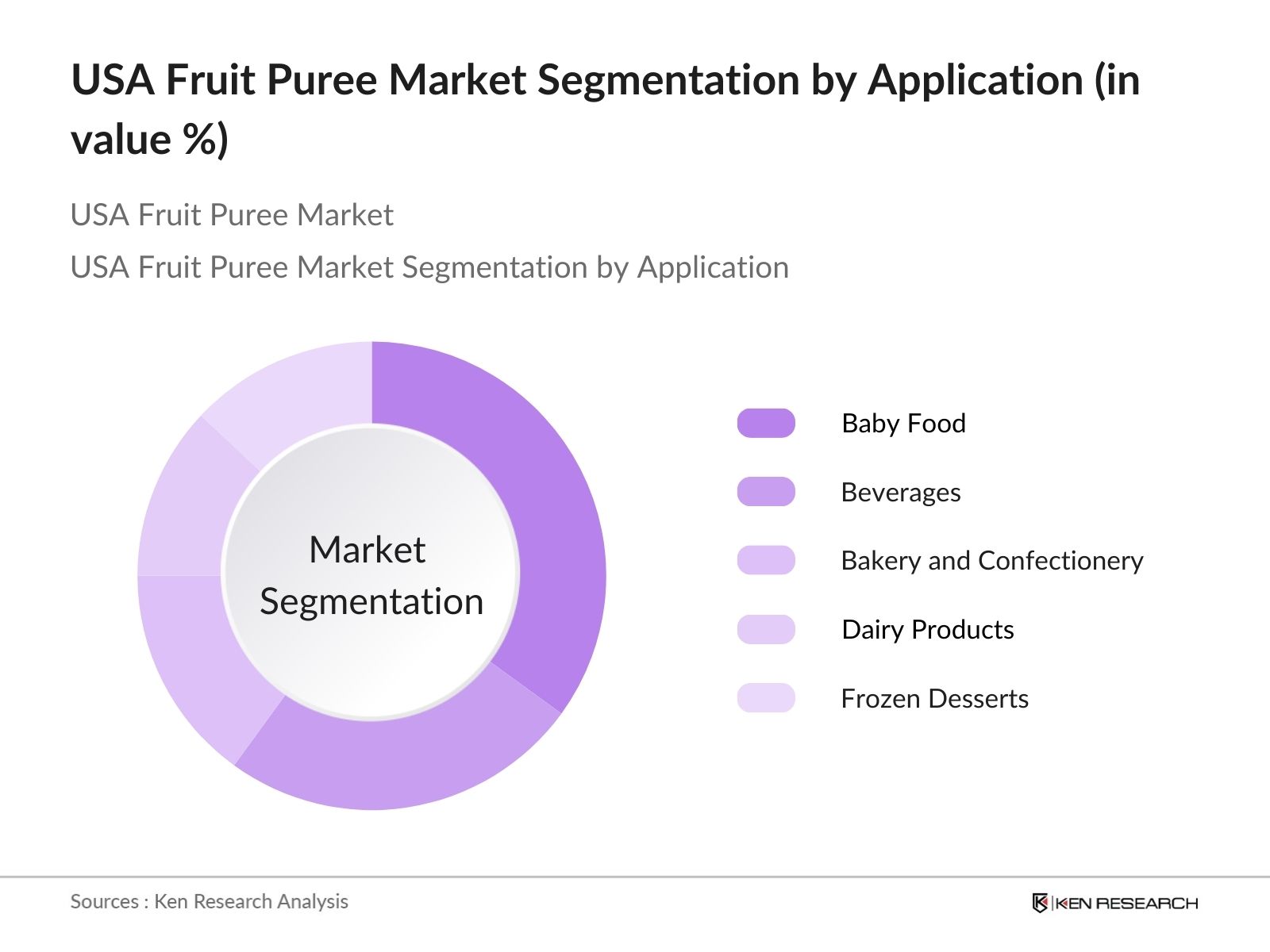
- By Application: The market is also segmented by application into baby food, beverages, bakery and confectionery, dairy products, and frozen desserts. Baby food holds a notable share of the market, primarily driven by parents preference for clean-label, organic options for their children. Fruit purees, known for their nutrient content and easy digestibility, are frequently used in baby food products. The convenience of ready-to-eat puree pouches has also contributed to the segments dominance, appealing to busy parents seeking nutritious, on-the-go feeding solutions.
USA Fruit Puree Market Competitive Landscape
The USA Fruit Puree market is dominated by established companies that leverage advanced processing technologies and wide distribution networks to maintain their competitive edge. Major players like The J.M. Smucker Company and Tree Top, Inc. lead the market, benefiting from long-standing relationships with fruit growers and their diverse product portfolios.
|
Company |
Year Established |
Headquarters |
Revenue (USD) |
No. of Employees |
Key Product Lines |
Distribution Channels |
Processing Techniques |
Market Strategy |
|
The J.M. Smucker Company |
1897 |
Ohio, USA |
- |
- |
- |
- |
- |
- |
|
Tree Top, Inc. |
1960 |
Washington, USA |
- |
- |
- |
- |
- |
- |
|
SunOpta Inc. |
1973 |
Minnesota, USA |
- |
- |
- |
- |
- |
- |
|
Del Monte Foods, Inc. |
1886 |
California, USA |
- |
- |
- |
- |
- |
- |
|
Kerry Group |
1972 |
Ireland |
- |
- |
- |
- |
- |
- |
USA Fruit Puree Market Analysis
USA Fruit Puree Market Growth Drivers
- Increasing Demand for Natural Ingredients: The growing demand for natural ingredients in food products is a growth driver in the USA fruit puree market. According to USDA, the consumption of fresh fruits in the US reached 126.5 kilograms per capita in 2023, showing an inclination toward natural and minimally processed foods. This trend is driven by consumer preferences for healthier, more natural food items that align with clean-label trends, particularly in the processed foods sector like fruit purees. The World Bank reports that this shift is linked to increased awareness of the health benefits of natural ingredients.
- Rising Health Consciousness Among Consumers: Health consciousness among US consumers has surged, driven by the prevalence of lifestyle diseases such as diabetes and obesity. The CDC's 2023 report indicated that nearly 42% of adults in the US were classified as obese, which has spurred demand for healthier alternatives like fruit purees, which are free from artificial sugars and additives. This trend is expected to continue as more consumers shift toward natural, unprocessed foods in their diets to manage weight and reduce health risks.
- Expansion of Baby Food Segment: The baby food market in the US has seen a steady demand for fruit purees as a primary ingredient in many infant food products. In 2023, the US Department of Agriculture reported that the number of children aged 0-5 had reached over 20 million, fueling demand for ready-to-eat, nutritious, and natural baby food options. Fruit puree, with its high nutritional content and convenience, has become a key component in meeting this demand, reflecting a growth opportunity within the segment.
USA Fruit Puree Market Challenges
- High Production and Processing Costs: Production and processing costs of fruit purees remain high due to labor, energy, and equipment expenses. The USDA reported in 2024 that the cost of processing fruits increased by 6.7%, driven by higher energy and labor costs. These cost factors challenge manufacturers, particularly small and medium-sized enterprises, making it difficult to offer competitively priced products. Furthermore, stringent food safety standards and the need for advanced processing technologies add to the financial burden on producers.
- Seasonal Dependence of Raw Material Availability: The seasonal nature of fruit production creates supply chain volatility for fruit puree manufacturers. The USDA data shows that unpredictable weather patterns, particularly due to climate change, led to a 9.8% fluctuation in fruit yields in 2023. This volatility in the availability of raw materials such as apples, berries, and mangoes can cause shortages and price hikes, making it difficult for producers to maintain consistent output levels and meet demand year-round.
USA Fruit Puree Market Future Outlook
Over the next five years, the USA Fruit Puree market is expected to witness growth driven by increasing demand for clean-label, organic products, and plant-based foods. The growing preference for natural ingredients in both the foodservice and retail sectors will continue to fuel demand. Additionally, innovations in fruit processing technologies, such as cold-pressed and high-pressure processing, will enable manufacturers to retain more nutrients and offer premium products, driving further growth in the market.
USA Fruit Puree Market Opportunities
- Innovation in Organic and Exotic Fruit Puree: There is growing interest in organic and exotic fruit purees, fueled by demand for premium and differentiated products. The USDA reported a 7.3% increase in organic fruit sales in 2023, driven by consumer awareness of health and sustainability issues. Exotic fruits like acai, guava, and dragon fruit are becoming popular in the US, offering new opportunities for fruit puree manufacturers to innovate and capture niche markets. These products cater to consumers seeking unique flavours and higher nutritional content.
- Growing Vegan and Plant-Based Food Trends: The rise of veganism and plant-based diets presents opportunities for fruit puree manufacturers. According to the Plant Based Foods Association, 2023 saw a 6% increase in the consumption of plant-based foods in the US. Fruit purees serve as essential ingredients in a wide range of vegan products, from desserts to smoothies. This growing trend opens up new avenues for manufacturers to cater to a rapidly expanding market segment, especially in the context of increasing health and sustainability awareness.
Scope of the Report
|
Fruit Type |
Mango Banana Apple Berries Citrus Fruits |
|
Application |
Baby Food Beverages Bakery and Confectionery Dairy Products Frozen Desserts |
|
Distribution Channel |
Online Retail Supermarkets and Hypermarkets Specialty Stores Foodservice |
|
Processing Type |
Conventional Organic |
|
Region |
Northeast Midwest South West |
Products
Key Target Audience
Fruit puree manufacturers
Food and beverage companies
Baby food producers
Retailers and distributors
Banks and Financial Institutions
Foodservice companies
Ingredient suppliers
Government and regulatory bodies (FDA, USDA)
Investor and venture capitalist firms
Companies
Players Mentioned in the Report
The J.M. Smucker Company
Tree Top, Inc.
SunOpta Inc.
Del Monte Foods, Inc.
Kerry Group
AGRANA Beteiligungs-AG
Nestl USA
Symrise AG
Doehler Group
Sensient Technologies Corporation
Table of Contents
1. USA Fruit Puree Market Overview
1.1. Definition and Scope
1.2. Market Taxonomy
1.3. Market Growth Rate
1.4. Market Segmentation Overview
2. USA Fruit Puree Market Size (In USD Bn)
2.1. Historical Market Size
2.2. Year-On-Year Growth Analysis
2.3. Key Market Developments and Milestones
3. USA Fruit Puree Market Analysis
3.1. Growth Drivers
3.1.1. Increasing Demand for Natural Ingredients
3.1.2. Rising Health Consciousness Among Consumers
3.1.3. Expansion of Baby Food Segment
3.1.4. Growing Popularity in Beverage Industry
3.2. Market Challenges
3.2.1. High Production and Processing Costs
3.2.2. Seasonal Dependence of Raw Material Availability
3.2.3. Supply Chain Disruptions (Weather and Logistics)
3.3. Opportunities
3.3.1. Innovation in Organic and Exotic Fruit Puree
3.3.2. Growing Vegan and Plant-Based Food Trends
3.3.3. Expansion into New Geographical Markets
3.4. Trends
3.4.1. Rise in Demand for Organic Fruit Puree
3.4.2. Use of Advanced Processing Techniques for Quality Retention
3.4.3. Increasing Use of Fruit Puree in Functional Foods
3.5. Government Regulations
3.5.1. FDA Regulations on Food Safety
3.5.2. Labeling and Organic Certification Requirements
3.5.3. Import/Export Tariffs and Restrictions
3.6. SWOT Analysis
3.7. Stakeholder Ecosystem
3.8. Porters Five Forces Analysis
3.9. Competition Ecosystem
4. USA Fruit Puree Market Segmentation
4.1. By Fruit Type (In Value %)
4.1.1. Mango
4.1.2. Banana
4.1.3. Apple
4.1.4. Berries (Strawberry, Blueberry, etc.)
4.1.5. Citrus Fruits (Orange, Lemon, etc.)
4.2. By Application (In Value %)
4.2.1. Baby Food
4.2.2. Beverages
4.2.3. Bakery and Confectionery
4.2.4. Dairy Products
4.2.5. Frozen Desserts
4.3. By Distribution Channel (In Value %)
4.3.1. Online Retail
4.3.2. Supermarkets and Hypermarkets
4.3.3. Specialty Stores
4.3.4. Foodservice
4.4. By Type of Processing (In Value %)
4.4.1. Conventional
4.4.2. Organic
4.5. By Region (In Value %)
4.5.1. Northeast
4.5.2. Midwest
4.5.3. South
4.5.4. West
5. USA Fruit Puree Market Competitive Analysis
5.1. Detailed Profiles of Major Competitors
5.1.1. Nestl USA
5.1.2. The Kraft Heinz Company
5.1.3. Tree Top, Inc.
5.1.4. The J.M. Smucker Company
5.1.5. SunOpta Inc.
5.1.6. Del Monte Foods, Inc.
5.1.7. AGRANA Beteiligungs-AG
5.1.8. Symrise AG
5.1.9. SVZ International B.V.
5.1.10. Doehler Group
5.1.11. Kerry Group
5.1.12. Ingredion Incorporated
5.1.13. Diana Food
5.1.14. TreeHouse Foods, Inc.
5.1.15. Sensient Technologies Corporation
5.2. Cross Comparison Parameters (Market Share, Revenue, Product Offerings, Distribution Channels, Processing Type, Organic Certifications, Market Presence, Innovation Capabilities)
5.3. Market Share Analysis
5.4. Strategic Initiatives
5.5. Mergers and Acquisitions
5.6. Investment Analysis
5.7. Private Equity Investments
6. USA Fruit Puree Market Regulatory Framework
6.1. USDA and FDA Standards for Fruit Processing
6.2. Organic Certification and Compliance
6.3. Trade and Tariff Regulations
6.4. Environmental Impact Regulations
7. USA Fruit Puree Future Market Size (In USD Bn)
7.1. Future Market Size Projections
7.2. Key Factors Driving Future Market Growth
8. USA Fruit Puree Future Market Segmentation
8.1. By Fruit Type (In Value %)
8.2. By Application (In Value %)
8.3. By Distribution Channel (In Value %)
8.4. By Type of Processing (In Value %)
8.5. By Region (In Value %)
9. USA Fruit Puree Market Analysts Recommendations
9.1. TAM/SAM/SOM Analysis
9.2. Key Customer Segments
9.3. White Space Opportunity Analysis
9.4. Strategic Partnerships and Collaboration
Research Methodology
Step 1: Identification of Key Variables
The research begins by mapping out all key stakeholders in the USA Fruit Puree Market, involving fruit producers, food manufacturers, distributors, and retailers. This phase uses extensive desk research and secondary sources to identify the primary variables affecting market trends, such as consumer preferences and supply chain dynamics.
Step 2: Market Analysis and Construction
Historical data analysis is conducted on fruit puree production, consumption, and revenue trends. The data is collated from both primary and secondary sources, ensuring a comprehensive understanding of market penetration rates, product demand, and sales trends. This stage also includes an evaluation of industry-specific performance metrics.
Step 3: Hypothesis Validation and Expert Consultation
To validate market hypotheses, interviews with industry experts, including representatives from major fruit puree manufacturers, are conducted. These consultations offer insights into market operations, pricing strategies, and future demand forecasts, helping refine the report's data points and assumptions.
Step 4: Research Synthesis and Final Output
The final stage involves synthesizing the research data into actionable insights. Inputs from fruit puree manufacturers, food and beverage companies, and distributors are integrated to create a holistic market report. The resulting analysis presents a detailed view of the current market landscape and future growth potential.
Frequently Asked Questions
01. How big is the USA Fruit Puree Market?
The USA Fruit Puree market was valued at USD 1 billion and is driven by rising demand for natural, organic ingredients across the food and beverage industry. Key applications include baby food and beverages.
02. What are the challenges in the USA Fruit Puree Market?
Challenges in the USA Fruit Puree market include high production costs due to seasonal dependence on raw materials and supply chain disruptions caused by weather conditions. Additionally, the cost of adopting advanced processing techniques is a barrier for some manufacturers.
03. Who are the major players in the USA Fruit Puree Market?
Major players in the USA Fruit Puree market include The J.M. Smucker Company, Tree Top, Inc., SunOpta Inc., Del Monte Foods, Inc., and Kerry Group. These companies lead due to their strong distribution networks, product innovation, and partnerships with fruit producers.
04. What are the growth drivers of the USA Fruit Puree Market?
The USA Fruit Puree market is driven by increased demand for health-conscious products, the expansion of organic food offerings, and rising consumer interest in functional foods. The growing use of fruit puree in beverages, dairy, and baby food segments further supports market growth.
Why Buy From Us?

What makes us stand out is that our consultants follows Robust, Refine and Result (RRR) methodology. i.e. Robust for clear definitions, approaches and sanity checking, Refine for differentiating respondents facts and opinions and Result for presenting data with story

We have set a benchmark in the industry by offering our clients with syndicated and customized market research reports featuring coverage of entire market as well as meticulous research and analyst insights.

While we don't replace traditional research, we flip the method upside down. Our dual approach of Top Bottom & Bottom Top ensures quality deliverable by not just verifying company fundamentals but also looking at the sector and macroeconomic factors.

With one step in the future, our research team constantly tries to show you the bigger picture. We help with some of the tough questions you may encounter along the way: How is the industry positioned? Best marketing channel? KPI's of competitors? By aligning every element, we help maximize success.

Our report gives you instant access to the answers and sources that other companies might choose to hide. We elaborate each steps of research methodology we have used and showcase you the sample size to earn your trust.

If you need any support, we are here! We pride ourselves on universe strength, data quality, and quick, friendly, and professional service.