















USA Life Coaches Market Outlook to 2030
Region:North America
Author(s):Shreya Garg
Product Code:KROD4340
November 2024
83
About the Report
USA Life Coaches Market Overview
- The USA life coaching market is valued at USD 1.52 billion, driven by a combination of increased awareness of mental health, personal development needs, and the rise in corporate wellness programs. Life coaching has evolved from niche personal development to a broader professional service, with demand from both individuals and organizations seeking to improve personal and professional success. Remote and virtual coaching platforms have further driven market adoption by making life coaching more accessible to a wider audience, boosting growth in recent years.
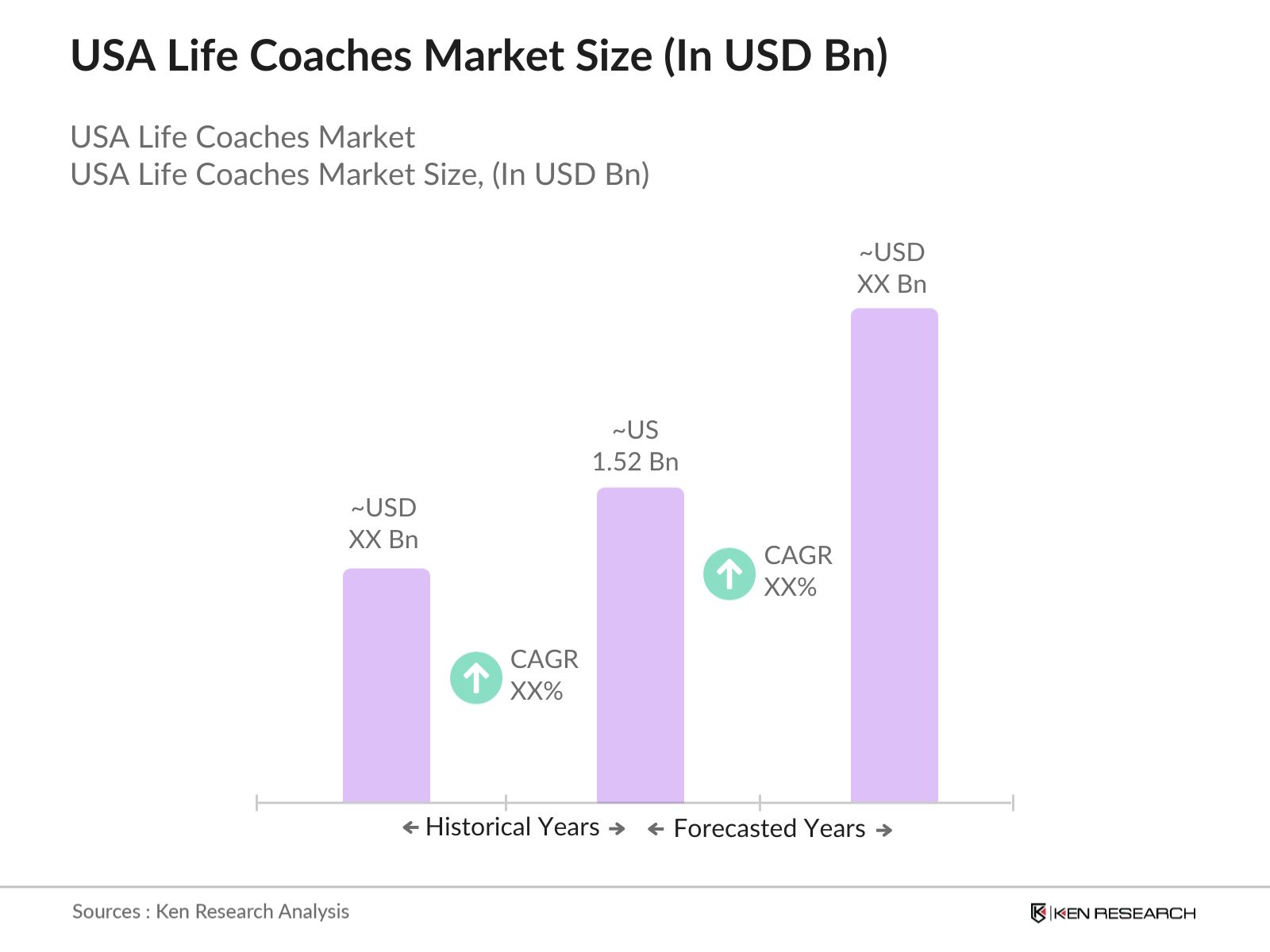
- Cities like New York, Los Angeles, and Chicago dominate the life coaching market due to their concentration of high-income professionals and corporations seeking coaching services. These cities also have a well-established culture of personal development and corporate training, leading to higher demand for life coaching services. Moreover, the presence of leading educational institutions and corporate headquarters in these regions further enhances the markets growth.
- Life coaching in the U.S. is guided by voluntary certification programs. The U.S. Department of Labor recognizes certification bodies such as the International Coach Federation (ICF) and the National Board for Health & Wellness Coaching (NBHWC), which had certified over 37,000 coaches by 2023. While these certifications are not mandatory, they offer credibility and assurance of standards, helping coaches build trust with clients and differentiate themselves in a crowded market.
USA Life Coaches Market Segmentation
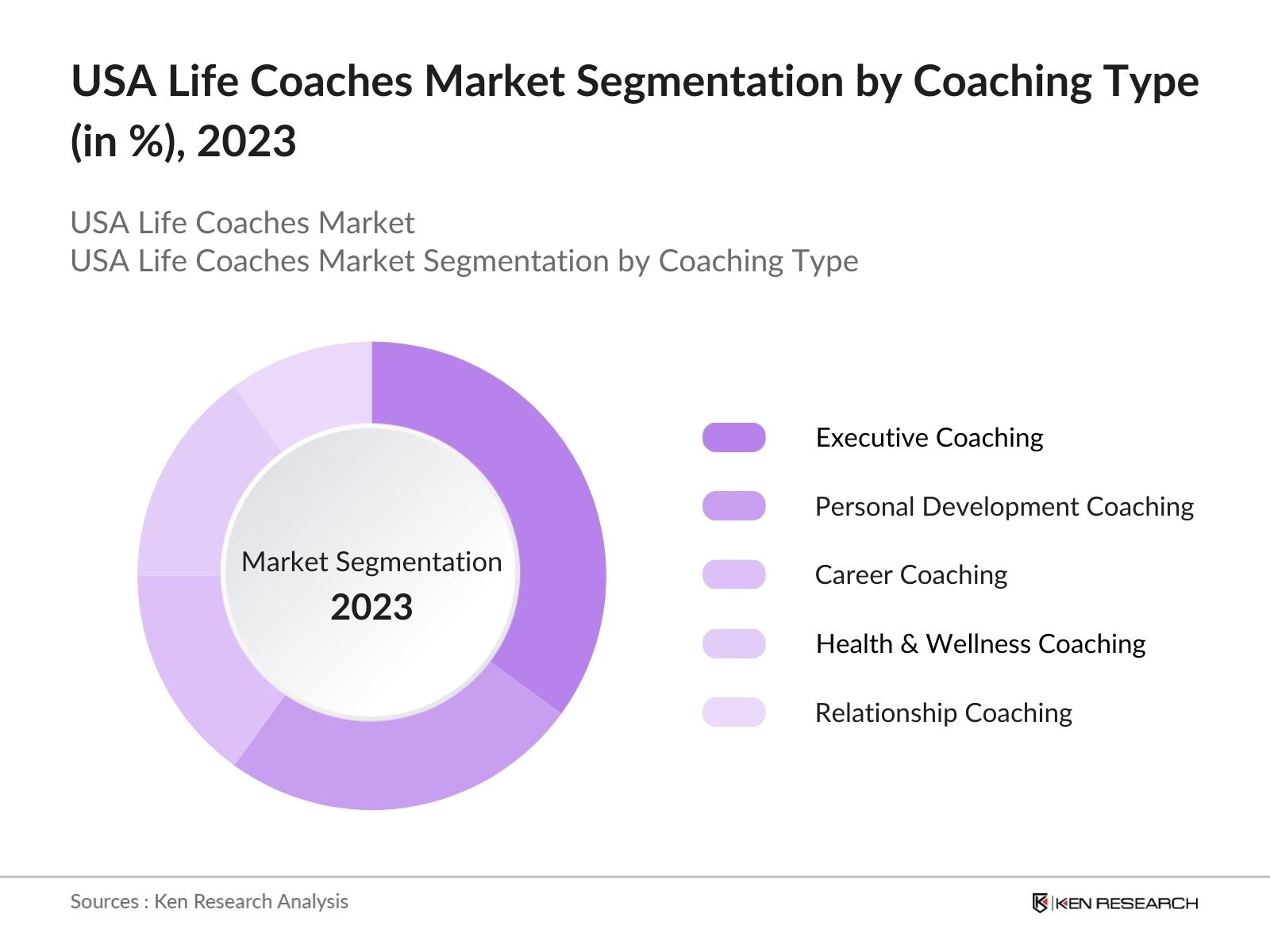
By Coaching Type: The market is segmented by coaching type into executive coaching, personal development coaching, career coaching, health & wellness coaching, and relationship coaching. Executive coaching dominates the market due to its presence in corporate environments, where senior leaders and executives seek guidance to improve leadership skills, decision-making capabilities, and organizational strategies. Corporations in the USA increasingly invest in executive coaching to ensure business continuity and improve the overall performance of their leadership teams.
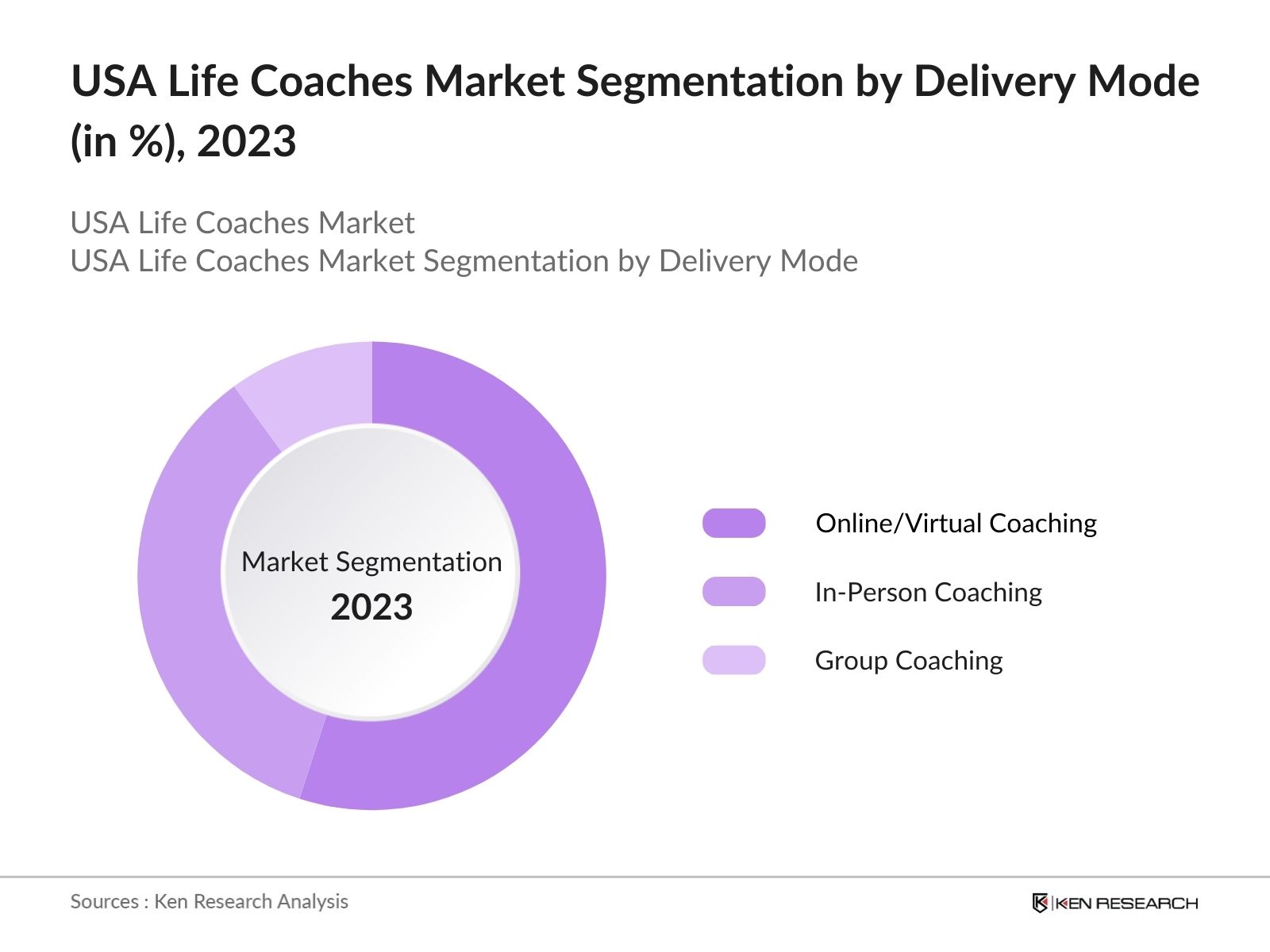
By Delivery Mode: The market is also segmented by delivery mode into in-person coaching, online/virtual coaching, and group coaching. Online/virtual coaching has the highest market share due to the convenience and flexibility it offers both coaches and clients. With the rise of digital platforms and communication tools, clients increasingly prefer virtual coaching sessions as they allow for more personalized and flexible schedules. Additionally, the expansion of digital coaching apps and platforms has further propelled this segment.
USA Life Coaches Market Competitive Landscape
The USA life coaching market is characterized by a mixture of globally recognized coaches, smaller boutique firms, and digital coaching platforms. Many key players operate on both a personal and corporate level, offering services across different life coaching segments. The market is dominated by well-known individuals and organizations that have developed reputations, often through book publications, speaking engagements, and strong digital presences. The advent of technology has also seen the rise of platform-based coaching companies such as BetterUp, which offer scalable coaching solutions for enterprises.
|
Company |
Establishment Year |
Headquarters |
Specialization |
No. of Clients |
Revenue (2023) |
Certifications |
Key Technologies |
Global Presence |
|
Tony Robbins |
1986 |
San Diego, CA |
||||||
|
BetterUp |
2013 |
San Francisco, CA |
||||||
|
The Life Coach School |
2011 |
Dallas, TX |
||||||
|
Co-Active Training Institute |
1992 |
San Rafael, CA |
||||||
|
Brendon Burchard |
2009 |
Portland, OR |
USA Life Coaches Industry Analysis
Growth Drivers
- Rising Awareness of Mental Health: The increasing focus on mental health awareness has contributed to the demand for life coaches in the USA. In 2023, the National Institute of Mental Health reported that around 57.8 million U.S. adults lived with mental illness. This has led to higher demand for professional life coaching services to support mental well-being, alongside traditional therapy. The U.S. Department of Health and Human Services (HHS) allocated $3.2 billion in 2023 toward mental health initiatives, underscoring the growing importance of mental health services, including life coaching, to meet this demand.
- Corporate Wellness Programs: Corporate wellness programs increasingly include life coaching as an essential component. In 2022, over 60% of companies with more than 200 employees offered wellness programs that included life coaching services. The U.S. Bureau of Labor Statistics (BLS) reported that corporate wellness programs collectively benefited over 140 million employees nationwide. This rise in corporate demand has contributed to the life coaching market's expansion, as organizations prioritize employee development and personal growth to increase productivity and reduce turnover costs.
Market Challenges
- Lack of Regulatory Oversight: The absence of regulatory oversight in the life coaching industry creates challenges related to standardization. The U.S. Department of Labor highlights that life coaching lacks a national accreditation body or mandatory credentialing, resulting in inconsistent service quality. With approximately 23,000 individual life coaches operating without standardized qualifications, this unregulated nature has limited the credibility and growth potential of the sector.
- High Cost of Services: Life coaching services in the U.S. can be cost-prohibitive for many individuals. According to the Bureau of Economic Analysis (BEA), the average household income in the U.S. was $74,580 in 2022, while life coaching fees can range between $100 to $500 per session. This high-cost limits accessibility, especially for low- to middle-income households. Without affordability, the potential reach of life coaching services remains restricted, impacting market growth.
USA Life Coaches Market Future Outlook
Over the next five years, the USA life coaching market is expected to grow due to increasing demand for personal development, leadership training, and corporate wellness programs. As businesses recognize the value of life coaching in improving productivity and employee well-being, more companies will likely integrate coaching into their human resources strategies. The rise of digital platforms will also make coaching services more accessible, especially in remote and virtual formats. Innovations such as AI-powered coaching solutions and data-driven insights will offer new opportunities for personalized coaching experiences.
Future Market Opportunities
- Integration of AI and Digital Tools in Coaching: The integration of artificial intelligence (AI) and digital tools in coaching presents growth opportunities. In 2023, the U.S. Department of Commerce reported that AI-driven tools for personalized coaching saw a 30% increase in adoption across various service sectors, including life coaching. Tools like AI-powered chatbots and virtual assistants help coaches provide real-time feedback and personalized development plans, enhancing client engagement and operational efficiency.
- Expansion of Niche Coaching: Niche coaching services such as career, relationship, and spiritual coaching are gaining traction in the U.S. In 2022, the U.S. Census Bureau recorded that 12.3 million people actively sought career coaching services, while 6.7 million opted for relationship coaching. This trend suggests a growing appetite for specialized coaching services, allowing coaches to cater to specific client needs and expand their service offerings, which drives market diversity.
Scope of the Report
|
By Coaching Type |
Executive Coaching Personal Development Coaching Career Coaching Health & Wellness Coaching Relationship Coaching |
|
By Delivery Mode |
In-Person Coaching Online/Virtual Coaching Group Coaching |
|
By Client Type |
Corporate Clients Individual Clients Educational Institutions |
|
By Credentialing |
ICF-Certified Coaches NBHWC-Certified Coaches Non-Certified Coaches |
|
By Region |
Northeast Midwest West Coast Southeast Southwest |
Products
Key Target Audience
Corporate HR Departments
Mental Health Organizations
Entrepreneurs and Small Business Owners
High-Net-Worth Individuals
Athletes and Sports Teams
Investor and Venture Capitalist Firms
Banks and Financial Institutes
Government and Regulatory Bodies (International Coaching Federation, National Board for Health & Wellness Coaching)
Non-Profit Organizations
Companies
Major Players
Tony Robbins
BetterUp
The Life Coach School
Brendon Burchard
Co-Active Training Institute
Martha Beck Inc.
Jack Canfield Coaching Group
Mindvalley Coaching
Erickson Coaching International
Institute for Professional Excellence in Coaching (iPEC)
High Performance Institute
Udemy Life Coaching Courses
Integral Coaching Canada
Noomii
CoachVille
Table of Contents
1. USA Life Coaches Market Overview
1.1. Definition and Scope
1.2. Market Taxonomy
1.3. Key Market Growth Factors
1.4. Market Segmentation Overview
2. USA Life Coaches Market Size (In USD Bn)
2.1. Historical Market Size
2.2. Year-On-Year Growth Analysis
2.3. Key Market Developments and Milestones
3. USA Life Coaches Market Analysis
3.1. Growth Drivers
3.1.1. Rising Awareness of Mental Health
3.1.2. Corporate Wellness Programs (Increasing demand for life coaches within corporate training)
3.1.3. Increased Adoption of Remote Coaching (Due to digital platforms and technology)
3.1.4. Changing Lifestyles and Self-Development Focus
3.2. Market Challenges
3.2.1. Lack of Regulatory Oversight (Absence of standardization and credentialing)
3.2.2. High Cost of Services (Impact on client affordability)
3.2.3. Market Fragmentation (Numerous small players and individual coaches)
3.3. Opportunities
3.3.1. Integration of AI and Digital Tools in Coaching
3.3.2. Expansion of Niche Coaching (Career, Relationship, Spiritual coaching)
3.3.3. Growth of Group Coaching and Workshops (Cost-effective alternatives)
3.4. Trends
3.4.1. Personalization and Tailored Coaching Programs
3.4.2. Increased Use of Social Media for Branding and Client Acquisition
3.4.3. Blended Coaching Models (Combining online and in-person sessions)
3.5. Government Regulation
3.5.1. Certification Bodies and Accreditation Programs (ICF, NBHWC, etc.)
3.5.2. Professional Liability Insurance Requirements
3.5.3. Taxation Policies for Coaching Services (Impact on independent coaches)
3.6. SWOT Analysis
3.7. Stakeholder Ecosystem (Corporate clients, individual clients, regulatory bodies)
3.8. Porters Five Forces Analysis
3.9. Competitive Ecosystem
4. USA Life Coaches Market Segmentation
4.1. By Coaching Type (In Value %)
4.1.1. Executive Coaching
4.1.2. Personal Development Coaching
4.1.3. Career Coaching
4.1.4. Health & Wellness Coaching
4.1.5. Relationship Coaching
4.2. By Delivery Mode (In Value %)
4.2.1. In-Person Coaching
4.2.2. Online/Virtual Coaching
4.2.3. Group Coaching
4.3. By Client Type (In Value %)
4.3.1. Corporate Clients
4.3.2. Individual Clients
4.3.3. Educational Institutions
4.4. By Credentialing (In Value %)
4.4.1. ICF-Certified Coaches
4.4.2. NBHWC-Certified Coaches
4.4.3. Non-Certified Coaches
4.5. By Region (In Value %)
4.5.1. Northeast
4.5.2. Midwest
4.5.3. West Coast
4.5.4. Southeast
4.5.5. Southwest
5. USA Life Coaches Market Competitive Analysis
5.1 Detailed Profiles of Major Competitors
5.1.1. Tony Robbins
5.1.2. Martha Beck Inc.
5.1.3. Jack Canfield Coaching Group
5.1.4. BetterUp
5.1.5. The Life Coach School
5.1.6. Brendon Burchard
5.1.7. Co-Active Training Institute
5.1.8. CoachVille
5.1.9. Institute for Professional Excellence in Coaching (iPEC)
5.1.10. High Performance Institute
5.1.11. Udemy Life Coaching Courses
5.1.12. Mindvalley Coaching
5.1.13. Noomii
5.1.14. Integral Coaching Canada
5.1.15. Erickson Coaching International
5.2 Cross Comparison Parameters (Years of Experience, Certification Status, Niche Specializations, Online Presence)
5.3. Market Share Analysis
5.4. Strategic Initiatives
5.5. Mergers and Acquisitions
5.6. Investment Analysis
5.7. Venture Capital Funding
5.8. Government Grants
5.9. Private Equity Investments
6. USA Life Coaches Market Regulatory Framework
6.1. Certification and Credentialing Standards
6.2. Compliance Requirements
6.3. Licensing and Legal Considerations
7. USA Life Coaches Future Market Size (In USD Bn)
7.1. Future Market Size Projections
7.2. Key Factors Driving Future Market Growth
8. USA Life Coaches Future Market Segmentation
8.1. By Coaching Type (In Value %)
8.2. By Delivery Mode (In Value %)
8.3. By Client Type (In Value %)
8.4. By Credentialing (In Value %)
8.5. By Region (In Value %)
9. USA Life Coaches Market Analysts Recommendations
9.1. TAM/SAM/SOM Analysis
9.2. Marketing Initiatives
9.3. Customer Cohort Analysis
9.4. White Space Opportunity Analysis
Research Methodology
Step 1: Identification of Key Variables
The first phase involved constructing an ecosystem map of the USA life coaching market, incorporating all key stakeholders. Desk research was conducted using proprietary databases and government sources to define the critical variables influencing the market.
Step 2: Market Analysis and Construction
Historical data on the USA life coaching market was compiled, with particular attention to market penetration, revenue generation, and the ratio of life coaches to potential clients. This data was analyzed for accuracy.
Step 3: Hypothesis Validation and Expert Consultation
Market hypotheses were validated through consultations with industry experts using CATIS. This provided both operational and financial insights, which contributed to refining the data.
Step 4: Research Synthesis and Final Output
Engagement with life coaching firms and professionals provided deeper insights into service trends, consumer preferences, and segment performance. This final stage ensured the accuracy of the bottom-up approach used in the analysis.
Frequently Asked Questions
01. How big is the USA Life Coaches Market?
The USA life coaching market is valued at USD 1.52 billion, driven by the increasing demand for personal development and corporate coaching solutions.
02. What are the challenges in the USA Life Coaches Market?
Challenges in the USA life coaching market include the lack of regulatory oversight, high service costs, and market fragmentation, where many independent coaches face competition from larger organizations.
03. Who are the major players in the USA Life Coaches Market?
Key players in the USA life coaching market include Tony Robbins, BetterUp, The Life Coach School, Brendon Burchard, and Co-Active Training Institute, all of which have strong brand presence and digital platforms.
04. What are the growth drivers of the USA Life Coaches Market?
The USA life coaching market is driven by rising demand for personal development, corporate training, and the expansion of digital coaching platforms that allow for more accessible services.
05. What are the trends in the USA Life Coaches Market?
Key trends in the USA life coaching market include the personalization of coaching programs, increased use of digital platforms for virtual coaching, and the growing popularity of niche coaching segments like wellness and career coaching.
Why Buy From Us?

What makes us stand out is that our consultants follows Robust, Refine and Result (RRR) methodology. i.e. Robust for clear definitions, approaches and sanity checking, Refine for differentiating respondents facts and opinions and Result for presenting data with story

We have set a benchmark in the industry by offering our clients with syndicated and customized market research reports featuring coverage of entire market as well as meticulous research and analyst insights.

While we don't replace traditional research, we flip the method upside down. Our dual approach of Top Bottom & Bottom Top ensures quality deliverable by not just verifying company fundamentals but also looking at the sector and macroeconomic factors.

With one step in the future, our research team constantly tries to show you the bigger picture. We help with some of the tough questions you may encounter along the way: How is the industry positioned? Best marketing channel? KPI's of competitors? By aligning every element, we help maximize success.

Our report gives you instant access to the answers and sources that other companies might choose to hide. We elaborate each steps of research methodology we have used and showcase you the sample size to earn your trust.

If you need any support, we are here! We pride ourselves on universe strength, data quality, and quick, friendly, and professional service.