















Vietnam Skin Care Product Market Outlook to 2030
Region:Asia
Author(s):Yogita Sahu
Product Code:KROD11097
November 2024
89
About the Report
Vietnam Skin Care Product Market Overview
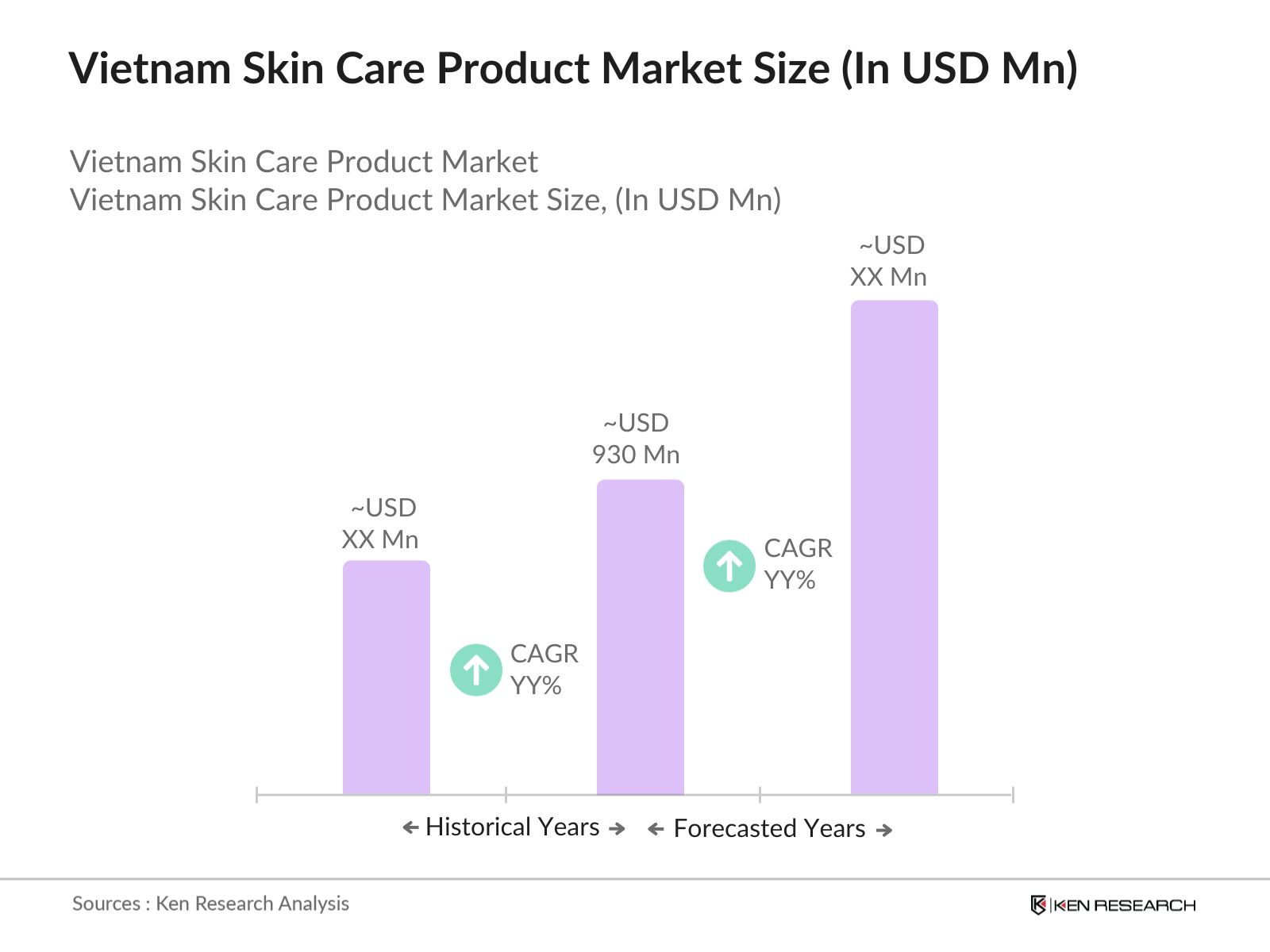
- The Vietnam Skin Care Product Market is valued at USD 930 million, primarily driven by increased consumer awareness about skin health, the influence of beauty trends, and the expanding middle-class population in Vietnam. Urbanization and a growing interest in high-quality, premium skincare products have accelerated market demand. The Vietnamese governments support for local manufacturing and international investments also drives the market forward, particularly in Hanoi and Ho Chi Minh City.
- Ho Chi Minh City and Hanoi are the dominant cities in the Vietnamese skin care product market. Their dominance stems from the higher disposable incomes, urban population, and consumer sophistication found in these areas. These cities host the highest concentration of retail outlets and skincare brands, both international and domestic, catering to a wide range of consumer needs.
- In 2024, the Vietnamese Ministry of Natural Resources and Environment introduced a sustainability guideline for beauty and skincare industries to encourage eco-friendly practices. By incentivizing companies that adopt biodegradable packaging, the government aims to reduce plastic waste by over 2 million tons annually, encouraging skincare brands to shift towards sustainable packaging.
Vietnam Skin Care Product Market Segmentation
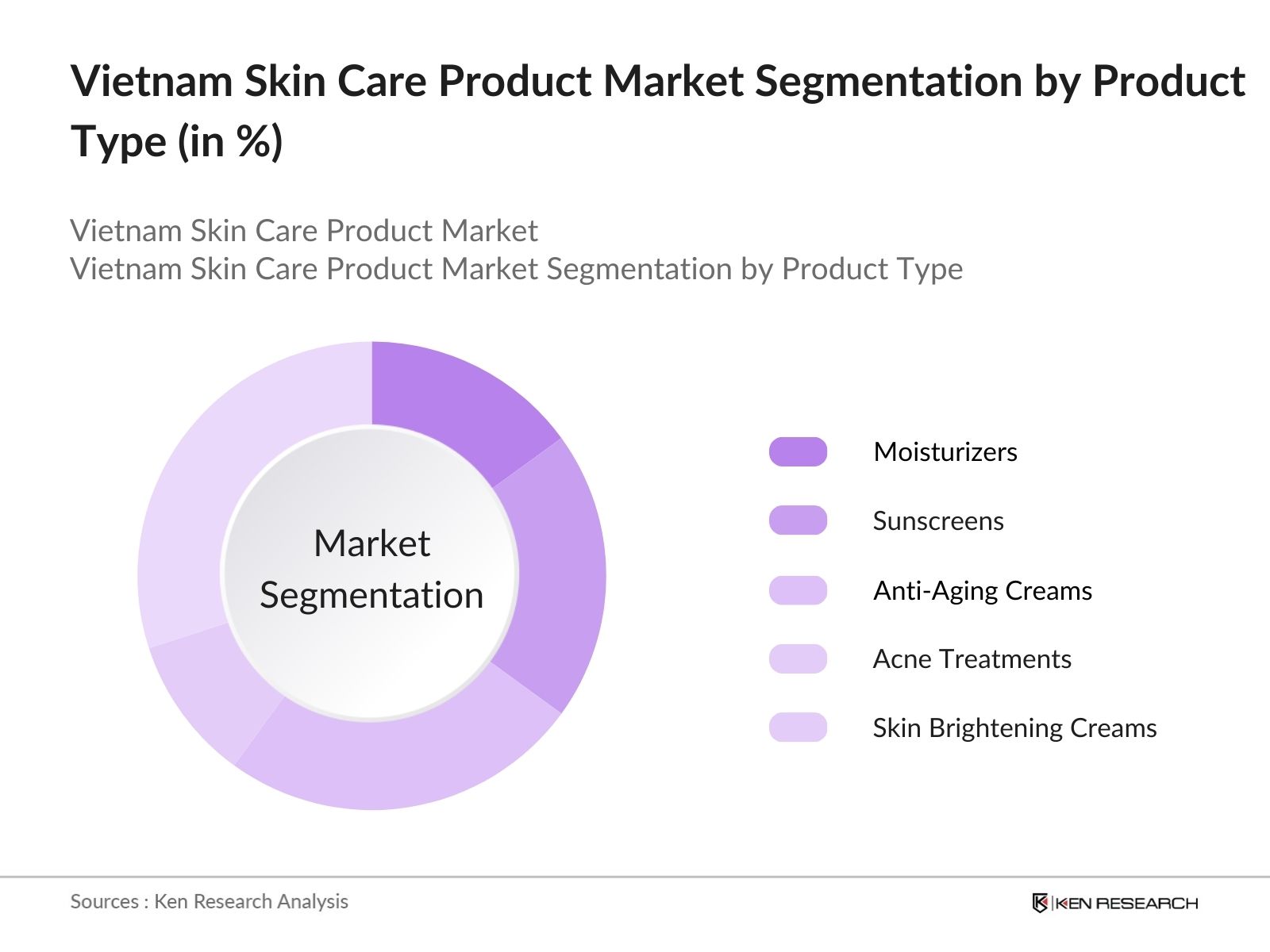
By Product Type: The market is segmented by product type into moisturizers, sunscreens, anti-aging creams, acne treatments, and skin-brightening creams. Skin-brightening creams hold a dominant share due to cultural beauty standards that favor fair and radiant skin. Major brands actively market products that cater to this demand, ensuring a steady consumer base in urban areas, especially among young professionals.
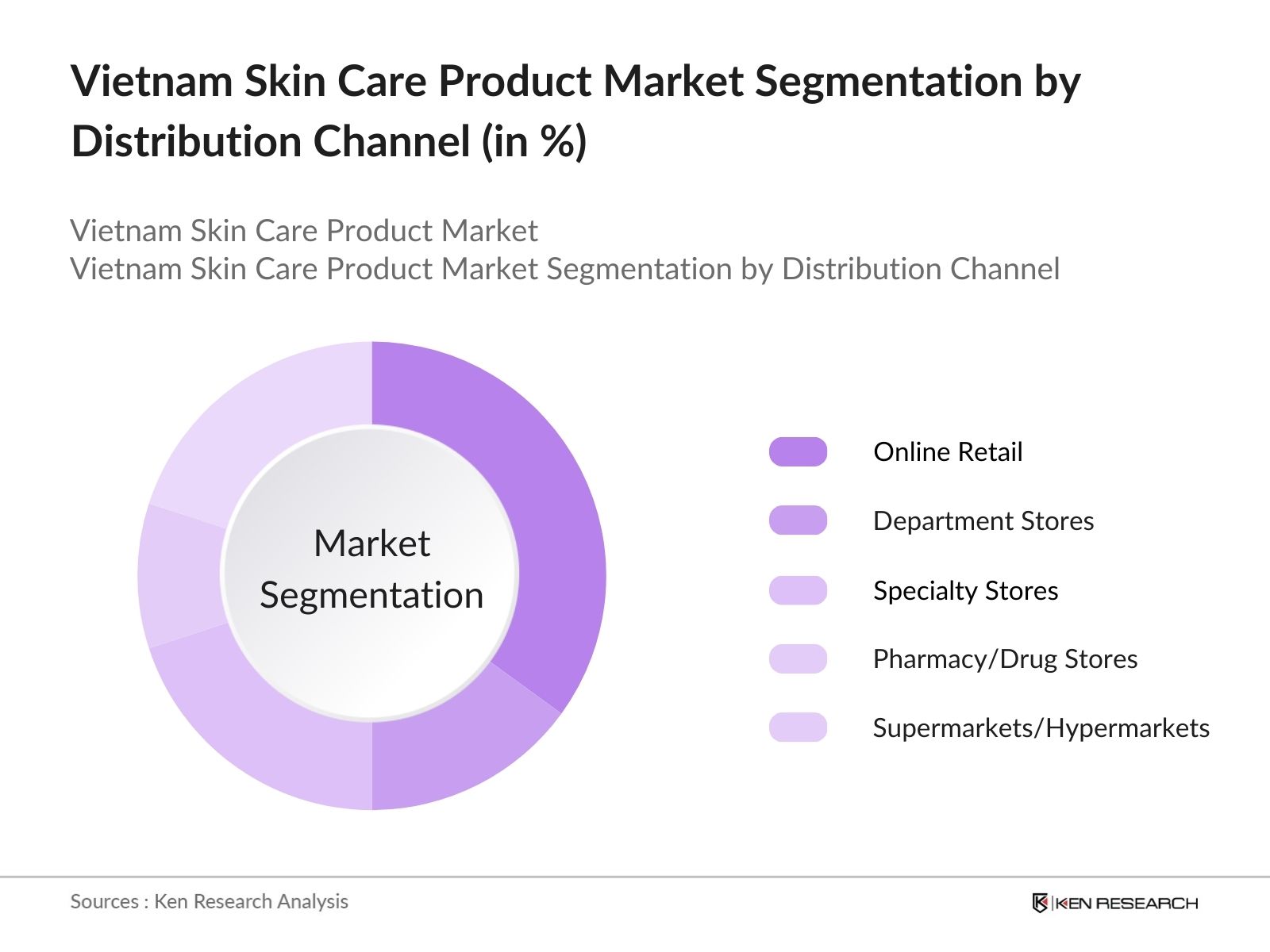
By Distribution Channel: The market is segmented by distribution channel into online retail, department stores, specialty stores, pharmacy/drug stores, and supermarkets/hypermarkets. Online retail is rapidly becoming the preferred choice among consumers, particularly for younger demographics, due to the convenience, accessibility of international brands, and frequent discounts available online. This growth is facilitated by the rise of e-commerce platforms such as Tiki and Shopee, which streamline product accessibility and consumer engagement.
Vietnam Skin Care Product Market Competitive Landscape
The market is led by a combination of multinational and domestic players who benefit from strong brand loyalty, diverse product portfolios, and widespread distribution networks. The market is competitive, with international companies competing with emerging Vietnamese brands that leverage cultural relevance.

Vietnam Skin Care Product Market Analysis
Market Growth Drivers
- Increasing Consumer Demand for Premium Products: The demand for premium skincare products is accelerating as more Vietnamese consumers adopt skincare routines influenced by global trends and social media. In 2024, over 12 million consumers in urban areas are seeking premium skincare solutions, especially for anti-aging and brightening purposes. This trend is propelled by higher income levels in cities like Ho Chi Minh City and Hanoi, where the number of high-income households has surpassed 1.2 million, creating a robust market for high-end skincare.
- Rising E-commerce Penetration: E-commerce has surged in Vietnam, enabling skincare brands to reach a broader consumer base. In 2024, online sales of skincare products are expected to reach 7.5 million units, with major e-commerce platforms reporting skincare as one of the top five product categories. The increased availability and convenience of purchasing products online have made skincare more accessible to consumers across the country, fueling growth.
- Influence of K-Beauty and Global Trends: The popularity of Korean beauty (K-Beauty) and other global skincare trends has led to a rise in product variety in Vietnam. Currently, Vietnamese stores stock over 3,000 imported skincare items, largely from South Korea and Japan. Local consumers, numbering about 18 million aged 18-35, are increasingly drawn to global skincare regimes, boosting sales in this category.
Market Challenges
- High Dependence on Imports: Vietnam heavily relies on imported skincare products, with approximately 80% of its skincare products sourced from countries like South Korea, Japan, and the USA. This dependency makes the market vulnerable to global price fluctuations and supply chain disruptions. Import taxes and logistic expenses have added over 15,000 VND per unit to the average retail price of imported skincare products, impacting consumer affordability.
- Increasing Counterfeit Products: The Vietnamese skincare market is facing a rising issue of counterfeit products, with nearly 5,000 incidents reported in 2024 by consumer protection agencies. These counterfeit products damage brand trust and pose risks to consumer health, especially in unregulated online marketplaces. Addressing counterfeiting has become a key priority for both local and international skincare brands operating in Vietnam.
Vietnam Skin Care Product Market Future Outlook
Over the next five years, the Vietnam Skin Care Product industry is expected to witness steady growth, driven by increasing demand for premium, natural, and organic skincare products. Urbanization and rising incomes will continue to expand the consumer base, while e-commerce channels will enhance accessibility to a broader range of skincare products.
Future Market Opportunities
- Shift Toward Clean and Organic Skincare Products: Over the next five years, the demand for organic skincare products is expected to rise as consumers grow more health-conscious. By 2029, organic product sales are projected to grow by over 1.5 million units, driven by a preference for products free from chemicals and artificial additives. This trend will see local brands increasing their organic product lines to meet consumer demands.
- Advancements in Personalized Skincare: With innovations in AI and digital skin diagnostics, personalized skincare solutions will become mainstream by 2028. Its estimated that 40% of skincare consumers in urban Vietnam will use diagnostic apps to determine suitable skincare products. This trend will drive brands to invest in technology partnerships, enhancing customer engagement and satisfaction.
Scope of the Report
|
Product Type |
Moisturizers Sunscreen Anti-Aging Creams Acne Treatment Skin Brightening Creams |
|
End User |
Women Men Teenagers |
|
Distribution Channel |
Online Retail Department Stores Specialty Stores Pharmacy/Drug Stores Supermarkets/Hypermarkets |
|
Ingredient Type |
Natural/Organic Synthetic Hybrid Formulations |
|
Region |
Northern Vietnam Central Vietnam Southern Vietnam |
Products
Key Target Audience Organizations and Entities Who Can Benefit by Subscribing This Report:
Skin Care Product Manufacturers
Retail and E-commerce Platforms
Investors and Venture Capitalist Firms
Dermatologists and Skin Care Experts
Cosmetic Regulatory Bodies (Vietnam Food Administration, Ministry of Health)
Pharmacies and Drug Stores
Packaging and Raw Material Suppliers
Government and Regulatory Bodies (Vietnam Ministry of Industry and Trade)
Companies
Unilever
L'Oral
Shiseido
Vin Group
Beiersdorf
Johnson & Johnson
Procter & Gamble
Kao Corporation
Rohto Pharmaceutical Co., Ltd.
Amorepacific Corporation
Table of Contents
1. Vietnam Skin Care Product Market Overview
1.1 Definition and Scope
1.2 Market Taxonomy
1.3 Market Growth Rate Analysis
1.4 Overview of Market Segmentation
2. Vietnam Skin Care Product Market Size (In USD Million)
2.1 Historical Market Size Analysis
2.2 Year-On-Year Growth Analysis
2.3 Key Market Developments and Milestones
3. Vietnam Skin Care Product Market Analysis
3.1 Growth Drivers
3.1.1 Rising Disposable Income
3.1.2 Increasing Demand for Natural Ingredients
3.1.3 Expanding Urban Population
3.2 Market Challenges
3.2.1 High Competition in Domestic Brands
3.2.2 Regulatory and Compliance Barriers
3.2.3 Product Counterfeiting Issues
3.3 Opportunities
3.3.1 Technological Advancements in Product Formulation
3.3.2 E-commerce Expansion in Rural Areas
3.3.3 Demand for Customizable Skin Care Solutions
3.4 Trends
3.4.1 Increased Focus on Organic and Vegan Products
3.4.2 Growing Popularity of K-Beauty and J-Beauty Products
3.4.3 Advanced Anti-Aging Solutions
3.5 Government Regulations
3.5.1 Cosmetics Compliance Framework
3.5.2 Import and Export Restrictions
3.5.3 Labeling and Safety Standards
3.6 SWOT Analysis
3.7 Stakeholder Ecosystem
3.8 Porters Five Forces Analysis
3.9 Competitive Ecosystem
4. Vietnam Skin Care Product Market Segmentation
4.1 By Product Type (In Value %)
4.1.1 Moisturizers
4.1.2 Sunscreen
4.1.3 Anti-Aging Creams
4.1.4 Acne Treatment
4.1.5 Skin Brightening Creams
4.2 By End User (In Value %)
4.2.1 Women
4.2.2 Men
4.2.3 Teenagers
4.3 By Distribution Channel (In Value %)
4.3.1 Online Retail
4.3.2 Department Stores
4.3.3 Specialty Stores
4.3.4 Pharmacy/Drug Stores
4.3.5 Supermarkets/Hypermarkets
4.4 By Ingredient Type (In Value %)
4.4.1 Natural/Organic
4.4.2 Synthetic
4.4.3 Hybrid Formulations
4.5 By Region (In Value %)
4.5.1 Northern Vietnam
4.5.2 Central Vietnam
4.5.3 Southern Vietnam
5. Vietnam Skin Care Product Market Competitive Analysis
5.1 Detailed Profiles of Major Companies
5.1.1 Unilever
5.1.2 L'Oral Group
5.1.3 Shiseido
5.1.4 Este Lauder Companies
5.1.5 Amorepacific Corporation
5.1.6 Johnson & Johnson
5.1.7 Procter & Gamble
5.1.8 Kao Corporation
5.1.9 Beiersdorf AG
5.1.10 Coty Inc.
5.1.11 Rohto Pharmaceutical Co., Ltd.
5.1.12 Clarins Group
5.1.13 Himalaya Wellness
5.1.14 LG Household & Health Care
5.1.15 SkinCeuticals
5.2 Cross Comparison Parameters (Market Share, Revenue, Product Portfolio, Distribution Network, R&D Investments, Regional Focus, Product Innovation, Sustainability Initiatives)
5.3 Market Share Analysis
5.4 Strategic Initiatives
5.5 Mergers and Acquisitions
5.6 Investment Analysis
5.7 Venture Capital Funding
5.8 Government Grants and Incentives
5.9 Private Equity Investments
6. Vietnam Skin Care Product Market Regulatory Framework
6.1 Safety and Environmental Standards
6.2 Compliance and Certification Processes
6.3 Product Labeling Requirements
7. Vietnam Skin Care Product Future Market Size (In USD Million)
7.1 Future Market Size Projections
7.2 Key Drivers for Future Growth
8. Vietnam Skin Care Product Future Market Segmentation
8.1 By Product Type (In Value %)
8.2 By End User (In Value %)
8.3 By Distribution Channel (In Value %)
8.4 By Ingredient Type (In Value %)
8.5 By Region (In Value %)
9. Vietnam Skin Care Product Market Analysts Recommendations
9.1 TAM/SAM/SOM Analysis
9.2 Consumer Cohort Analysis
9.3 Marketing Initiatives
9.4 White Space Opportunity Analysis
Disclaimer Contact UsResearch Methodology
Step 1: Identification of Key Variables
The first phase involved identifying key variables within the Vietnam Skin Care Product Market through a comprehensive stakeholder map. This mapping process was supported by extensive secondary research to capture industry-specific data points essential to market dynamics.
Step 2: Market Analysis and Data Compilation
Next, historical data for the Vietnam Skin Care Product Market was compiled, including revenue trends, product penetration, and retail distribution analysis. This data was carefully assessed to ensure accuracy and relevance in the estimated growth calculations.
Step 3: Hypothesis Testing and Expert Validation
Market hypotheses were tested via computer-assisted telephone interviews (CATIs) with industry experts, enabling a deeper understanding of consumer behavior and product preferences. These insights were critical in refining our data accuracy and validating the analysis framework.
Step 4: Synthesis and Final Reporting
The final stage involved synthesizing insights from local and global players in the skincare market to corroborate data through bottom-up approaches, ensuring a comprehensive and well-validated final analysis of the Vietnam Skin Care Product Market.
Frequently Asked Questions
1. How big is the Vietnam Skin Care Product Market?
The Vietnam Skin Care Product Market is valued at USD 930 million, primarily driven by an expanding consumer base and growing awareness regarding skincare.
2. What are the key drivers for growth in the Vietnam Skin Care Product Market?
Key growth drivers in the Vietnam Skin Care Product Market include increasing disposable income, consumer preference for premium products, and rising demand for organic and natural ingredients.
3. Which cities dominate the Vietnam Skin Care Product Market?
Ho Chi Minh City and Hanoi are the dominant cities, driven by high urbanization rates and a preference for premium skincare products among consumers.
4. What are the primary challenges in the Vietnam Skin Care Product Market?
Challenges in the Vietnam Skin Care Product Market include high market competition, regulatory barriers, and the rise of counterfeit products affecting consumer trust.
Why Buy From Us?

What makes us stand out is that our consultants follows Robust, Refine and Result (RRR) methodology. i.e. Robust for clear definitions, approaches and sanity checking, Refine for differentiating respondents facts and opinions and Result for presenting data with story

We have set a benchmark in the industry by offering our clients with syndicated and customized market research reports featuring coverage of entire market as well as meticulous research and analyst insights.

While we don't replace traditional research, we flip the method upside down. Our dual approach of Top Bottom & Bottom Top ensures quality deliverable by not just verifying company fundamentals but also looking at the sector and macroeconomic factors.

With one step in the future, our research team constantly tries to show you the bigger picture. We help with some of the tough questions you may encounter along the way: How is the industry positioned? Best marketing channel? KPI's of competitors? By aligning every element, we help maximize success.

Our report gives you instant access to the answers and sources that other companies might choose to hide. We elaborate each steps of research methodology we have used and showcase you the sample size to earn your trust.

If you need any support, we are here! We pride ourselves on universe strength, data quality, and quick, friendly, and professional service.